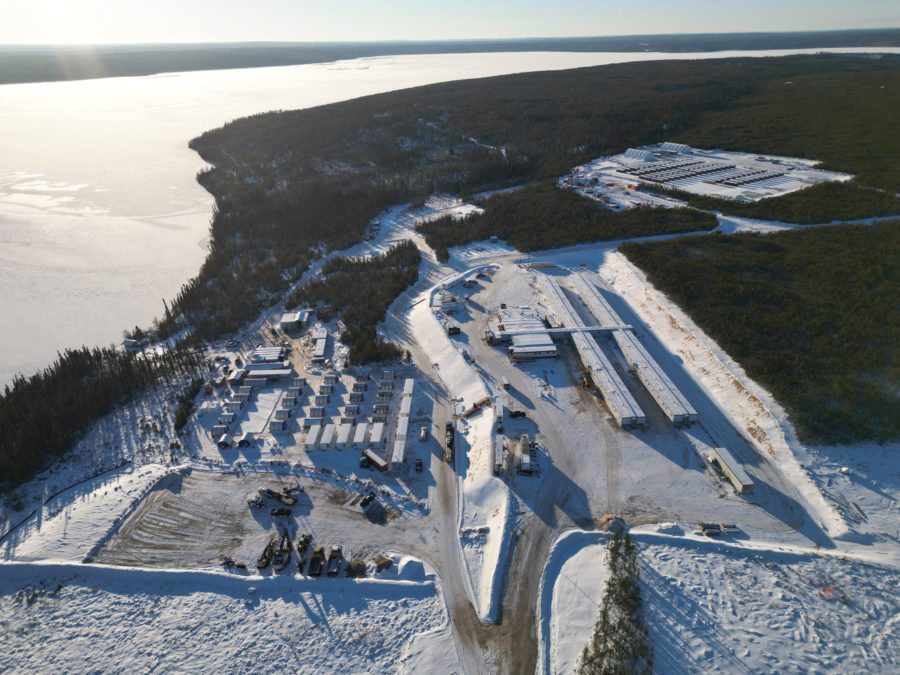

TORONTO—NexGen Energy Ltd. has drilled what it’s calling a “transformational” hole at its flagship Rook I uranium project in northern Saskatchewan, a discovery that may reshape investor expectations for the asset and intensify exploration activity in the region.
The Canadian miner announced that drillhole RK-25-232 intersected 3.9 meters of mineralization registering over 61,000 counts per second (cps)—a proxy for uranium content—within a broader 13.8-meter mineralized zone starting at a depth of 452.2 meters. It is the shallowest high-grade hit ever recorded at Patterson Corridor East (PCE), a growing discovery adjacent to NexGen’s fully permitted Arrow deposit.
“This intercept…represents a transformational moment,” said CEO Leigh Curyer. “It takes PCE into a category to rival Arrow at the same stage of drilling.”
Doubling Down on Discovery
The results mark a turning point for PCE, which was first identified just over a year ago. Four nearby holes—each drilled at least 50 meters from RK-25-232—also returned >61,000 cps over similar widths, effectively doubling the known strike and vertical extent of the high-grade subdomain. What was once 100 meters of strike length and 170 meters of vertical extent has grown to 210 meters and 335 meters, respectively. Critically, the zone remains open in all directions, suggesting substantial exploration upside.
The rapid delineation mirrors—but may outpace—the early evolution of the Arrow deposit, which forms the backbone of Rook I’s development plans and is widely viewed as one of the world’s most significant undeveloped uranium assets. Arrow contains probable reserves of 239.6 million pounds U₃O₈, grading 2.37%.

Market Timing and Global Stakes
NexGen’s discovery comes at a moment of resurgent interest in nuclear energy and constrained global uranium supply. The uranium spot price has surged over 200% since early 2021, recently peaking near $100 per pound before retreating slightly. Analysts say global decarbonization efforts, energy security concerns, and restarts of mothballed reactors have rekindled long-term demand for uranium.
“This kind of result couldn’t come at a better time,” said David Talbot, uranium analyst at Red Cloud Securities. “The market is finally waking up to the structural supply deficit. A new high-grade zone at PCE that could rival Arrow gives NexGen a second leg of growth—and potentially global strategic value.”
The timing is also critical given the geopolitical climate. Sanctions on Russian nuclear fuel and uncertainty around Kazakh supply have elevated the profile of secure, high-grade, Tier 1 uranium projects in politically stable jurisdictions. Saskatchewan’s Athabasca Basin—home to some of the richest uranium deposits on Earth—has emerged as a key focus for Western utilities seeking diversification.
Technical Edge and Geological Promise
The high-grade zone at PCE is hosted in competent basement rock, mirroring the geological setting at Arrow. Importantly, the mineralization in RK-25-232 lies roughly 300 meters shallower than similar intersections at Arrow, potentially translating to lower mining costs and simplified development pathways.
“Finding uranium of this intensity so early in the 2025 program is incredible,” Curyer said, noting that similar results at Arrow were only seen well into resource definition. “This validates a very significant regional mineralizing event.”
Winter drilling will continue to focus on expanding the mineralized footprint and defining the continuity of the high-grade zone from RK-25-232. Investors will be watching for signs that PCE could evolve from a promising satellite target into a standalone deposit with production potential.
A Repricing in Sight?
Despite the drilling success, NexGen’s shares have traded modestly higher, suggesting the market has yet to fully internalize the implications of the new results. As of Tuesday, the company had a market capitalization of roughly C$4.2 billion, well below that of producers such as Cameco Corp., even as its asset base expands and nears development.
“Rook I is already shovel-ready, and now we may be looking at a second Arrow-style system unfolding next door,” said one institutional investor with holdings in the company. “It’s hard to find this kind of upside anywhere else in the uranium space.”
The broader uranium sector remains underowned by generalist investors, who have only begun reallocating capital amid a longer-term energy transition. If NexGen’s future results at PCE confirm a major new discovery, it could serve as a catalyst not just for the company, but for renewed interest across the Athabasca region.