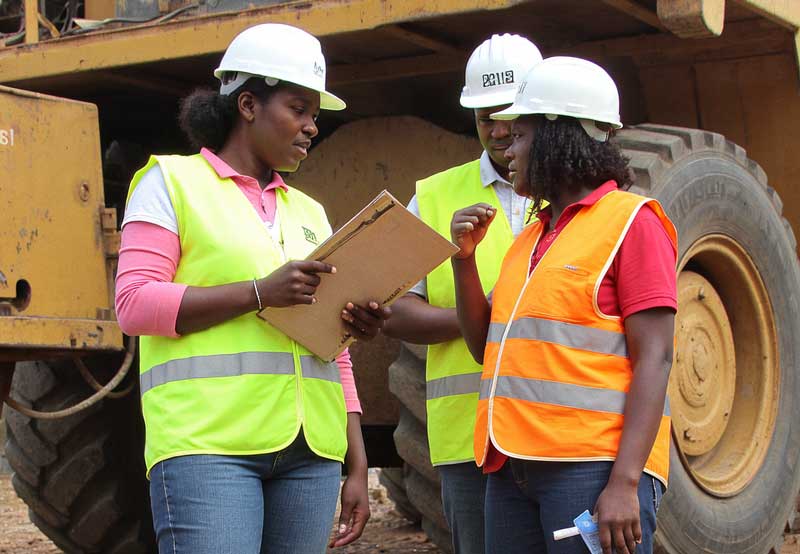

LAGOS—For Nigeria’s mining sector, long tethered to gendered expectations and a legacy of male dominance, a quiet transformation is underway. Women, once peripheral to the extractive industry’s labor force, are emerging at its core—as engineers, executives, and policy architects.
They currently comprise just 18% of Nigeria’s formal mining workforce, according to data from the Nigeria Extractive Industries Transparency Initiative (NEITI). But that figure belies a deeper shift. At companies like Segilola Resources Operating Limited (SROL), women are not just participating—they’re leading.
“Inclusion here is not tokenism,” said Ijeoma Ohiaeri, Head of Corporate Affairs at SROL. “We have women in exploration, in management, in strategy. Their visibility creates a pipeline for future leaders.”
The shift is not accidental. At SROL, Nigeria’s first industrial gold mine and the flagship project of Toronto-listed Thor Explorations Ltd., gender inclusion is written into its DNA. Chief Executive Segun Lawson has made it a priority, pushing women into operational and decision-making roles.
“Mines are more than drill sites,” said Madhurii Sarkar-Amoda, the company’s Community Development & Stakeholder Manager. “They’re communities. And women, especially in Nigeria, understand the nuances of those communities.”

The Business Case for Inclusion
The industry’s pivot toward inclusivity is also increasingly pragmatic. Studies from McKinsey & Co. and Deloitte show that gender-diverse companies outperform their peers financially. In mining—a sector grappling with ESG scrutiny, aging workforces, and a growing skills gap—attracting and retaining female talent is no longer optional.
Still, challenges persist. Female miners across Nigeria say the greatest barriers aren’t geological—they’re cultural. “The toughest part isn’t underground,” said Louise Porteus, Environment & Social Manager at Thor Explorations and a 2022 honoree on Women in Mining UK’s “Top 100 Women in Mining” list. “It’s boardrooms where you’re the only woman, or field stations where bias still lingers.”
Porteus said inclusion is about more than optics. “We need leadership development, mentorship, and structural support. Otherwise, these gains won’t be sustained.”
Cultural and Policy Obstacles
Nigeria’s mining laws are gender-neutral, but the industry’s legacy isn’t. Many sites still lack facilities for women, and few firms offer flexible work arrangements or parental leave policies that reflect the realities of female professionals. According to a 2023 report by Women in Mining Nigeria, only 12% of surveyed firms had dedicated policies to support women’s career progression.
“To attract women, you must accommodate them,” said Uduak Okon, a mining geologist and member of the Nigerian Mining and Geosciences Society. “That means rethinking everything from safety gear sizing to maternity leave.”
There are signs of progress. The Ministry of Solid Minerals is reportedly considering gender targets for upcoming mineral licensing rounds, and WIMIN (Women in Mining Nigeria) has launched a mentoring network that now includes over 300 active members.
But some insiders warn against over-engineering the solution. “The sector doesn’t need quotas—it needs a level field,” said one executive at a mid-tier tin operation in Jos. “If you fix the pipeline—recruitment, training, retention—the numbers will follow.”
Building the Next Generatio
Efforts are also underway to create a talent pipeline that reflects Nigeria’s gender demographics. SROL has partnered with local universities to offer scholarships to female students in geology and mining engineering. Others, like the African Minerals Development Centre, are funding outreach programs for high school girls.
“You can’t be what you can’t see,” said Sarkar-Amoda. “We take students to our site, show them our female metallurgists, drillers, environmental officers. It changes their perception.”
The aim is not merely to make mining inclusive but to make it sustainable. Nigeria is betting on mining as a hedge against its oil dependency, with projections from PwC estimating that the sector could contribute up to 3% of GDP by 2025, up from 0.3% in 2020.
“If we want to scale the sector, we need all hands—male and female,” said Sarkar-Amoda.
Looking Ahead: A Tectonic Shift Still in Motion
The story of women in Nigerian mining is not yet a success story—but it is a compelling chapter in progress. From gold in Osun State to lead-zinc in Ebonyi, women are proving that competence, not chromosomes, drives results.
The question now is whether the industry will institutionalize these gains or merely applaud them from the sidelines.
“There’s a lot of noise around inclusion,” said Porteus. “The real test is whether the culture shifts. Are women being promoted? Are their concerns being heard? That’s what matters.”
The answers will determine not just the face of Nigerian mining, but its future.