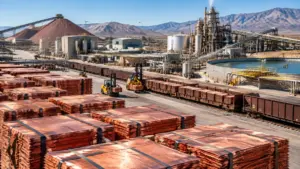
Ramaco Resources has signed a landmark research and development agreement with the U.S. Department of Energy, positioning the company at the forefront of America’s new rare-earth mining strategy.

Ramaco Resources Partners with DOE for Rare Earth Discovery
In a major development for the U.S. mining industry, Ramaco Resources (NASDAQ: METC) has entered into a cooperative research and development agreement (CRADA) with the U.S. Department of Energy’s National Energy Technology Laboratory (NETL). The deal aims to accelerate the discovery, mining, and processing of rare-earth elements (REEs) and other critical minerals at the company’s Brook Mine in Sheridan County, Wyoming.
Announced on October 30, 2025, the agreement establishes a structured framework for collaborative R&D across multiple fields—rare earths, carbon allotropes, advanced materials, and coal-derived by-products. Under this partnership, Ramaco Resources will integrate advanced computing, artificial intelligence, and quantum technologies to improve scientific workflows and mineral-processing efficiency.
“We’re transforming a traditional coal mining company into a technology-driven materials supplier for the nation’s energy and defense future,” said Randall Atkins, Chairman and CEO of Ramaco Resources, during the announcement. “This collaboration with the Department of Energy represents the future of domestic mineral independence.”
Brook Mine: Ramaco Resources Turns Coal into Critical Minerals
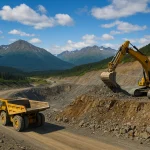
The centerpiece of this transformation is Brook Mine, a property owned and operated by Ramaco Resources, which opened officially in July 2025. The site marks both the first new U.S. rare-earth mine in more than 70 years and Wyoming’s first new coal mine in half a century.
More Read

Originally developed as a metallurgical coal project, Brook Mine has revealed rich concentrations of rare-earth elements embedded in coal seams—a geological feature that may redefine how American miners value coal deposits. Independent analysis by Fluor Corp. suggests the mine could yield around 1.7 million tons of rare-earth-oxide equivalent, potentially meeting up to 5 % of U.S. annual demand.

The project’s scope is significant: the currently permitted area covers 4,500 acres, with another 11,500 acres under exploration. Ramaco Resources plans to construct a pilot processing facility on-site to test extraction and separation techniques under DOE supervision.
Why the U.S. Government Is Backing Ramaco Resources
The U.S. government’s renewed interest in Ramaco Resources is rooted in its broader critical-minerals strategy. China dominates more than 70 % of global rare-earth mining and 90 % of processing, creating vulnerabilities across supply chains for electric vehicles, wind turbines, and defense systems.
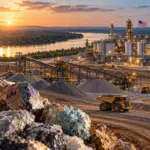
The Department of Energy’s partnership with Ramaco Resources gives federal researchers access to an active domestic mine, enabling live testing of separation technologies and environmental impact models. For Ramaco, the deal provides access to NETL’s high-performance computing and materials-science capabilities, substantially reducing technical risk.
The partnership follows Washington’s recent push to fund domestic mineral independence through programs under the Defense Production Act Title III and the DOE Critical Minerals Initiative, both aimed at securing U.S.-based mineral supply for strategic industries.
Ramaco Resources Stock Surges 200 % in 2025
Investor confidence in Ramaco Resources has surged alongside its strategic pivot. The company’s stock has gained more than 200 % since January 2025, peaking at $57.80 in mid-October before stabilizing near $30. Following the DOE announcement, shares spiked 14 % pre-market and closed 2.4 % higher in regular trade.
Analysts attribute this rally to a fundamental re-rating of Ramaco Resources as not just a coal producer, but a potential rare-earth supplier. Research firm Bernstein noted that “the DOE partnership materially de-risks Ramaco’s entry into the rare-earth market and may unlock new access to government procurement and grant funding.”
While the company still derives revenue from metallurgical coal, investors are now valuing it as a critical-minerals growth stock—a rare crossover in the modern mining landscape.
From Coal to Carbon Technology: A Blueprint for the Sector
Ramaco Resources is positioning Brook Mine as a case study in industrial reinvention. Its adjoining Carbon Advanced Materials Center (iCAM) is exploring ways to convert coal-derived carbon into graphene, carbon fiber, and synthetic graphite—materials vital for EV batteries and aerospace composites.
This diversification aligns with federal and private-sector interest in coal-to-critical-minerals technology, which could turn legacy mining assets into renewable-era supply hubs. The company’s model—extracting rare earths from coal seams while generating carbon-based advanced materials—represents a multi-product, low-waste mining strategy that could reshape how coal-rich regions sustain employment and innovation.
Skillings Analysis
- Strategic transformation: Ramaco Resources is redefining coal mining as a gateway to materials innovation. By turning a conventional coal deposit into a rare-earth and carbon-tech asset, it is pioneering a new model for U.S. resource independence.
- Execution risk: The challenge will be scaling extraction and separation economically. No U.S. company has yet proven commercial-scale recovery of rare-earths from coal byproducts at competitive cost.
- Market impact: The DOE partnership gives Ramaco Resources a credibility advantage that could attract institutional capital and stimulate similar projects nationwide.
AI, Quantum Science, and the “Smart Mine” Framework
One standout element of the DOE–Ramaco Resources partnership is its focus on digital mining. The company plans to leverage AI and quantum computing to analyze geochemical data, automate workflow design, and optimize yield forecasting.
By integrating DOE’s high-performance computing resources, Ramaco Resources aims to reduce time-to-discovery cycles, improve ore-body modeling, and enhance environmental monitoring. This “smart-mine” architecture could make Brook Mine one of the most technologically advanced rare-earth projects in the Western Hemisphere.
If successful, it could provide a replicable framework for U.S. miners seeking to modernize exploration and extraction across other unconventional ore bodies, from phosphates to fly-ash deposits.
Environmental Standards and Federal Oversight
Ramaco Resources has emphasized its commitment to responsible development. Wyoming regulators have approved a closed-loop water management system to minimize waste discharge, while the company’s processing plans aim to capture and recycle tailings for secondary recovery.
Environmental groups acknowledge that, despite skepticism toward coal mining, U.S.-based REE production under DOE oversight offers far stricter safeguards than imports from countries with weaker labor and pollution standards.
If Ramaco Resources can prove that rare-earth extraction from coal is both viable and low-impact, it could set a precedent for sustainable mineral development within fossil-fuel basins.
Looking Ahead: Ramaco Resources’ 2026-27 Roadmap
The next 18 months will test whether Ramaco Resources can convert potential into production. The company’s roadmap includes:
- Pilot separation facility at Brook Mine by mid-2026.
- DOE-supervised testing of extraction and purification technologies.
- Offtake negotiations with U.S. defense and battery-manufacturing partners by late 2026.
- Expansion of iCAM’s carbon-materials line to include synthetic graphite by 2027.
If milestones are achieved, Brook Mine could become the blueprint for America’s broader critical-minerals push—proving that the country’s coal basins still hold strategic value in the age of electrification.
For mining professionals and analysts, the rise of Ramaco Resources encapsulates the next phase of U.S. mining: one where legacy fuel companies reinvent themselves as material-science leaders.
In short, Ramaco Resources is no longer just a coal stock—it is a bellwether for how American miners can thrive in the global transition toward advanced materials and supply-chain resilience.