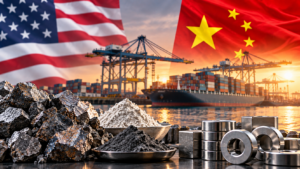
The global race for critical minerals is narrowing its focus toward a single, high-stakes deadline: January 2027. This is the date by which the United States Department of Defense (DoD) will implement a strict ban on Chinese-origin rare earth magnets in “covered systems.” As the deadline approaches, the burden of proof for supply chain security is shifting from theoretical exploration to operational processing. In the heart of Appalachia, a $150 million privately funded processing hub is positioning itself as the critical link in a non-Chinese, allied supply chain.

Led by Washington D.C.-based GreenMet, the project in Rupert, Greenbrier County, West Virginia, represents a fundamental shift in how the West views mineral security. Rather than relying on a single mega-mine, the facility employs a hub-and-spoke model that aggregates feedstock from local coal waste and high-grade concentrates from Greenland and Cameroon. It is a logistical play designed to break the monopoly that has allowed China to control nearly 90% of global rare earth permanent magnet production.
The January 2027 Catalyst: Regulatory Hardball
The January 2027 ban is not merely a policy suggestion; it is a regulatory mandate that has sent shockwaves through the defense industrial base. The National Defense Authorization Act (NDAA) requires that magnets containing neodymium-iron-boron (NdFeB) and samarium-cobalt (SmCo) must not be sourced from China, Russia, North Korea, or Iran.
For decades, the West has been content to outsource the dirty, complex chemistry of rare earth separation and magnet manufacturing to China. However, as rare earth vertical integration becomes the new industry standard, the West Virginia hub provides the midstream capacity necessary to bypass Chinese refineries. Without domestic separation and processing, even “allied” ore remains a liability if it must be shipped to China for final processing.

More Read

The Hub-and-Spoke Model: Linking Appalachia to the World
The Rupert facility is structured as the “hub” of a diversified mineral network. The “spokes” are three distinct supply chains that ensure the plant remains operational regardless of local supply fluctuations.

1. West Virginia Coal Tailings
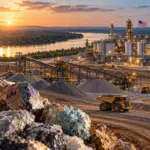
The primary local feedstock comes from the Greenbrier Smokeless Coal Company. The site holds nearly 10 million tons of “mid-vol” coking coal tailings and slurry. These waste products are rich in rare earth elements (REEs) that were historically discarded. Using technology provided by Flash Metals USA, the facility rapidly heats these tailings to approximately 1,800°F before cooling and separating the minerals. This process effectively turns an environmental liability into a strategic asset.
2. The Greenland Offtake
To supplement the relatively low-grade REEs found in coal waste, GreenMet has secured offtake agreements for high-grade concentrates from Greenland. These materials provide the heavy rare earths (HREEs) essential for high-performance magnets used in fighter jets, missile guidance systems, and electric vehicle (EV) drivetrains.
3. The Cameroon Connection
The inclusion of Cameroon as a “spoke” highlights the global nature of this supply chain. By processing African concentrates in West Virginia, the project avoids the geopolitical risks associated with local refining in underdeveloped regions while securing the raw materials needed for scale.

Market Snapshot: Global Rare Earth Production and Forecast
As of July 2026, the rare earth market remains volatile as Western companies scramble to commission new capacity before the 2027 defense ban.
| Region/Metric | 2025 Actual (Estimated) | 2026 Forecast | 2027 Target (Allied Supply) |
|---|---|---|---|
| Chinese Market Share (Refining) | 88% | 85% | <75% |
| US Domestic Separated REO (Metric Tons) | 43,000 | 48,000 | 65,000+ |
| NdPr Price (USD/kg) | $62.00 | $68.50 | $74.00 (Bull Case) |
| Non-Chinese Magnet Capacity | 12% | 15% | 22% |
Data Source: Skillings Mining Intelligence Market Analysis
Breaking the Magnet Bottleneck
The real challenge is not just finding rare earths; it is the magnet manufacturing process itself. Neodymium-iron-boron magnets are the strongest permanent magnets commercially available. China’s dominance is not just in mining but in the specialized knowledge required to manufacture these magnets at scale and at a price point that is competitive.
The GreenMet hub is part of a broader $10 billion capital commitment earmarked for downstream processing facilities. By linking the Rupert hub with partners like AmForge: which specializes in complex project delivery: the project aims to move from raw ore to finished magnets entirely within the United States and allied borders. This follows a trend seen in other strategic commodities, such as the 2026 antimony outlook, where domestic processing is the primary bottleneck for defense applications.

Economic Resilience in Greenbrier County
Beyond the geopolitical implications, the $150 million investment is a purely private play. GreenMet has explicitly stated that the project receives no state subsidies or taxpayer incentives. This is a notable departure from other high-profile “green energy” projects that rely heavily on government grants.
When fully operational, the hub is expected to create nearly 250 high-tech jobs in a region that has seen a steady decline in traditional coal mining employment. The facility leverages existing mining infrastructure: such as the Greenbrier Smokeless Coal site: to minimize the environmental footprint and speed up the permitting process. It is a rare example of the energy transition directly benefiting traditional mining communities.
Geopolitical Risks and the Road to 2027
While the West Virginia hub is a significant step forward, several risks remain. The technical challenge of extracting high-purity REEs from coal tailings at a commercial scale is substantial. Furthermore, the global “hub-and-spoke” model relies on stable maritime logistics. Any disruption in the shipment of concentrates from Greenland or Cameroon could leave the Rupert facility under-utilized.
Moreover, China is unlikely to surrender its market share without a fight. Historically, Beijing has used export quotas and price manipulation to squeeze Western competitors. For the West Virginia hub to succeed, it will need sustained offtake agreements from defense contractors who are now legally obligated to prioritize security of supply over the lowest possible price.

The Path Forward
The West Virginia Rare Earth Hub is more than a mining project; it is a test case for Western industrial policy. If GreenMet can successfully integrate local coal waste with global offtake and deliver the high-purity materials required for the 2027 defense magnet ban, it will provide a blueprint for other critical minerals and metals projects across the globe.
The message to the mining industry is clear: the era of simply digging holes is ending. The future belongs to those who can master the midstream: the complex, high-value chemistry of separation and manufacturing that turns raw earth into a strategic shield.