By Charles Pitts

Lion Rock Minerals’ latest assays from the Minta Est project in Cameroon include a standout result: 0.3 metres at 21.15% TREO within a broader 2.3-metre interval grading 4.54% TREO from surface.
The result is significant, but its value depends on more than the headline number. Investors and project developers need to assess whether the grade is representative, how thick and continuous the mineralisation is, which minerals host the rare earths, and whether those minerals can be upgraded into a saleable product.
The Minta Est result is also an important reminder that “high grade” is relative to deposit type. A 21% TREO assay is exceptional for most rare earth deposits, while grades of 2% to 5% can already be highly competitive in hard-rock systems. At the same time, a high-grade concentrate or pilot-plant product should not be confused with an in-situ ore grade.
What Lion Rock’s 21.15% TREO result shows
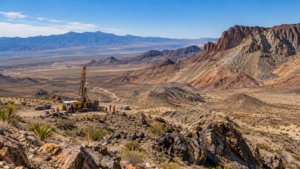
Lion Rock reported the 21.15% TREO result from retained auger samples at Minta Est. The company said the mineralisation begins at surface, continues into saprolite and remains open at depth because the auger equipment could not fully penetrate the underlying material.
More Read

Several broader intervals were also reported:

| Drill hole | Interval | TREO grade | Context |
|---|---|---|---|
| MRAU0238 | 2.3 metres from surface | 4.54% | Includes 0.3 metres at 21.15% TREO |
| MRAU0239 | 3.0 metres from surface | 3.40% | Whole-hole interval |
| MRAU0247 | 2.0 metres from surface | 3.49% | Whole-hole interval |
| MRAU0257 | 5.0 metres from surface | 1.67% | Mineralisation continues into saprolite |
| MRAU0258 | 5.6 metres from surface | 1.14% | Includes a higher-grade internal zone |
The company’s announcement states that these are in-situ drill-interval grades, not panned or chemically upgraded concentrate grades. That distinction matters. It means the 21.15% result represents the rare earth oxide content calculated from the sampled material in the ground, subject to the usual exploration-stage limitations around sample size, continuity and geological interpretation.
Lion Rock’s selected assay dataset also shows a broad spread of grades. Across 90 valid results, the median TREO grade was 0.46%, while 40 results were at least 0.5% TREO and 26 were at least 1% TREO. The peak result is therefore important, but the project’s economic case will depend on the thickness and continuity of the mineralised zones rather than the isolated maximum.
More Read
The company has completed a 761-hole campaign at Minta Est, generating 3,666 samples. Further results should help establish whether the high-grade zones form a coherent, mineable system or represent local enrichment within a more variable heavy-mineral deposit.
Why 21% TREO is unusual
TREO, or total rare earth oxides, is the combined oxide-equivalent content of the rare earth elements reported in a sample. It includes elements such as neodymium, praseodymium, dysprosium, terbium, lanthanum and cerium.
There is no single industry-wide definition of “high-grade” TREO. The benchmark changes according to deposit style, mineralogy, mining method and processing route.
As a practical screening framework:
| Deposit type | Indicative project-grade range | Grade commonly viewed as high |
|---|---|---|
| Ionic adsorption clay | 0.05%–0.30% TREO | About 0.20%–0.60% |
| Hard-rock carbonatite or alkaline deposit | 0.5%–5% TREO | About 1%–3% |
| Monazite-rich mineral sands or hard rock | Highly variable | Sustained grades above 1%–2% |
| Concentrate or refined intermediate | Often 20%–70%+ TREO | Product grade, not ore grade |
These ranges are indicative rather than formal reporting standards. Some ionic-clay projects can be economic at lower grades because mining is shallow and leaching may require limited energy. Conversely, a high-grade hard-rock project may face significant crushing, grinding, chemical cracking and residue-management costs.
For comparison, St George Mining’s Araxá project in Brazil has reported a mineral resource of 40.6 million tonnes grading 4.13% TREO, according to the company’s project information. Its Measured and Indicated resource categories contain most of the current higher-confidence material, while the deposit remains open in several directions.
That places Araxá’s resource grade well above many conventional rare earth projects. It also provides context for Minta Est: a 21.15% interval is exceptional, but the key question is whether similar grades can be demonstrated over enough thickness and area to influence mine planning.
The rare earth basket matters as much as total grade
A tonne of ore containing 2% TREO is not automatically more valuable than a tonne containing 1% TREO. The contained elements and their recoveries determine the realised value.
Lion Rock’s leading Minta Est intervals contain an NdPr component of approximately 21% to 24% of TREO. NdPr refers to neodymium and praseodymium, the principal light rare earths used in high-strength permanent magnets. Dysprosium and terbium, which improve magnet performance at higher temperatures, contribute approximately 0.6% to 1.6% of TREO in the reported intervals.
The 21.15% sample carried 5.50% magnet rare earth oxides, according to Lion Rock’s assay table. That does not mean 5.50% of the entire sample is NdPr, Dy or Tb; it is the calculated magnet-REE oxide content within the in-situ material.
The basket is important for two reasons:
- Magnet elements can command stronger market interest than low-value cerium and lanthanum.
- Heavy rare earths can carry strategic value despite occurring at lower concentrations.
The basket must still be tested through beneficiation and chemical processing. An attractive assay does not establish that the rare earths can be recovered at commercial rates or converted into a specification that customers will accept.

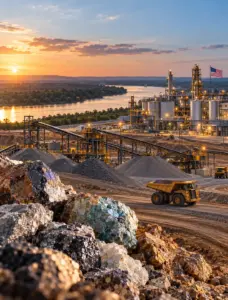
Rare-earth mineral-sands processing equipment.
Minta Est and Araxá illustrate two different development questions
Minta Est is associated with monazite-bearing heavy-mineral systems in a shallow mineral-sands environment. The potential advantages include near-surface mining and the possibility of using physical separation to produce a heavy-mineral or monazite-rich feed.
The principal technical issues are likely to include:
- Mineralogical confirmation of the rare earth host minerals.
- Monazite recovery through gravity, magnetic or other physical separation.
- Liberation and concentrate quality.
- Thorium and uranium management.
- The scale and continuity of the mineralised sands and saprolite.
- Co-product credits from rutile and zircon.
Monazite concentrates can contain high levels of rare earth oxides, but they may also require complex chemical treatment. Radioactive elements can add requirements for permitting, residue storage, transport and product handling.
Araxá presents a different development pathway. The Brazilian project is a hard-rock carbonatite system with both rare earths and niobium. St George has reported broad, near-surface TREO mineralisation and is developing a flowsheet that can potentially recover value from both commodities.
Historical pilot-plant work at Araxá produced a rare earth oxalate product at more than 99% purity and achieved approximately 86% TREO recovery over a nine-month campaign. More recent test work reported a rare earth concentrate grading 15.7% TREO from niobium flotation tailings, compared with a 9.8% TREO feed.
Those results are encouraging because they address recovery and product quality rather than grade alone. St George is also progressing further locked-cycle and recycle test work, with a larger pilot plant planned to generate design data for potential commercial processing.

Pilot-plant equipment used to test rare-earth recovery and product quality.
Processing route will determine how much grade becomes value
The broad processing options can be summarised as follows:
Mineral sands and monazite
A typical route may involve screening, desliming, gravity concentration and magnetic or electrostatic separation. The objective is to remove low-value gangue and produce a monazite-rich concentrate.
That concentrate may then undergo chemical cracking, commonly through acid or caustic treatment, to convert the rare earths into a solution. Further purification and precipitation can produce a mixed rare earth carbonate, oxalate or other intermediate.
This route may benefit from shallow mining and co-products, but radiation management and chemical consumption can become material cost and permitting factors.
Carbonatite and other hard rock
Hard-rock deposits generally require crushing and grinding before flotation, magnetic separation or other beneficiation steps. The resulting concentrate is then chemically cracked and refined.
Araxá’s dual niobium-rare earth character may provide an important operating advantage if both circuits can share infrastructure and generate complementary revenue. However, integrated flowsheets can also increase plant complexity and require careful control of recovery losses between circuits.
Ionic adsorption clay
Ionic-clay deposits generally use shallow mining followed by leaching or ion exchange. Their lower grades can be offset by soft ground, low strip ratios and relatively low-temperature processing.
The main risks include reagent consumption, recovery variability, impurity management and the environmental performance of the leaching system.
What investors should look for next
For Minta Est, the next milestones are likely to be more important than another isolated peak assay. Investors and developers should monitor:
- Results from the larger 3,666-sample campaign.
- Diamond drilling into the saprolite below the auger refusal zones.
- Mineralogical work using XRD, QEMSCAN and related techniques.
- Bulk-sample recovery and concentrate-upgrade results.
- Continuity of the 1%–4% TREO intervals.
- Thorium and uranium deportment.
- Potential rutile and zircon by-product credits.
For Araxá, the focus is moving from resource definition toward process validation. The critical evidence will come from locked-cycle testing, pilot-plant recoveries, product specifications, reagent consumption and the ability to recover niobium and rare earths without excessive cross-circuit losses.
The central lesson is straightforward: 21% TREO can be a transformational exploration result, but it is not a project valuation on its own. Grade must be connected to width, tonnes, mineralogy, recovery, basket composition, infrastructure, permitting and product markets.
For the rare earth mining sector, the strongest projects will be those that combine a credible resource with a simple mining profile, a recoverable magnet-REE basket and a processing route capable of producing consistent, saleable products.
Sources
- Lion Rock Minerals: High-Grade Rare Earths Discovery from Surface at Minta
- Lion Rock Minerals: Minta Rutile and Monazite Project
- St George Mining: Araxá Project
- St George Mining: First RC Assays Deliver High-Grade Rare Earths and Niobium
- U.S. Geological Survey: Final 2025 List of Critical Minerals
- Skillings: Rare Earths Truce and Strategic Supply Risk