By Charles Pitts

Mining M&A has moved beyond simple reserve replacement. Buyers are competing for assets that combine geological quality with permits, infrastructure, processing access, skilled workforces and a credible route to cash flow.
That shift is visible in the numbers. PwC’s Mine 2026 report says mining deal value topped US$70 billion in 2025, even though completed deal volume fell 20% from the previous year. Gold, silver, copper and lithium accounted for about 70% of total value, with Rio Tinto’s US$6.7 billion acquisition of Arcadium Lithium the largest deal to close during the year.
Early 2026 data point to the same pattern. Mining Beacon tracked 226 financing and M&A transactions worth US$43.78 billion in the first quarter, including 44 corporate and asset-level acquisitions valued at US$21.63 billion. Gold-focused M&A represented US$10.6 billion, or 49% of the quarter’s M&A value, while copper-heavy deals contributed US$8.77 billion, or 40.5%.
The headline totals vary by methodology, but the strategic message is consistent: miners are paying for time, scale and supply-chain position.
More Read

The deal-flow tracker: what buyers are actually acquiring
The following tracker combines selected transactions and sector totals reported by PwC and Mining Beacon. It is not a complete database of every announced deal. Values are headline figures and may reflect different transaction methodologies.

| Period | Buyer or lead parties | Target or asset | Commodity | Structure | Headline value | Strategic signal |
|---|---|---|---|---|---|---|
| 2025 | Rio Tinto | Arcadium Lithium | Lithium | Corporate acquisition | US$6.7B | Major producer secures lithium scale during a weak price cycle |
| Q1 2026 | Zijin Mining Group | Allied Gold Corp. | Gold | Takeover bid | US$4.05B | Chinese capital competes for international gold production |
| Q1 2026 | Zijin Mining Group | Chifeng Jilong Gold Mining controlling stake | Gold | Controlling-stake transaction | US$2.65B | Portfolio expansion through corporate-level scale |
| Q1 2026 | BHP and Wheaton Precious Metals | Antamina silver stream | Silver | Streaming transaction; not conventional M&A | US$4.3B | By-product exposure becomes a source of strategic capital |
| Q1 2026 | Global mining and metals sector | Corporate and asset-level transactions | Multiple | Acquisitions and combinations | US$21.63B | Fewer, larger and more strategically directed transactions |
Source: PwC’s Mine 2026 report and Mining Beacon’s Q1 financing and M&A review.
The table also shows why M&A analysis should include more than takeovers. Streaming, joint ventures, earn-ins and state-backed financing can secure the same strategic objective: access to future production.
Why reserve replacement is no longer enough
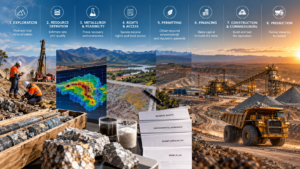
Large miners face a widening gap between production depletion and the delivery of new mines. Exploration remains essential, but a discovery does not immediately create supply. It must move through resource definition, feasibility studies, permitting, financing, construction and ramp-up.
That timeline makes producing and near-production assets unusually valuable.
PwC reported that the world’s top 40 mining companies generated US$173.6 billion in operating cash flow in 2025, up 12% year over year. EBITDA rose to US$248 billion, while the aggregate EBITDA margin increased to 27% from 23%.
The stronger cash position gives major producers capacity to transact. At the same time, the scarcity of permitted, infrastructure-connected assets makes organic growth slower and less predictable. The result is a market in which companies can be financially capable of buying, while potential targets remain limited.
This is particularly important in copper. The commodity has deep and liquid markets, but new supply faces long permitting timelines, rising capital costs, declining grades and complex infrastructure requirements. A copper deposit with a defined resource is not equivalent to a project with power, water, transport, metallurgy and social approvals already in place.
For operators, the implication is that project development milestones increasingly function as valuation milestones. For investors, the key question is not only how much metal an asset contains, but how many risks have already been retired.
Copper and gold are competing for different reasons
Gold has been the strongest source of transaction volume and value because producers can convert high prices into cash flow, while reserve replacement remains difficult.
PwC said gold producers recorded an aggregate EBITDA margin of approximately 71% in 2025. That profitability supports acquisitions, debt capacity and share-based consideration. Mining Beacon’s Q1 data also show the concentration of gold capital: gold-related deals and financings represented US$17.56 billion, or 40.1% of total mining and metals transaction value.
Gold M&A is therefore driven by a combination of immediate financial capacity and a need to replenish reserves. Producing assets in established jurisdictions can command strategic premiums because they offer revenue visibility and operational data.
Copper has a different investment logic. Its appeal is tied to electrification, grid expansion, data centers, renewable generation and industrial demand. The problem is that the project pipeline is not expanding quickly enough to satisfy projected demand.
That creates competition for advanced copper assets, processing facilities and regional portfolios. Buyers may accept construction or permitting risk when the alternative is waiting years for a new discovery. Partnerships and staged acquisitions can help spread that risk.
Skillings’ coverage of the Dos Amigos copper-gold project illustrates how strategic investors can enter projects through minority stakes rather than full takeovers. The structure can provide development capital while allowing the original owner to retain exposure and operational control.

Critical minerals are creating a different M&A playbook
Lithium, nickel and rare earths are attracting strategic interest, but their transactions often depend more heavily on policy, processing and offtake than on near-term operating margins.
In Q1 2026, Mining Beacon reported seven rare-earth transactions with a combined value of US$2.51 billion. The review also recorded lithium financing of about US$3.01 billion, compared with only US$391.5 million of lithium M&A.
That contrast matters. Capital is still moving into battery and magnet materials, but buyers are often using financing, partnerships, government support and offtake agreements rather than outright acquisitions.
PwC’s mineral-by-mineral framework makes the distinction clear:
- Gold: M&A and streaming are established routes to capital.
- Copper: Joint ventures, earn-ins and development finance are often required.
- Nickel: Integrated processing partnerships are central because of the divide between Class 1 and Class 2 supply.
- Magnet rare earths: Processing access, price support and government-backed offtake can be more important than mine ownership.
- Lithium: Corporate acquisitions remain selective, particularly when prices are weak, while project-level funding can continue if strategic buyers see long-term supply value.
This is where geopolitical competition enters the deal process. Governments want domestic or allied supply chains, while producers need capital and technical partners. A project may therefore attract interest because it offers not only mineral production, but also access to refining, magnets, battery chemicals or defense-related supply.
The brownfield premium is becoming a transaction premium
Existing infrastructure can materially change the economics of an acquisition.
A brownfield asset may offer a permitted processing plant, roads, power connections, water systems, geological records and established community relationships. These features can reduce development time and lower the amount of new capital required.
Skillings’ analysis of the brownfield advantage highlights the broader market preference for projects that can move more quickly from investment decision to production. In practice, the premium may appear in several ways:
- A higher valuation for a producing or permitted asset.
- A lower discount rate in project financing.
- Greater willingness to use equity or staged consideration.
- More competitive bidding among strategic buyers.
- A stronger ability to attract streaming or royalty capital.
The premium is not unlimited. Legacy environmental liabilities, tailings obligations, declining grades and rehabilitation costs can offset infrastructure advantages. Buyers must distinguish between a genuine brownfield opportunity and an old asset whose unresolved liabilities have simply been transferred to a new owner.

A practical screening framework for operators and investors
Deal announcements often emphasize production growth, synergies and strategic fit. A more useful assessment separates the asset’s value into five questions:
| Screening question | What to examine | Why it matters |
|---|---|---|
| How soon can cash flow begin? | Permitting, construction status, commissioning schedule | Time-to-revenue is increasingly valuable |
| How reliable is the resource? | Grade, recovery, reserve conversion and mine life | Determines whether headline production can be sustained |
| What infrastructure already exists? | Processing, power, transport, water and workforce | Reduces execution risk and capital intensity |
| Who controls the value chain? | Offtake, refining, marketing and strategic partners | Determines exposure to bottlenecks and policy restrictions |
| What liabilities transfer with the asset? | Reclamation, tailings, community agreements and litigation | Can erode apparent acquisition synergies |
For operators, the framework points to a strategic priority: make assets easier to value and integrate. Consistent operating data, transparent permitting records, credible closure plans and standardized technology systems can improve transaction readiness.
That last point is becoming more important as autonomous mining technology and digital systems spread across the sector. An asset with high-quality data and standardized workflows is easier for a buyer to audit, integrate and manage. Skillings’ coverage of the 1,000-truck autonomous mining milestone reflects why operational technology is now part of the strategic asset discussion, not merely an equipment decision.
What the rest of 2026 may bring
The next phase of mining M&A is unlikely to be a broad race for every available project. It is more likely to be selective competition for assets that satisfy several conditions at once:
- Exposure to gold, copper or strategically important critical minerals.
- A path to production within a manageable time frame.
- Infrastructure or processing advantages.
- A stable or strategically supported jurisdiction.
- Clear ownership, permitting and social-license conditions.
- An operating platform that can absorb the asset without excessive integration risk.
White & Case’s 2026 mining and metals survey identified strategic partnerships as the most likely transaction type, cited by 32% of respondents. That finding supports a broader interpretation of consolidation. The sector is not moving only toward larger corporate balance sheets; it is also building networks of shared ownership, offtake, government support and specialized financing.
The competitive advantage will belong to companies that can secure supply while limiting execution risk. In gold, that may mean buying production and reserves. In copper, it may mean partnering around a district or processing hub. In lithium and rare earths, it may mean linking mine development to refining, manufacturing and public-sector demand.
Mining M&A is therefore becoming less about buying rocks and more about buying certainty. The assets most likely to command attention are those that shorten timelines, reduce infrastructure gaps and provide a credible position in the energy-transition supply chain.