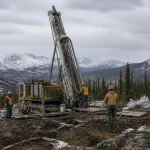
A diamond drilling rig operates at the Castle East project in the Cobalt-Gowganda district of Ontario, targeting high-grade silver veins.

By Charles Pitts
The global silver market, currently grappling with its sixth consecutive year of supply shortages, received a significant data point this week from Northern Ontario. Nord Precious Metals Mining Inc. (TSXV: NTH) announced drill results from its flagship Castle East project that underscore the extreme high-grade nature of the Cobalt-Gowganda district.
The company reported a bonanza intercept of 9,510 g/t silver (277.6 oz/ton) over 0.30 metres. This high-grade sliver was contained within a broader 1.85-metre interval grading 2,343.70 g/t silver (68.4 oz/ton) in hole CS-26-129W2. As silver prices hover near $78 per ounce in May 2026, these results arrive at a time when industrial demand and structural deficits are placing unprecedented pressure on global inventories.
Technical Deep Dive: Hole CS-26-129W2
The recent drilling success at Castle East is part of a broader 30,000-metre program designed to expand the known mineralization at the Robinson Zone and explore newly acquired leases. The specific intercept in hole CS-26-129W2 is notable not just for its grade, but for its mineralogical characteristics.
More Read

According to technical reports, the drill intersected a calcite vein featuring native silver with a distinct “plumose” or feathery texture. This texture is often associated with rapid mineral precipitation in high-energy hydrothermal systems, a hallmark of the historic Cobalt camp. Furthermore, the vein showed strong cobalt arsenide mineralization uniformly distributed throughout, with the 0.30-metre bonanza section also returning 3,460 ppm cobalt.


A high-grade core sample from the Castle East project showing visible native silver veins and dark cobalt arsenide mineralization.
The presence of “five-element” vein geochemistry: silver, cobalt, nickel, copper, and zinc: highlights the project’s relevance beyond precious metals. As the energy transition accelerates, the demand for critical minerals like cobalt and nickel has become a primary driver for diversified mining companies in the Canadian Shield.
More Read

The Macro Context: A $78 Silver Reality
The discovery comes as the silver market enters a critical phase. Analysts at J.P. Morgan and Goldman Sachs have recently adjusted their 2026 forecasts upward, with the silver spot price reaching $78.87 in late April. This price level is supported by a projected 2026 global supply deficit of 46.3 million ounces, a 15% increase over the previous year.
| Market Indicator (May 2026) | Value | Trend |
|---|---|---|
| Silver Spot Price | $78.87/oz | Bullish |
| 2026 Projected Deficit | 46.3 Moz | Widening |
| 5-Year Inventory Drawdown | 762 Moz | Depleting |
| Industrial Demand Growth | +4.2% YoY | Stable |
The widening gap between supply and demand is largely attributed to stagnant mine production. Most of the world’s silver is produced as a byproduct of lead, zinc, and copper mining. While copper production has seen record highs recently, it has not been enough to offset the explosive demand for silver in photovoltaic cells, electric vehicle electronics, and 5G infrastructure.
The Silver Institute notes that approximately 762 million ounces have been drawn from global stocks since 2021 to cover these shortfalls. For a project like Castle East, which currently hosts an Inferred resource of 7.56 million ounces of silver at an average grade of 8,582 g/t Ag, the current price environment significantly alters the economic calculus for potential development.
Strategic Positioning in the Cobalt-Gowganda District
Nord Precious Metals has spent the last year consolidating its land position in Ontario. Following a strategic lease acquisition, the company now holds title to all key mining leases in the area. This consolidation is critical; it allows the company to drill structures that were previously inaccessible due to fragmented ownership.
The 63-square-kilometre Castle property now encompasses three of the five most productive past-producing silver mines in the Gowganda Camp: Siscoe-O’Brien, Castle, and Millerett. By applying modern exploration techniques and advanced mining technology stacks to these historic sites, Nord is attempting to prove that the district’s “best days” may not be entirely in the past.

The exploration camp at the Gowganda Property serves as the logistical hub for the ongoing 30,000-metre drilling campaign.
Operational Outlook and Key Risks
Nord Precious Metals is currently in the midst of a fully funded 5,000-metre drilling phase, which is part of the larger 30,000-metre campaign. The focus remains on two fronts:
- Resource Expansion: Increasing the 7.56 million ounce Inferred silver resource.
- New Discovery: Testing “blind” veins identified through geophysical surveys that do not outcrop at the surface.
However, the path to production in Ontario is not without challenges. Permitting timelines for underground development remain a primary concern for investors. While the project benefits from existing infrastructure and a clear history of mining, modern ESG requirements and consultation processes are more rigorous than during the district’s initial boom in the early 20th century.
Furthermore, the “bonanza” grades, while spectacular, are often found in narrow veins. This requires precision drilling and, eventually, specialized narrow-vein mining techniques. The company’s ability to maintain continuity between these high-grade intercepts will be the deciding factor in its long-term valuation.

Industrial silver bullion bars. The persistent supply deficit has increased the focus on high-grade silver discoveries to replenish global inventories.
Conclusion: A Pivot Point for Junior Silver Miners
The 9,510 g/t Ag result from Castle East serves as a reminder of the latent potential in established mining districts. In an era where many new discoveries are low-grade, bulk-tonnage deposits, the high-grade silver-cobalt veins of Ontario offer a different value proposition.
As the silver market continues to tighten, the industry’s eyes will remain on Nord Precious Metals to see if these high-grade “hits” can be stitched into a robust, mineable resource. With silver at $78 and a deficit that shows no signs of closing, the margin for error in silver exploration has widened, but the rewards for high-grade success have never been higher.

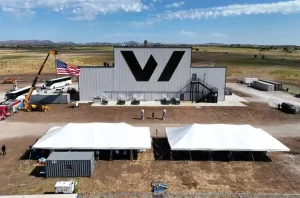
Modern modular processing units are becoming the standard for high-grade, smaller-scale operations in remote mining districts.