By Charles Pitts
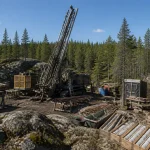
WHITEHORSE, YUKON : Cascadia Minerals (TSXV: CAM) has officially commenced a 10,000-meter diamond drill program at its flagship Carmacks copper-gold project, marking a significant escalation in exploration activity within Canada’s northern mineral belt. The 2026 campaign is designed to aggressively expand known sulphide mineralization at three primary targets: Zones 147, 2000S, and 1213: while testing several high-priority satellite targets within the project’s 232-square-kilometer land package.
The launch of the program comes as mining investors increasingly pivot toward stable jurisdictions with established infrastructure, particularly as the 2026 copper deficit begins to impact global supply chains. The Carmacks project, located approximately 200 kilometers north of Whitehorse, is uniquely positioned in the Yukon; it is accessible by a year-round resource road and sits adjacent to a high-voltage power line, a rarity for remote northern exploration projects.
Targeting the Sulphide Core
The primary objective for the 2026 drill season is to build upon the success of the 2025 program, which identified wide intervals of high-grade copper-gold mineralization at depth. Unlike the historical focus on oxide mineralization at Carmacks, Cascadia is targeting the underlying primary sulphides, which offer greater potential for scale and improved metallurgical recoveries.
More Read

Zone 147 remains the centerpiece of the expansion strategy. Recent results from 2025 (hole CD-25-033) returned 83.52 meters of 0.89% copper and 0.26 g/t gold, including a high-grade core of 26.33 meters grading 1.53% copper. The current 10,000-meter program will test the down-plunge and lateral extensions of this mineralization, which remains open in multiple directions.

Zone 2000S, located approximately 1 kilometer to the south, will also see significant attention. Last year’s drilling confirmed the continuity of the system with 87.44 meters of 0.63% copper. Geologists believe the 2000S zone may represent a larger, interconnected structural corridor that has yet to be fully delineated.
Zone 1213 is the newest high-priority front. Initial tests in 2025 returned 60.12 meters of 0.84% copper from very shallow depths. Because this zone had seen minimal historical drilling, it represents a substantial opportunity for Cascadia to increase the project’s total mineral resource estimate (MRE) with relatively low-cost, shallow drilling.
More Read


Strategic Context and Regional Significance
The expansion at Carmacks occurs during a period of renewed interest in the Yukon’s “Copper Belt.” As global majors like Hudbay Minerals report record production figures and seek to replenish pipelines, junior explorers with advanced-stage assets in the Yukon are gaining traction.
The Carmacks project currently hosts a measured and indicated resource of approximately 36 million tonnes grading 0.8% copper and 0.26 g/t gold. However, these figures are largely based on the oxide portion of the deposit. By proving the continuity and grade of the underlying sulphides, Cascadia aims to demonstrate that Carmacks is not just a boutique oxide project, but a significant sulphide-dominant copper-gold system capable of supporting a multi-decade operation.
The operational environment in the Yukon has also improved significantly. The territorial government’s continued investment in the Yukon Resource Gateway Project has upgraded access roads, reducing the logistical hurdles that traditionally plagued northern explorers. Cascadia is leveraging these improvements to maintain a modern tech stack for remote operations, including real-time data transmission from the drill site to their technical headquarters in Vancouver.
2026 Exploration Data Snapshot
To provide clarity on the targets being tested, the following table summarizes the key 2025 results that are serving as the roadmap for the current 10,000-meter program.
| Target Zone | 2025 Drill Hole | Interval (m) | Copper (%) | Gold (g/t) | Target Type |
|---|---|---|---|---|---|
| Zone 147 | CD-25-033 | 83.52 | 0.89 | 0.26 | Sulphide Expansion |
| including | CD-25-033 | 26.33 | 1.53 | 0.35 | High-Grade Core |
| Zone 2000S | CD-25-040 | 87.44 | 0.63 | 0.15 | Step-out Expansion |
| Zone 1213 | CD-25-035 | 60.12 | 0.84 | 0.16 | Shallow Sulphide |
| Gap Zone | CD-24-022 | 29.75 | 0.50 | 0.12 | New Discovery |
Note: Intervals are down-hole lengths; true widths are estimated at 70-90% of reported intervals.

Infrastructure and ESG Integration
Beyond the geological potential, Cascadia’s approach to the Carmacks project emphasizes environmental, social, and governance (ESG) factors: a critical requirement for any project seeking institutional backing in 2026. The project’s proximity to the Yukon power grid allows for the potential transition to a low-carbon mining operation in the future, should the project move toward development.
The company has also maintained a strong working relationship with the Little Salmon/Carmacks First Nation, on whose traditional territory the project is located. Ongoing consultation and environmental monitoring are central to the 2026 work plan, ensuring that the expansion of the drill program aligns with local community interests.
Outlook for the 2026 Season
With the first rigs now turning at Zone 147, Cascadia expects a steady flow of assay results starting in mid-summer. The 10,000-meter program is expected to conclude by late September, followed by an updated technical report if results confirm the continuity of the sulphide mineralization.
For investors, the primary risk remains the inherent volatility of exploration and the potential for narrowing widths at depth. However, the consistent grades encountered in 2025 have provided a high-confidence model for the current campaign. As the world searches for “safe” copper in a period of geopolitical instability, the Yukon’s Carmacks project stands as a prime example of the value found in brownfield expansion.