By Salini Krishnan | Mining Investments

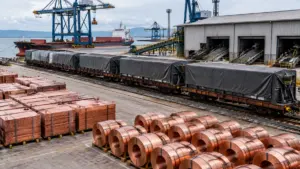
Copper set another record in London trading, with three-month LME copper near US$14,533 per tonne and reports citing an intraday high of about US$14,624/t. The rally is unfolding ahead of the Sept. 30 decision on potential U.S. copper tariffs under Section 232, while metal continues to move into Comex warehouses and Chilean mine output remains weak.
Gold was around US$4,429 an ounce, up about 0.6%, while silver traded near US$66.78/oz, up roughly 1%, as the dollar eased ahead of Thursday’s U.S. producer price data and Friday’s consumer price index. Those inflation prints will help determine whether the post-payrolls Federal Reserve rate-hike trade continues.
For mining investments, the tension is clear. Copper prices are at record levels and gold/silver remain elevated, yet the gold sector continues to trade near 0.6 times price-to-net-asset value, with mixed multiples across mid-tier producers and developers. The market is rewarding deliverable cash flow, infrastructure and district control more than headline resource size.
Market snapshot
Indicative reference levels only; not for trading.

| Commodity or metric | Reference level | Market signal |
|---|---|---|
| Gold | ~US$4,429/oz | Higher as the dollar eased |
| Silver | ~US$66.78/oz | Firm industrial and investment demand |
| Copper | ~US$14,533/t LME; Comex near US$6.40/lb | Record level ahead of the Section 232 decision |
| Comex copper stocks | ~675,000–688,000 tonnes | Near records as metal is pulled into the United States |
| Zinc | ~US$3,887/t | Firm base-metals backdrop |
| Nickel | ~US$16,610/t | Indonesian supply and operating conditions remain central |
| Uranium | ~US$89.50–90/lb spot | Term-market strength remains more important than spot alone |
| Lithium carbonate | ~RMB150,000/t | Recovery expectations depend on inventory drawdown |
| Brent crude | ~US$95/bbl | Important energy and haulage cost input |
| Iron ore | ~US$97.70/t | Steel demand remains a macro variable |
The inventory signal needs careful reading. Comex warehouses are full because traders and fabricators have been positioning copper inside the United States ahead of possible tariffs. At the same time, LME availability remains comparatively tighter. In other words, metal is piling up in the wrong place: abundant in the United States, but less available for consumers in other regions.

That geography can support a temporary regional premium without proving that underlying global consumption has accelerated by the same amount.
Valuation: the P/NAV read-through
The gold sector is valued at approximately 0.6x P/NAV, despite spot gold near US$4,400/oz. The discount partly reflects conservative long-term price assumptions, often well below current spot, but it also captures reserve replacement, sustaining capital, permitting, operating and jurisdictional risk.

| Company group | Indicative P/NAV | Primary valuation drivers |
|---|---|---|
| Gold sector | ~0.6x | Long-term price assumptions, reserve life and execution |
| Copper majors | 1.10–1.20x | Scale, infrastructure and long-life assets |
| Mid-tier copper | 0.50–0.80x | Funding, permitting and project delivery |
| Juniors | 0.30–0.60x | Resource conversion and capital-market access |
| Royalty/streaming companies | 1.20–2.00x | Cash-flow visibility and limited operating-cost exposure |
| Recent M&A clearing level | ~0.73x | Deliverable NAV, strategic fit and integration potential |
The important distinction is between modeled NAV and deliverable NAV: the value that can be financed, permitted, built and operated on schedule.
A developer can hold a large resource and still trade at a deep discount if it requires major infrastructure, faces uncertain metallurgy or depends on a capital-intensive processing route. Conversely, a smaller project can attract a premium when it feeds an existing plant or consolidates an operating district.
The Sept. CPI and PPI releases also matter for valuation. Strong inflation data could push bond yields and discount rates higher, reducing the present value of long-duration projects even while spot metals remain strong.
M&A intelligence: district control over headline scale
Today’s transactions reinforce the shift toward processing access, regional consolidation and strategic fit.
Rio Tinto agreed to acquire the Aurukun bauxite project in Queensland from Glencore and Mitsubishi Development. Financial terms were not disclosed. The deal remains subject to government and regulatory approvals, including engagement with the Wik Waya Traditional Owners. Aurukun is understood to have been scoped for up to 15 million tonnes per year of run-of-mine bauxite, equivalent to roughly 8 million dry tonnes of export product.
The project does not yet have a mining lease, so the transaction’s value depends on approvals, environmental work, land-use arrangements and the development path. Rio’s existing Queensland bauxite footprint could provide operating and infrastructure advantages, but those benefits do not remove social, regulatory or construction risk. Reuters reported on the transaction.
ACG Metals signed a binding agreement to acquire 100% of the Keşkek gold project licence in Türkiye from Meta Nikel Kobalt for approximately US$7.85 million. The consideration includes US$4 million in initial cash expected on licence transfer, targeted for October, and US$3.85 million deferred against environmental permitting.
The agreement also includes a 1% gross revenue royalty and a US$60/oz payment for reserves identified outside the defined pit. Keşkek covers roughly 666 hectares and is about 70 kilometres from ACG’s Gediktepe operation. Production is targeted for mid-2027, with the project intended to supply oxide ore to the Gediktepe heap-leach plant. The reported transaction terms are available here.
Capstone Copper completed its US$25 million all-share acquisition of San Pietro in Chile, consolidating the Mantoverde-Santo Domingo district. The transaction adds land and resource potential around existing infrastructure, but further drilling, metallurgy and technical work are required before the economic contribution can be fully assessed.
At the larger end of the market, USA Rare Earth’s proposed US$2.8 billion Serra Verde combination would connect Brazilian rare earths production with a broader non-Chinese magnet supply chain. The proposed Anglo-Teck combination remains the sector-defining copper event, with its strategic rationale centred on scale, long-life assets and district-level control.
Across these deals, the relevant question is not simply how much metal is being acquired. It is whether the transaction improves processing access, reserve replacement, infrastructure utilization or deliverable NAV.

Infrastructure and approvals will determine the development path for Aurukun.
Royalty and streaming deal analysis
Arc Mineral Royalties, formerly Stria Lithium, commenced trading on the TSX Venture Exchange under ARO after completing its change of business into a royalty and streaming company.
Its cornerstone exposure is a 1.0% NSR royalty on the Mt. Henry gold project in Western Australia, acquired for A$5 million in cash and 4 million shares. Arc also has an option to acquire an additional 1% NSR for A$10 million if Sinclair Gold announces a 2 million-ounce JORC-compliant mineral resource. The company completed a C$12 million private placement to support the transaction and its new platform.
The structure illustrates why royalty companies can command higher valuation multiples than operating miners. They gain exposure to mine production, exploration upside and commodity prices without directly funding most operating costs or sustaining capital.
Other transactions provide useful benchmarks:
- Vox Royalty acquired a 2.0% NSR on the White Dam gold operation in South Australia for A$5 million.
- Silver Crown Royalties agreed to acquire a 1.0% NSR on the Madre Sierra silver project in Peru for US$4 million.
- Rottenstone Gold, which plans to rebrand as Silver Royalties Corp., agreed to acquire a 0.75% NSR on Kinross-operated Great Bear.
- Ecora Royalties reported first-half portfolio contribution of US$31.3 million, up 75% year over year, while adjusted earnings rose 509%.

Royalty platforms monetize mine output without carrying the full cost base of an operator.
Royalty valuation checklist
- What is the upfront cost relative to expected attributable production?
- When is production expected to begin and ramp up?
- What is the estimated payback period?
- Is the royalty uncapped and transferable?
- Are there buyback, step-down or conversion provisions?
- Does the interest cover exploration ground and successor tenements?
- Which metal-price assumptions support the operator’s plan?
- How strong are the operator’s balance sheet and execution record?
- What permitting, jurisdictional and community risks remain?
- Does the royalty benefit from existing infrastructure?
Commodity price forecasts
Copper’s near-term direction remains tied to the tariff decision, inventory geography and Chilean supply.
| Scenario | Copper reference case | Conditions |
|---|---|---|
| Bear | US$13,400/t | Tariffs are rejected or delayed and U.S. stockpiles return to the wider market |
| Base | US$14,400/t | Tariff uncertainty persists while Chilean supply recovers only partially |
| Bull | US$15,000/t | Tariffs are implemented and mine disruptions continue |
Goldman Sachs has cited a year-end copper estimate near US$13,735/t and a gold forecast near US$4,900/oz. Silver’s wider scenario range reflects its dual exposure to investment flows and industrial demand:
| Silver scenario | Indicative range |
|---|---|
| Bear | US$50–63/oz |
| Base | US$65–80/oz |
| Bull | US$85–110/oz |
Uranium’s US$89.50–90/lb spot price understates the importance of the term market, where utility contracting and fuel-security concerns continue to support a premium.
Lithium carbonate is near RMB150,000/t. A base case of approximately RMB170,000/t in mid-to-late September would require stronger demand, inventory drawdown and discipline among higher-cost producers.
Investor checklist
- Stress-test copper NAVs at US$13,400/t.
- Separate tariff-driven stockpiling from underlying consumption.
- Monitor the Sept. 30 Section 232 decision.
- Treat the gold P/NAV discount as an investigation trigger, not a conclusion.
- Review royalty payback using realistic production assumptions.
- Test whether higher gold prices are reducing debt and extending mine life.
- Track permitting and Traditional Owner engagement at Aurukun.
- Examine infrastructure and processing access in every M&A transaction.
- Follow lithium inventories, Chinese conversion margins and project restarts.
- Monitor uranium term contracting rather than spot prices alone.
Featured M&A social snippet
LinkedIn/X: Mining M&A is moving beyond headline scale. Rio Tinto’s Aurukun agreement, ACG Metals’ Keşkek acquisition and Capstone Copper’s San Pietro consolidation all point to the value of district control, processing access and deliverable NAV. Arc Mineral Royalties’ launch adds another signal: investors continue to pay for royalty scale and cash-flow visibility when operating-cost exposure is limited.
This newsletter is for information and market analysis only. It does not constitute financial advice or a recommendation to buy or sell any security.
Related Skillings coverage
- Skillings Mining Intelligence: Copper Records, Royalty Cash Flow and the P/NAV Question
- Skillings Mining Intelligence: Rate Shock, Royalty Cash Flow and the P/NAV Discount
- Copper coverage from Skillings
- Lithium price forecast: supply, demand and project risk
- Nickel market outlook: Indonesia ore quotas and supply risk
- How mining mergers work: Anglo American and Teck explained