These holes discovered a second mineralized zone extending over 100 meters and characterized by extensive siliceous and phyllite alteration and extensive sulphide mineralization.

George Sookochoff, CEO of Belmont Resources, commented in a press release: “I am very pleased with the drill core images to date and particularly with the length of mineralization beneath and adjacent to the Athelstan gold deposit. We have identified targets and believe we have identified one or more feeder systems across extensive surface gold mineralization zones. If the survey results do support the visual results, we will be testing additional good targets in Q1 2024, particularly in the header Beneath the Prize Mine.”
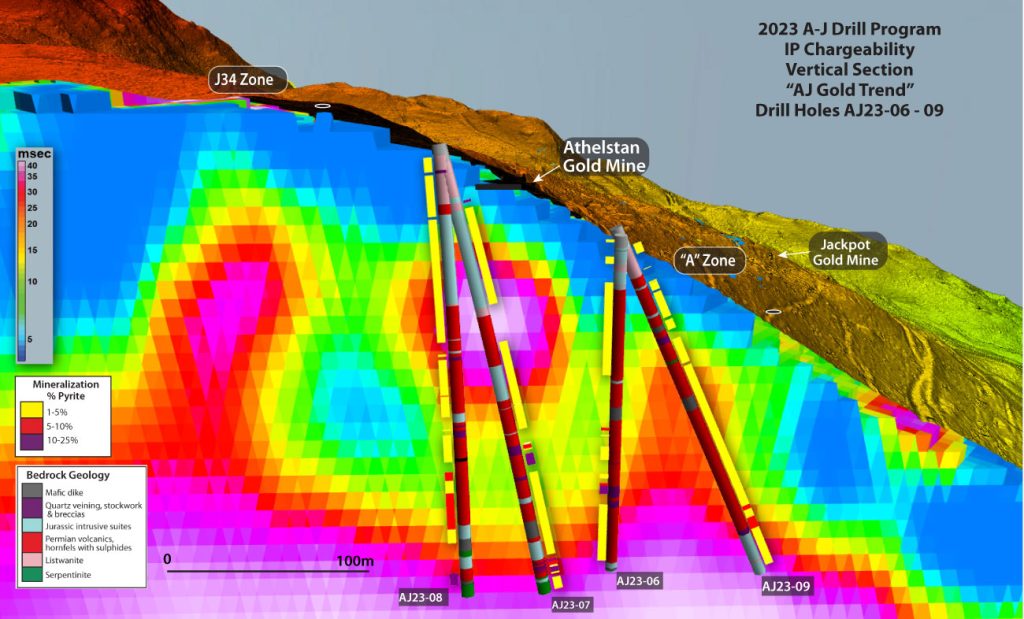
Drilling was specifically targeted at the ‘A’ zone located 100 meters southeast of holes AJ23-07 and AJ23-08, focusing on just below the surface gold mineralization. AJ23-06 and AJ23-09 were both drilled in the same geophysical anomaly beneath the Athelstan gold mine. Previously, holes AJ23-07 and AJ23-08 penetrated a 100-metre-long mineralized zone directly beneath the mine.
Recent drilling in the South Zone, including all four diamond holes, has penetrated over 100 meters of silicate, silica carbonate and chlorophyll alteration. These mineralized zones are located directly beneath and adjacent to the Athelstan mine, indicating that the Athelstan gold trend may extend for up to 100 metres. The core shows evidence of several meters of quartz shear and interdigitating veins in a variety of lithologies, containing pyrrhotite, pyrite and traces of copperite and arsenopyrite. These results suggest there may be conduits for deep hydrothermal fluids, possibly related to previously mined gold deposits in the area.
Related News
- Brazilian Potash is providing emergency response assistance to the wildfire crisis in Autazes
- Golden Ridge Resources completes phase 2 drilling at the Williams gold property, features a significant gold intersection, & explores a new mineralization zone
- Ximen Mining (TSXV:XIM) reports results from seventh hole at Amelia gold mine in British Columbia, encounters mineralization
- AtkinsRéalis appointed by Rio Tinto on world’s largest untapped iron ore deposit
- ENGIE successfully acquires BTE Renewables
In addition, near-surface silicomanganite units ranging from oxidized to unweathered states are frequently encountered, as well as extensive alteration zones containing moderate sulfide mineralization at depths unexplored by historical drilling or mining activity.
Belmont’s recently completed drill program consisted of nine holes totaling 2,000 meters designed to test several consistent geophysical and geological anomalies at the A-J property. The North Zone is the focus of exploring holes AJ23-01 to 05, and the South Zone is the focus of exploring holes AJ23-06 to 09.
The specific objective of drilling in the South Zone is to identify potential supply structures for near-surface gold mineralization. The area is part of a 1.0-kilometre mineralized gold trend that includes the Athelstan and Jackpot mines and has historically produced significant quantities of gold and silver.

Report by R.E. 2002 Miller B.Eng., P.Geo estimated potential gold resources in the surface and near-surface areas of the A-J Group at 2,000-5,000 ounces. This estimate is based on previous excavation results and mine yard sampling.
Gold mineralization in this area correlates with 2020 IP survey data indicating higher subsurface electrification and resistivity, as well as lower magnetism. These features are interpreted as evidence of sulfide mineralization and alteration zones.
Core logging for all four boreholes in the South Zone is now complete and samples have been sent to MSA Laboratories in Langley, British Columbia. for further analysis. Logging of the North Zone well is ongoing and expected to be completed soon.
Listavanite is a key mineral in this regard and is associated with high-grade gold mineralization. The mine’s historical production has come primarily from the Southern Zone, targeting massive and oxidized sulphide zones within the Listwanite. The serpentinization process, which involves the assimilation of gold into secondary sulfides or magnetite, is believed to play a role in the formation of these deposits. This is also confirmed by magnetic anomalies observed within the property.
Of particular note are the listvanite-related vein gold deposits in North America. Examples include the Mother Lode goldfields in California and the Abitibi greenstone belt in Canada. High-grade gold frequently occurs near carbonate-altered ultramafic rocks, such as listavanite, a feature also observed in several multi-million-ounce gold deposits in British Columbia.