By Penny Langford

The global race for critical minerals has shifted from a speculative sprint into a grueling marathon of industrial execution. As we approach the 2026 threshold, the "easy money" phase, driven by broad thematic hype around electric vehicles (EVs) and grid storage, has largely evaporated. What remains is a complex landscape where the distinction between a world-class resource and a "promotional" project determines the survival of capital.
For investors and operators alike, the transition from 2024’s volatility to the projected lithium price forecast 2026 requires a fundamental reassessment of risk. Identifying the common pitfalls in critical minerals portfolio management is no longer just about avoiding losses; it is about positioning for a supply-constrained reality that experts believe will define the latter half of the decade.
Here are seven critical mistakes currently being made in the sector and the strategic adjustments needed to fix them before 2026.
1. Chasing Geopolitical Headlines Over Project Economics
In the current environment, a single press release regarding a new "strategic partnership" between Western governments can send a junior miner’s stock up 10% in a morning session. However, relying on geopolitical noise as a primary investment signal is a dangerous strategy.
More Read

Policy is often inconsistent. While the U.S. and EU have announced various "trading blocs" and "critical mineral clubs," these frameworks do not automatically translate into a bankable feasibility study. A project that requires a $150 rare earth basket price to break even is still a poor investment, even if it is located in a "friendly" jurisdiction.

The Fix: Use headlines as alerts to revisit fundamentals. Ask if the government support is contractual, such as a price floor or a direct grant, or merely political rhetoric. If a project cannot survive without subsidies, it remains a high-risk speculation.
2. Ignoring Project Stage and Capital Intensity
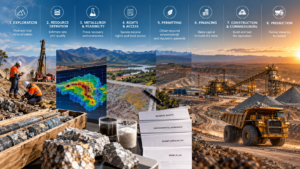
Many participants treat early-stage explorers as if they were months away from production. In reality, the path from a "bonanza intercept", similar to the Lundin Gold results at Fruta del Norte, to a cash-flowing mine can take over a decade in the critical minerals space.
More Read

The capital intensity of these projects is immense. Developing a Tier-1 lithium or nickel asset requires billions in upfront CAPEX, often leading to massive shareholder dilution if the company cannot secure non-dilutive financing or a major partner.

The Fix: Categorize holdings by stage: Grassroots, Advanced Exploration, Feasibility, or Production. Size your positions according to the risk of that specific stage. For example, a project at the San Gabriel surge stage has a much different risk profile than a drill-hole story in a new district.
3. Overpaying for "Thematic" Stories
Between 2021 and 2023, the "EV Revolution" theme led to valuations that assumed commodity prices would stay at record highs forever. When prices corrected, these stocks collapsed because their internal rates of return (IRR) were calculated at peak prices.
Whether it is the uranium market outlook or the lithium sector, paying for a stock that only makes sense if the metal price triples is essentially gambling on a supply shock rather than investing in a business.

The Fix: Run conservative scenarios. If a company’s presentation uses a $25,000/tonne lithium price but the spot market is at $13,000, be skeptical. Look for "low-cost quartile" producers that can remain profitable even during cyclical downturns.
4. Underestimating Jurisdiction and Permitting Risks
A world-class deposit in a jurisdiction where permitting takes 15 years, or where the "social license to operate" is non-existent, is effectively a stranded asset. We have seen significant delays in projects across the Americas due to environmental reviews and local opposition.
Infrastructure risk is also a major factor. For example, the Simandou infrastructure project illustrates how even the best resources in the world can be held back by the sheer complexity of logistics and regional politics.
The Fix: Conduct a jurisdiction audit. Has this country or state permitted a new mine in the last five years? Are there unresolved indigenous claims? If the answer is "no," the "discount" on the stock price is there for a reason.
5. Failing to Vet Management’s Execution Track Record
Mining is an execution-heavy industry. A "good" deposit can be ruined by a management team that overspends on corporate overhead or fails to understand the technical nuances of metallurgy. In the critical minerals sector, where processing (separating the mineral from the rock) is often harder than the mining itself, technical expertise is non-negotiable.

The Fix: Look for teams that have built mines before, not just teams that have "sold" stocks. Check if insiders are buying shares with their own money on the open market. Success in the mining industry is rarely a first-time event for a CEO.
6. Confusing "Strategic Importance" with "Profitability"
Governments around the world are labeling everything from potash to manganese as "strategic." While this helps with permitting and perhaps low-interest loans, it does not guarantee a profit.
The market saw this with Albemarle’s CAPEX cuts, where even the industry leaders must respond to market economics regardless of how "strategic" their product is to the global supply chain.
The Fix: Treat government backing as a secondary catalyst, not the primary thesis. A project must be commercially viable on its own merits.
7. Misaligning Time Horizons with Market Volatility
Critical minerals stocks are hyper-volatile. Single-day moves of 10% are standard. Many investors enter the space with a "long-term" mindset but panic-sell during a standard 20% sector correction. Conversely, short-term traders often get trapped in illiquid names that take years to reach their next milestone.
The Fix: Define your role before you buy. Are you a three-month trader playing a drill result catalyst, or a five-year investor betting on the 2026–2030 supply gap? Your "stop-loss" and "take-profit" strategy must match your time horizon.
Preparing for the 2026 Landscape
As we move toward 2026, the critical minerals sector will likely see a widening gap between the "haves" and the "have-nots." Companies that have secured financing agreements and progressed through the permitting gauntlet will be the primary beneficiaries of the next demand upswing.
By fixing these seven mistakes now: rebalancing toward quality management, realistic price decks, and stable jurisdictions: investors can move from reactive trading to proactive positioning. The 2026 supply roadmap is already being written; the key is ensuring your portfolio is on the right side of the ledger.
LinkedIn/X Social Snippet
Headline: Are you making these 7 mistakes with your critical minerals portfolio?
Body: From chasing headlines to ignoring CAPEX reality, many investors are positioned for 2021’s market instead of 2026’s supply crunch. Penny Langford breaks down the "fix" for your mining stocks before the next cycle turns. #CriticalMinerals #MiningNews #Lithium2026 #Uranium #Copper #InvestingStrategies #SMR
Market Snapshot: Critical Minerals Indicators
| Indicator | Current Status | 2026 Outlook |
|---|---|---|
| Lithium Spodumene (6%) | Consolidating | Supply Deficit Projected |
| Uranium Spot | Trending Up | Strong Multi-Year Bull Case |
| Copper LME | Volatile | Structural Shortage Expected |
| Nickel LME | Oversupplied (Laterite) | High-Grade (Class 1) Scarcity |