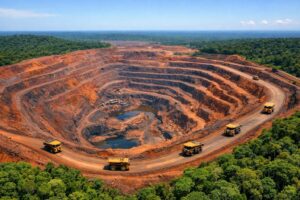
Nobody wants to admit it, but Big Tech has a uranium problem. And they’re about to solve it by doing something the industry hasn’t seen before: stepping directly into the supply chain.

Microsoft, Amazon, Google: these companies are suddenly having very serious conversations with uranium miners. Not about buying data center equipment. About financing entire mining projects in exchange for guaranteed offtake rights.
This isn’t corporate social responsibility theater. This is strategic resource procurement at scale.
The Numbers Don’t Lie
The uranium market faces a structural deficit of 30 to 40 million pounds annually. Current mine supply sits at 165 to 170 million pounds. Reactor demand? Over 200 million pounds.
There’s not enough to go around.
More Read
By 2040, uranium requirements are projected to more than double from 2025 levels: potentially exceeding 204 million metric tons in high-growth scenarios. And that’s the conservative estimate. It assumes AI demand growth follows historical trends.

It won’t.

More Read
Data centers powering artificial intelligence consume extraordinary amounts of electricity. A single large-scale AI training cluster can draw 100 megawatts or more. Per facility. These aren’t incremental power needs. They’re baseload requirements that need to run 24/7 with zero interruption.
Coal is politically dead. Natural gas creates emissions problems for companies with net-zero commitments. Solar and wind are intermittent. That leaves nuclear as the only scalable, carbon-free baseload option that can actually deliver the gigawatts these companies need.
But you can’t just flip a switch and get nuclear power. You need uranium. And the uranium supply chain has been underinvested for fifteen years.
How These Deals Actually Work
The Canadian uranium miner NexGen Energy is in early talks with technology companies about potential financing for its flagship Rook I project in Saskatchewan. Specifically, NexGen is negotiating with hyperscale data center operators interested in providing project financing in exchange for stakes in production offtake from its Arrow deposit.
These aren’t equity stakes in the traditional sense. Tech companies aren’t buying NexGen. They’re not taking board seats or operational control.
Instead, they’re offering something uranium miners desperately need: capital to bring projects online faster. In exchange, they’re securing guaranteed purchase rights: the ability to buy uranium output at market prices when production begins.
The strategic calculus here isn’t subtle. Big Tech needs reliable uranium supply to underpin their nuclear power ambitions. Uranium miners need capital to accelerate development timelines that typically stretch 10 to 15 years from discovery to first production.
It’s a natural fit. Except for one problem.

The Timeline Problem
Those two clocks don’t sync.
Big Tech is making “hundreds of billions” in data center investments right now. They need power in 2027, 2028, 2029. Uranium projects, even with aggressive financing, take years to commission.
Meanwhile, the existing uranium supply base is aging out. Cigar Lake: one of the world’s highest-grade uranium deposits: will be offline in 10 years. MacArthur River has 15 years left. These aren’t distant concerns. These are imminent supply gaps hitting exactly when AI infrastructure demand is peaking.
The market knows this. Spot uranium prices have been volatile but structurally supported. Long-term contract prices are climbing as utilities and now tech companies compete for future supply. The psychology has shifted from “uranium is plentiful” to “we need to lock down offtake now.”
And when Big Tech enters a commodity market with checkbooks open, things get interesting fast.
Why This Is Different From Past Cycles
This isn’t the first time non-traditional buyers have entered uranium markets. Utilities have always been the anchor customers. Financial buyers came and went during the last uranium bull cycle in the mid-2000s.
But tech companies bring something neither of those groups had: unlimited capital and operational urgency.
When Microsoft announces a 20-year power purchase agreement to restart Three Mile Island, that’s not a press release. That’s a signal. When Amazon invests in small modular reactor technology, that’s not R&D spending. That’s supply chain vertical integration.
These companies are treating energy infrastructure the same way they treat semiconductor supply chains or cloud compute capacity: as strategic assets that cannot be left to spot market dynamics.

Which means they’re willing to deploy capital at scales and speeds the uranium mining industry hasn’t seen before. Traditional project financing involves banks, export credit agencies, multilateral institutions: entities that move slowly and require extensive due diligence.
Tech companies can move faster. They have balance sheets that dwarf most mining companies. And they’re solving for different variables. A utility optimizes for cost per megawatt-hour over 40 years. A tech company optimizes for reliability and speed to market for AI infrastructure that’s generating revenue today.
That difference matters.
The Broader Nuclear Renaissance
This uranium supply story sits inside a larger narrative: the nuclear renaissance that energy analysts have been predicting for a decade and is finally materializing.
Extended reactor lifespans are keeping more existing capacity online longer. New reactor builds in China, India, and Eastern Europe are adding substantial baseload demand. Small modular reactor technology: long delayed: is now attracting serious commercial deployment capital.
And then AI demand hits on top of all that.
The global electricity system was already facing a generational infrastructure challenge before large language models and generative AI exploded into mainstream deployment. Electrification of transport, industrial processes, heating: all of it points to dramatically higher electricity consumption through 2050.
AI accelerates that timeline. It pulls forward demand that energy planners expected in 2035 and drops it in 2027.
The uranium market wasn’t ready. Mining development cycles haven’t sped up. Regulatory approval timelines for new mines and expansions remain glacial. Exploration spending during the post-Fukushima uranium bear market was insufficient to discover and develop the deposits needed for this demand surge.

So now you have hyperscale data center operators: companies used to solving problems with capital and technology: staring at a commodity market that doesn’t respond to those tools. You can’t disrupt geology. You can’t agile-methodology your way through a mining feasibility study. And you definitely can’t software-engineer uranium out of the ground.
Which is why they’re doing the next best thing: buying their way to the front of the line.
What Happens Next
Expect more deals structured like the NexGen conversations. Project financing from tech companies in exchange for offtake rights will become standard. These arrangements allow miners to maintain operational independence while accessing faster, larger capital pools than traditional mining finance can provide.
This capital influx should accelerate brownfield expansions and greenfield developments. Projects that looked marginal at $65 per pound uranium suddenly look compelling at $85 or $95 with guaranteed offtake from a tech giant. Development timelines that penciled at 12 years might compress to 8 or 9 with fully funded construction budgets.
But even with acceleration, supply response is measured in years, not quarters. The 30 to 40 million pound annual deficit isn’t closing in 2026 or 2027. It’s not closing in 2028 either.
The market will remain structurally tight until new primary production comes online in meaningful volumes. That’s late 2020s at the earliest for most advanced projects. Some won’t hit nameplate capacity until the 2030s.
In the meantime, Big Tech will keep writing checks to uranium miners. Because the alternative: being short on baseload power when your competitors are bringing new AI training clusters online: is not an option.
Welcome to the new reality. The nuclear renaissance isn’t a policy white paper anymore. It’s a balance sheet item. And the companies driving AI infrastructure growth are treating it exactly that way: as critical path infrastructure they cannot afford to leave unsecured.
The uranium supply chain just became a tech sector priority. And when tech decides something is a priority, capital flows. Fast.