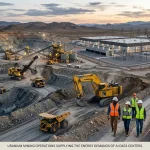
2026 Lithium Power Map : Early Access Open ($59) | Get the latest sector data and secure your copy here: https://skillings.short.gy/LithiumPreSale

The landscape of nuclear fuel financing shifted dramatically today as Uranium Royalty Corp (URC) announced a $1.9 billion merger with Sweetwater Royalties. The transaction, which creates a dominant U.S.-domiciled entity to be known as “New URC,” signals the start of what analysts are calling an M&A supercycle in the critical minerals space. By consolidating a vast Wyoming land position with a NASDAQ-listed platform, the deal aims to capture the widening spread between uranium spot prices and the net asset value (NAV) of existing royalty portfolios.
As the AI-driven data center expansion continues to put unprecedented pressure on the global power grid, uranium has moved from a niche energy commodity to a strategic national asset. This merger represents a massive bet on the longevity of the nuclear renaissance, positioning the new entity to serve as a primary liquidity provider for developers across the Athabasca Basin and the Western United States.
Market Snapshot: Commodity Performance and Intelligence
The following data points reflect the closing benchmarks for the mid-April 2026 trading session.
| Commodity | Spot Price (USD) | 24h Change | 2026 YTD | Investment Sentiment |
|---|---|---|---|---|
| Gold | $4,839.20/oz | +1.2% | +18.4% | Bullish (Safe Haven) |
| Copper | $5.45/lb | +0.8% | +12.1% | Deficit-Driven |
| Uranium (U3O8) | $108.50/lb | +0.4% | +9.2% | Consolidation Phase |
| Silver | $48.15/oz | +2.1% | +22.0% | Industrial/Monetary |
The $1.9B Uranium Royalty Consolidation
The merger between Uranium Royalty Corp and Sweetwater Royalties is not merely a combination of balance sheets; it is a strategic land grab. Sweetwater, backed by Orion Resource Partners and the Ontario Teachers’ Pension Plan, brings approximately 4.5 million mineral acres and 850,000 fee surface acres to the table. Most of this acreage is concentrated in Wyoming, a jurisdiction that has reclaimed its title as the “uranium capital” of the United States.
More Read
For investors, the most critical aspect of this deal is the P/NAV (Price to Net Asset Value) rerating potential. Traditionally, royalty companies trade at a premium to their mining counterparts because they offer exposure to price upside without the operational risks of capital expenditure (CAPEX) blowouts or labor strikes. By moving to a primary NASDAQ listing under the “New URC” banner, the entity is seeking to attract institutional capital that has previously been sidelined by the liquidity constraints of junior exchanges.

The acquisition structure involves roughly $330 million in cash and over $813 million in new shares. This provides the company with a “war chest” for future acquisitions, a necessary tool as the uranium outlook suggests a tightening supply market through 2027.

More Read

American Atomics and the Colorado Uranium Frontier
While the URC merger captures the headlines, smaller players are also moving aggressively to lock down domestic supply. American Atomics (trading under the ticker NUKE) has finalized its 100% acquisition of a high-grade uranium project in Colorado. This move underscores a broader industry trend: the shift toward brownfield redevelopment in tier-one jurisdictions.
As environmental, social, and governance (ESG) hurdles for greenfield projects remain high, companies are finding that the brownfield advantage offers a faster route to production. Colorado, much like Wyoming, provides a regulatory environment that understands the nuances of in-situ recovery (ISR) mining, a method that New URC is also heavily favoring in its Wyoming assets.
Precious Metals Streams: OR Royalties and the Bathurst Assets
The M&A fever is not confined to the nuclear sector. OR Royalties recently secured a $28 million precious metals stream on Canadian Copper’s Bathurst assets. This deal is particularly noteworthy because it focuses on the byproduct gold and silver from base metal operations.
With gold prices rebounding near $4,839/oz, mining companies are increasingly using “streaming” to fund the expansion of copper and zinc mines. This non-dilutive financing allows operators to keep their equity intact while providing royalty companies with high-margin exposure to a rampant gold market. The Bathurst assets, located in a historically rich volcanic-hosted massive sulfide (VHMS) belt, represent the type of “safe-haven” jurisdiction that investors are flocking to as geopolitical tensions rise.

Copper’s AI Investment Floor
The copper market continues to be anchored by the “AI grid floor.” As massive investments flow into the global electrical grid to support AI data centers, the demand for copper wiring and infrastructure has created a structural deficit. Analysts predict a 30% deficit through 2030, a gap that the current project pipeline is ill-equipped to fill.
This deficit is driving a wave of consolidation as major miners look to acquire junior explorers with proven resources. The current “M&A Supercycle” is defined by this urgency to secure “green metals” before the supply gap becomes insurmountable. Companies that have successfully navigated the top 10 power list are those that have aligned their extraction strategies with the needs of the 2026 power grid.
The Investment Lens: P/NAV and Scalability
From an investment standpoint, the theme of 2026 is scalability. The royalty model is proving to be the most resilient vehicle for navigating the volatility of the mid-2020s. By aggregating multiple streams across different commodities: uranium, gold, and copper: these companies create a diversified hedge against inflation.
- P/NAV Shifts: We are seeing a divergence where large-cap royalty companies are trading at 1.8x to 2.2x NAV, while juniors are languishing at 0.6x. This creates an arbitrage opportunity for the “New URC” and other consolidators to buy undervalued assets using their premium-priced paper.
- Scalability: Unlike traditional miners, a royalty company does not need to hire a thousand new workers to manage a billion-dollar merger. The overhead remains low, allowing the majority of cash flow to be returned to shareholders or reinvested in new streams.
- Jurisdictional De-risking: The focus on Wyoming, Colorado, and Canada reflects a “near-shoring” of the supply chain. Investors are no longer willing to accept the risk profile of unstable regions, even if the grades are higher.

The shift toward consolidation is a clear signal that the industry is bracing for a long-term bull market in energy and industrial metals. Whether it is Uranium Royalty Corp’s massive play in Wyoming or American Atomics’ strategic acquisition in Colorado, the underlying message is the same: the race for secure, domestic, and scalable supply is the defining theme of the decade. As these companies merge and scale, the focus will remain on those capable of powering the global transition with efficiency and foresight.
2026 Lithium Power Map : Early Access Open ($59) | Get the latest sector data and secure your copy here: https://skillings.short.gy/LithiumPreSale