2026 Lithium Power Map : Early Access Open ($59) | Get the latest sector data and secure your copy here: https://skillings.short.gy/LithiumPreSale

The global energy landscape in April 2026 is defined by an aggressive pivot toward nuclear baseload power, driven by the dual pressures of decarbonization targets and the massive electricity requirements of artificial intelligence data centers. As spot prices for $U_{3}O_{8}$ hover at multi-year highs, the investment community has shifted its focus from speculative juniors to the primary producers capable of meeting a widening structural deficit.
For the 2026 portfolio, the “uranium thesis” is no longer about a potential recovery; it is about managing supply chain risks and identifying producers with the operational leverage to capitalize on sustained high pricing. The market remains tight, with the World Nuclear Association indicating that Kazakhstan, Canada, and Namibia continue to provide roughly 75% of global supply. However, geopolitical realignments and logistics constraints have created a tiered market where Western-aligned production carries a significant premium.
Kazatomprom: The incumbent giant facing headwinds
National Atomic Company Kazatomprom remains the world’s largest producer, accounting for approximately 21% of global uranium output. Operating in Kazakhstan, which supplies nearly 40% of the world’s uranium, the company’s scale is unmatched. However, the 2026 outlook for Kazatomprom is nuanced by logistical and geopolitical complexities.
For years, Kazatomprom was the primary swing producer, maintaining low-cost production through In-Situ Recovery (ISR) mining. Entering 2026, the company has faced persistent challenges regarding the availability of sulfuric acid: a critical reagent for ISR mining: and inflationary pressures on labor and materials. Furthermore, the geopolitical “middle ground” Kazakhstan occupies has become increasingly difficult to navigate. With traditional export routes through Russia facing increased scrutiny and potential sanctions from Western utilities, Kazatomprom has been forced to accelerate the development of the Trans-Caspian International Transport Route.
More Read

Despite these hurdles, Kazatomprom’s dividend potential remains a significant draw for institutional investors. The company’s low production costs ensure that even with increased capital expenditure for new “Subsoil Use Contracts,” it generates substantial free cash flow at current price levels. Investors in 2026 are viewing Kazatomprom as a play on total global volume, though one that requires a high tolerance for Eurasian geopolitical risk.

Cameco Corporation: The Western blue chip
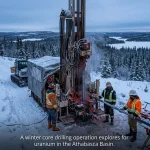
Cameco (CCO:TSX, CCJ:NYSE) has solidified its position as the preferred vehicle for Western institutional capital. Controlling the world’s highest-grade uranium assets in the Athabasca Basin of Saskatchewan, Canada, Cameco has moved beyond being a simple miner to becoming an integrated nuclear fuel provider.
https://cdn.marblism.com/u6VkLX_7Yli.webp
More Read

The company’s strategic acquisition of a 49% stake in Westinghouse: completed in late 2023: has proven to be a transformative move by 2026. This vertical integration allows Cameco to capture value across the entire fuel cycle, from mining and milling to fuel fabrication and reactor services. With the global battery revolution highlighting the need for stable, non-intermittent power, Cameco’s long-term contracting strategy has allowed it to lock in high floor prices while maintaining exposure to spot market upside.
Operationally, the Tier-1 assets at McArthur River and Cigar Lake are the bedrock of Cameco’s 2026 production profile. Unlike many global peers, Cameco operates in a top-tier mining jurisdiction with established infrastructure and clear regulatory frameworks. This “jurisdictional alpha” has led to a significant valuation premium over its international competitors. For 2026, Cameco is less about speculative growth and more about “pure-play” stability and the potential for increased capital returns as its debt from the Westinghouse acquisition continues to be retired.
Uranium Energy Corp (UEC): The domestic growth engine
As the United States intensifies its efforts to secure a domestic nuclear fuel supply chain, Uranium Energy Corp (UEC) has emerged as the leading growth play in the North American market. UEC has spent the last several years aggressively acquiring physical uranium and distressed assets, positioning itself as the largest resource-base owner in the U.S.
By 2026, UEC’s focus has shifted from asset accumulation to production execution. With its hub-and-spoke production model in South Texas and Wyoming, the company is leveraging ISR technology to bring domestic supply online relatively quickly compared to traditional underground mines. The U.S. government’s push to ban Russian uranium imports: and the subsequent funding for domestic enrichment and conversion: has provided a massive tailwind for UEC.

While UEC does not yet match the production volume of Cameco or Kazatomprom, its growth upside is tied to its “unhedged” strategy. Unlike the majors that lock in long-term contracts, UEC has historically maintained more exposure to the spot price, offering investors higher leverage during price spikes. In 2026, UEC represents the “Growth” component of the top three, targeting investors who believe that the domestic supply squeeze in the U.S. will drive prices significantly higher than the global average.
Supply constraints vs. the demand for “SMR Ready” fuel
The overarching theme for 2026 is the reality of the supply deficit. While industry conferences flag a critical moment for mining’s transformation, few sectors face as steep a climb as uranium. The lead times for new mines are often measured in decades, not years.
A major driver in 2026 is the emergence of Small Modular Reactors (SMRs). These smaller, more flexible reactors are being deployed by industrial companies and technology firms to power energy-intensive operations. This has created a new class of “offtake” buyers who are competing with traditional utilities for available supply. The demand is no longer just about keeping the lights on in cities; it is about powering the digital infrastructure of the 21st century.
https://cdn.marblism.com/lWQJY5x67s1.webp
The market is also contending with the depletion of secondary supplies. For years, “underfeeding” by enrichers and the drawdown of government stockpiles kept a lid on prices. In 2026, those cushions are largely gone. The market is now in a “production-driven” phase, where every pound of uranium must be mined from the ground. This shift favors the “Big 3” producers who have the permits and infrastructure already in place.
Geopolitical risk management in the fuel cycle
Geopolitics has transitioned from a secondary consideration to a primary price driver. The bifurcation of the global market into “Western” and “Eastern” blocs is particularly evident in uranium. Utilities in the U.S., Europe, and Japan are increasingly unwilling to sign contracts that involve Russian enrichment or Kazakh logistics that pass through Russian territory.
This has benefited Canadian and Australian assets immensely. Recent events, such as the strategic realignment in the DRC boosting copper supply, show that the West is willing to use diplomatic and financial weight to secure mineral corridors. In uranium, this manifest as a “security premium” paid for pounds produced in stable democracies.
Production growth vs. dividend potential
When evaluating these three producers for a 2026 portfolio, investors must choose between immediate income and long-term upside.
- Kazatomprom: Best for investors seeking high dividends and exposure to the absolute lowest-cost production, provided they can stomach the regional instability.
- Cameco: Best for institutional-grade exposure, combining massive high-grade reserves with a diversified revenue stream from the Westinghouse services business.
- UEC: Best for high-leverage growth and those betting on the “re-shoring” of the American nuclear industry.
https://cdn.marblism.com/wtFzngOH58z.webp
The 2026 Outlook: A sustained bull cycle
The uranium market in 2026 is characterized by a “higher for longer” pricing environment. While volatility remains: often driven by shifting sentiment around nuclear safety or short-term inventory movements: the fundamentals of the trade are reinforced by the PDAC 2025 focus on critical minerals. Nuclear energy is now widely accepted as an essential component of the green transition, and the producers who can reliably deliver the fuel are the primary beneficiaries.
Investors should monitor the quarterly production reports from Kazatomprom and Cameco closely for any signs of “operational creep” or supply misses, as the market is currently priced for perfection. Any significant supply disruption in 2026 could send spot prices into a vertical trajectory, given the lack of idle capacity elsewhere in the world.