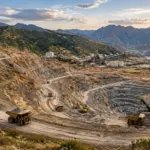
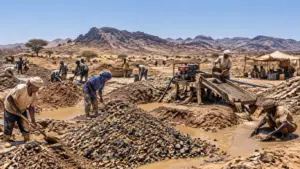
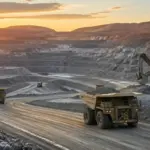
The Gaspé Copper project includes historic mine workings and areas targeted for resource expansion.

Copper drilling by Osisko Metals (TSX: OM; OTCQX: OMZNF) has extended the mineralized footprint of the past-producing Gaspé Copper project in eastern Quebec, with a high-grade interval returning 4.74% copper beneath historic workings.
Drill hole 30-1228 intersected 256.5 metres averaging 0.85% copper and 5.13 grams per tonne silver, including 28.5 metres at 4.74% copper and 27.4 grams per tonne silver, Osisko said in a Sept. 10 release.
The hole was drilled near the western margin of the company’s Needle Mountain pit area, approximately 800 metres west of the 2026 mineral resource estimate. Osisko classified the result as an out-of-pit expansion intercept, meaning it could help define mineralization beyond the current resource model rather than simply improve confidence in material already included in the estimate.
The result follows a series of broad and higher-grade intervals reported from the Gaspé Copper project this year. It also adds to the project’s investment case at a time when copper supply concerns are supporting interest in new North American developments.
More Read
The Northern Miner previously reported on Osisko’s 2026 drilling campaign, including an interval of 80 metres grading 1.93% copper and a 30-metre subinterval at 3.49% copper in the Needle Mountain expansion area. The latest 4.74% result was disclosed by Osisko Metals in its own release.

High-grade copper around old workings
The latest intercept is notable not only for its grade but also for its position relative to the historic underground mine.
Osisko said hole 30-1228 passed through pillars associated with the former B and C zone underground workings. The high-grade section was located at the C Zone level, with mineralization extending below the C Zone to a vertical depth of about 275 metres.

The company interpreted the result as evidence that copper mineralization may remain around residual pillars, between historic mining zones and beneath areas that have already been worked.
That distinction matters for mine planning. A deposit with broad, lower-grade mineralization can support a large open-pit concept, but higher-grade zones may improve the sequencing and economics of the operation if they can be mined early or blended into the mill feed.
The reported intervals are drill-core lengths rather than confirmed true widths. Osisko estimates true widths across the current program at approximately 80% to 90% of reported core lengths, depending on the geometry of the mineralization.

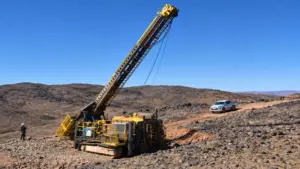
Copper mineralization in drill core is used to refine the shape, grade and continuity of the Gaspé system.
Other results from the latest batch included:
| Drill hole | Classification | Reported interval | Copper grade | Additional detail |
|---|---|---|---|---|
| 30-1228 | Out-of-pit expansion | 256.5 m | 0.85% Cu | Includes 28.5 m at 4.74% Cu and 27.4 g/t Ag |
| 30-1235 | Infill | 257.5 m | 0.39% Cu | Located near the southern resource margin |
| 30-1233 | Infill | 177.5 m | 0.40% Cu | Intersected B and C zone horizons |
| 30-1226 | In-pit expansion | 101.0 m | 0.44% Cu | Near the eastern Needle Mountain area |
| 30-1234 | Out-of-pit expansion | 67.7 m | 0.63% Cu | Northwestern margin of the pit area |
| 30-1225 | Out-of-pit expansion | 49.7 m | 0.74% Cu | Drilled beneath the western pit wall |
The results are part of a 2026 program designed to convert inferred resources into measured and indicated categories while testing areas beyond the current resource boundaries.
A large Quebec copper resource
Gaspé Copper is centered on the historic Copper Mountain mine near Murdochville on Quebec’s Gaspé Peninsula. Noranda operated the mine from 1955 until 1999. Osisko acquired the property from Glencore Canada in 2023 and has since focused on rebuilding the geological database and expanding the resource through drilling.
In April, Osisko reported a pit-constrained measured and indicated resource of 1.83 billion tonnes grading 0.27% copper, 0.017% molybdenum and 1.57 grams per tonne silver. The estimate contains approximately 10.77 billion pounds of copper, 673.2 million pounds of molybdenum and 92.8 million ounces of silver.
The company also reported 238.8 million tonnes of inferred material grading 0.41% copper, 0.016% molybdenum and 1.88 grams per tonne silver.
Those figures describe mineral resources, not mineral reserves. They do not yet demonstrate that the material can be mined profitably. Additional drilling, metallurgical work, engineering, permitting and economic studies would be required before a construction decision.
Osisko is targeting permits and construction in the early 2030s, according to The Northern Miner. The publication previously reported an initial capital estimate of approximately $1.8 billion, although that figure remains subject to future engineering and project studies.
Quebec’s copper development backdrop
The Gaspé results arrive as Quebec positions copper as a critical and strategic mineral tied to electrification, grid investment and supply-chain security.
The province’s critical and strategic minerals strategy emphasizes resource development, processing capacity, infrastructure and social acceptability. Copper projects can also benefit from a broader Canadian policy push to improve domestic access to materials used in power networks, electric vehicles and renewable energy systems.
Quebec’s advantages include a relatively established mining services sector, access to hydroelectric power and a history of permitting large resource projects. But those advantages do not remove the main development risks.
A future Gaspé mine would still need to address environmental assessment, community and Indigenous engagement, water management, mine waste, transport requirements and the cost of restoring or replacing legacy infrastructure. The project’s proximity to historic workings may reduce some development uncertainty, but it also creates additional technical questions around old stopes, pillars and ground conditions.

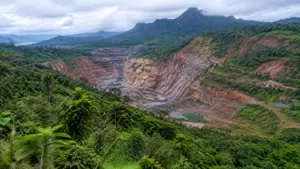
Modern drilling is testing mineralization around pillars and zones left between historic underground workings.
What the result means for the stock story
The Cramer-style market read-through is straightforward: a 4.74% copper interval is an attention-grabbing headline, but the potential rerating depends on whether Osisko can turn isolated high-grade results into a larger, mineable and financeable development.
For investors and analysts, the key questions are likely to be:
- Can the high-grade zones be traced across multiple holes?
- How much of the mineralization lies inside the existing pit concept?
- Can material currently classified as waste be converted into resource tonnes?
- Will higher grades improve the project’s strip ratio, mill feed or development schedule?
- Can the company advance Gaspé without excessive dilution or a disproportionate debt burden?
- How will copper prices, construction costs and permitting timelines affect project economics?
These questions are especially relevant to any copper price forecast for 2026. A stronger copper market can support lower cut-off grades and improve the value of large, lower-grade resources. But it can also inflate competition for equipment, labour and construction capacity.
Osisko’s April resource estimate used long-term assumptions of US$4.50 per pound copper, US$20 per pound molybdenum and US$45 per ounce silver for its equivalent-grade calculations. Those assumptions are not a price forecast, and they should not be confused with a project valuation. They are inputs to resource modelling and pit optimization.
The company will need to show that the deposit remains robust across a range of copper prices, recovery rates, capital costs and operating assumptions.
Drilling remains the near-term catalyst
Osisko said assay results are arriving at a faster pace and that further updates are expected as the 2026 program continues. The company is also drilling to the south and southwest toward Needle East and Needle Mountain, while testing mineralization west of the current resource model.
The immediate catalyst is therefore not a construction decision. It is the next phase of geological definition: more holes, tighter spacing, updated modelling and a clearer view of how high-grade zones relate to the broader porphyry-skarn system.

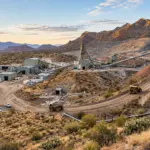
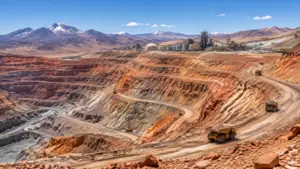
Existing infrastructure and regional access will be important factors in any future Gaspé development plan.
For Quebec, Gaspé offers the possibility of redeveloping a historic mining district around a strategically important metal. For Osisko, the challenge is to demonstrate that the project is more than a large resource with occasional high-grade hits.
The latest drilling improves that case. It extends mineralization beyond the current model, confirms copper around historic workings and delivers one of the strongest intervals reported from the project to date.
The next step is determining how much of that geological potential can survive the more demanding tests of resource classification, mine design, permitting and project finance.
Source: Osisko Metals’ drilling release; The Northern Miner’s coverage of earlier Gaspé drilling.