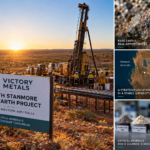
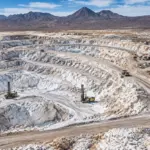
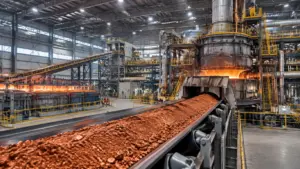
Rare earth separation tanks and piping at an industrial processing facility.

By Salini Krishnan
China’s critical minerals policy is approaching a decisive test. On Nov. 10, 2026, the suspension of Beijing’s broader October 2025 rare earth export controls is scheduled to expire, potentially restoring licensing requirements for additional elements, foreign-made products containing Chinese rare earths and the technologies used to refine, recycle and manufacture magnets.
The deadline is not an automatic embargo. It is the end of a suspension. Beijing could extend, modify or selectively enforce the measures. But the distinction offers limited comfort to manufacturers already facing longer lead times, higher prices and growing reluctance among Chinese suppliers to commit to U.S. and Japanese customers.
The immediate supply-chain reality is that China’s April 2025 controls on seven medium and heavy rare earths remain active. The broader November package would add another layer to an already concentrated system in which China accounted for about 91% of refined magnet rare earth output and roughly 94% of sintered permanent magnet production in 2024, according to the International Energy Agency.

For operators and investors, the question is no longer whether the West can mine more ore. It is whether it can build refining, recycling and magnet capacity quickly enough to reduce exposure to Chinese processing before licensing policy becomes a permanent feature of trade.

The control system is layered, not binary
The most important planning error would be to treat November 10 as the start of the disruption. The current system already combines active licensing requirements, targeted enforcement and a suspended package that could return with little lead time.
| Control layer | Affected materials or activities | Status and key trigger | Supply-chain significance |
|---|---|---|---|
| April 2025 controls | Samarium, gadolinium, terbium, dysprosium, lutetium, scandium and yttrium, including oxides, alloys, compounds and magnet materials | Active; shipment-by-shipment licensing remains required | Direct exposure for high-performance magnets used in EVs, wind turbines, electronics and defense |
| October 2025 package | Additional rare earths including holmium, erbium, thulium, europium and ytterbium | Suspended until Nov. 10, 2026 | Could broaden the number of specialty materials requiring Chinese approval |
| Extraterritorial rule | Foreign-made products containing at least 0.1% by value of specified Chinese-origin rare earths, or produced using covered Chinese technology | Scheduled to return if the suspension lapses | Extends compliance risk into third-country manufacturing and global bill-of-materials tracking |
| Technology and equipment controls | Separation, smelting, metal production, magnet manufacturing, recycling and related equipment | Suspended with the wider October package | Could constrain Western projects that still depend on Chinese equipment, chemical inputs or technical expertise |
| Western refining response | New separation, metallization and magnet projects in the United States, Australia, Canada and Europe | Under construction, financing or demonstration | Adds capacity, but most projects remain years from commercial scale |
| Recycling response | Magnet recovery from hard drives, motors, vehicles and manufacturing scrap | Pilot and demonstration stage in many Western markets | Could reduce primary mining needs, but depends on collection, feedstock quality and processing capacity |
The Fastmarkets analysis describes Nov. 10 as a critical deadline for refiners, recyclers and magnet makers outside China. It also highlights the gap between domestic Chinese and ex-China prices: on Aug. 27, dysprosium oxide in Rotterdam was assessed at $1,250-$1,675 per kilogram, compared with $270-$330 per kilogram free on board China.

That price split is not simply a market inefficiency. It reflects licensing friction, limited non-Chinese supply and the premium manufacturers are willing to pay for material that can be shipped with greater certainty.

Automated equipment and magnet blanks inside a rare earth magnet manufacturing plant.
Japan is the clearest early warning
Japan provides the strongest evidence that formal licensing can become a targeted geopolitical instrument.
Chinese customs data cited by Fastmarkets and other industry reporting showed no exports of dysprosium oxide or terbium oxide to Japan during 2026 through the period covered by its September analysis. Japanese manufacturers have historically reduced their overall dependence on China, but they remain highly exposed to Chinese supplies of heavy rare earths used in high-performance magnets.
Reporting by Asahi Shimbun and other Japanese media has followed the resulting pressure on automakers, electronics manufacturers and defense-related supply chains. Alternative supply from Australia’s Lynas and Japan Australia Rare Earths is growing, but early volumes remain small relative to previous Chinese shipments.
The U.S. position is less uniform but is moving in the same direction. In September, Reuters reported that some Chinese rare earth companies had halted selected shipments to U.S. buyers over geopolitical concerns, including cases in which licenses had reportedly been approved.
That matters because it shows that a license is not necessarily a guarantee of delivery. Supplier risk assessments, end-user scrutiny and the possibility of future enforcement can affect trade before a regulation formally takes effect.
The Royal United Services Institute argues that China’s approach is designed to preserve its advantage in magnet manufacturing while restricting access to selected materials and technologies. That structure allows Beijing to maintain high-value exports while retaining the ability to tighten supply at specific points in the chain.
The West is building capacity, but the gap remains large
The Western response is becoming more concrete. The United States has supported domestic separation, magnet manufacturing and recycling projects, while Australia, Canada, Japan and the United Kingdom are funding alternative supply chains.
The first U.S. mining project to complete the FAST-41 federal permitting process offers a useful institutional example. The Federal Permitting Improvement Steering Council announced that South32’s $3.3 billion Hermosa zinc and manganese project in Arizona completed federal permitting on Sept. 2. Hermosa is not a rare earth mine, but the project demonstrates how coordinated permitting could shorten the path for other critical minerals developments.
Congress has also moved to widen that pathway. The House passed H.R. 1501, the Protecting Domestic Mining Act, which would codify mining and mineral processing as eligible project categories under FAST-41. The legislation had not become law at the time of publication, but its passage signals stronger political support for faster domestic project development.
Recycling is another important response, although it cannot immediately replace primary supply. The IEA estimates that recycling could reduce the need for primary magnet rare earth supply by as much as 35% by 2050 under supportive policy and technology conditions. In the near term, however, much of the available scrap is concentrated in China, where most magnets are manufactured.
Projects such as HyProMag’s hydrogen-processing approach and Ionic Technologies’ hydrometallurgical separation process show the direction of travel. Yet recyclers must still secure consistent feedstock, qualify recovered oxides and avoid dependence on Chinese separation equipment and chemical inputs.

Rare earth magnet scrap and processing equipment inside a recycling facility.
Three scenarios for supply security
The November deadline creates three practical scenarios for companies planning procurement, capital allocation and compliance.
| Scenario | Policy outcome | Supply-security effect | Indicators to monitor |
|---|---|---|---|
| Bull case: managed extension | China extends or narrows the suspension and maintains workable general licenses | Avoids an immediate shock and gives Western projects more time to qualify customers and scale | Official Chinese notices, license approval times, Japan-related exemptions and new offtake agreements |
| Base case: selective reactivation | October controls return in modified form, with tighter treatment of sensitive end users and technologies | Creates a two-tier market: more predictable supply for lower-risk users and higher premiums for defense, advanced electronics and Japanese buyers | Supplier contract length, ex-China dysprosium and terbium premiums, equipment export approvals |
| Bear case: broad snapback | The suspension expires without meaningful carve-outs and technology and extraterritorial rules are enforced aggressively | Delays, inventory drawdowns and forced redesigns across magnets, EVs, wind power and defense supply chains | License denials, 0.1% rule enforcement, shipment refusals and shortages of magnet-grade material |
The CES Intelligence assessment frames the truce as a countdown rather than a settlement. Its central observation is that refining capacity, not geological availability, is the binding constraint. That distinction should guide Western policy: permitting a mine without building separation and magnet capacity does not create supply security.
What decision-makers should do before November
Companies exposed to rare earths should treat Nov. 10 as a compliance and procurement milestone rather than a single market event.
First, map the supply chain to the separation plant and technology provider, not just the immediate trader or magnet supplier. The potential 0.1% rule means that Chinese-origin content may matter even when the finished product is assembled elsewhere.
Second, identify components containing dysprosium, terbium, samarium or yttrium and separate them into three groups: materials with no substitute within 18 months, materials that can be requalified, and materials already diversified.
Third, review inventory targets against lead times rather than price forecasts. A license delay can idle a production line even when the market price remains affordable.
Finally, distinguish between announced Western capacity and qualified commercial capacity. A refinery under construction, a demonstration recycling plant and a magnet line with approved customers should not be treated as equivalent supply.
The November deadline will test whether the West has moved beyond mining policy toward full supply-chain construction. The answer, so far, is mixed. Permitting reform, public financing and recycling investment are accelerating. But China’s lead in separation, equipment, expertise and magnet manufacturing remains substantial.
The likely result is not immediate decoupling. It is a more fragmented market in which material origin, processing technology and end use determine access. For mining companies, manufacturers and policymakers, that makes critical minerals less a question of where the ore is located than who controls the steps between the ore and the finished product.
Social snippets
LinkedIn:
China’s Nov. 10, 2026 rare earth deadline is not an automatic embargo. It is the expiry of a suspension covering broader licensing, technology controls and a potential 0.1% extraterritorial rule. With April 2025 controls still active, Western refining, recycling and magnet projects face a race against policy uncertainty. Read Salini Krishnan’s analysis of the three supply-security scenarios and the response capacity now taking shape outside China.
X:
China’s Nov. 10 rare earth deadline is a supply-chain stress test, not a simple embargo date. April 2025 controls remain active; broader rules could return across materials, technology and foreign-made products. Western capacity is growing, but refining and magnets remain the chokepoints.