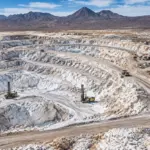
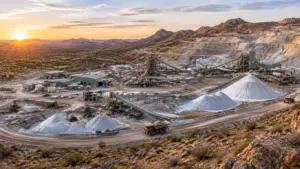
Autonomous ultra-class haul trucks travel through an open-pit mine at dusk.

By Mo Shine
Komatsu’s commissioning of its 1,000th ultra-class autonomous haul truck marks a change in the mining technology market. Autonomous haulage is no longer defined mainly by pilot projects or isolated fleets. It is becoming an operating model that combines heavy equipment, electrification, software, connectivity and mine-wide control.
The milestone truck was a Komatsu 930E-5AT equipped with the company’s FrontRunner Autonomous Haulage System. With a rated payload of 290 metric tons, the truck was deployed at Barrick’s Nevada Gold Mines operation in the United States. Komatsu says it is the first original equipment manufacturer to commission 1,000 autonomous ultra-class trucks worldwide.
The company also says FrontRunner-equipped customers have moved more than 11.5 billion metric tons of material autonomously since the commercial system was introduced in 2008. More than 500 of the 1,000 trucks are from the 930E electric-drive family, operating across North America, South America, Australia and Europe.
That scale matters because the economics of autonomy improve when the system is deployed across an entire production network rather than measured truck by truck.


Connected control systems are becoming central to autonomous fleet management.
From driverless trucks to integrated production systems
The first business case for autonomous haulage was relatively direct: remove people from repetitive, hazardous haul cycles and improve operating consistency.
The current business case is broader. An autonomous truck must interact with shovels, drills, water carts, graders, light vehicles, charging infrastructure, dispatch software and maintenance systems. In many mines, autonomous and manually operated equipment will share the same site for years.
EACON illustrates how quickly this market is expanding beyond a single OEM ecosystem. The company reports that its autonomous solution has been deployed on more than 3,500 mining trucks globally, including more than 1,500 battery-electric units. The figures are company-reported and are not an independently audited industry census, but they point to the increasing scale of commercial deployment.
EACON’s platform is designed for retrofit and factory-fit applications across diesel, hybrid-electric and battery-electric trucks. Its operating model also includes coordination between autonomous vehicles and manually operated equipment, an important requirement for mines transitioning in stages rather than replacing their fleets at once.
As Skillings reported in its earlier analysis of electric haulage, the operational challenge is not simply whether a truck can navigate without a driver. Operators must also manage charging queues, state of charge, grid capacity, regenerative braking, route grade and energy use per tonne.
That makes autonomy and electrification complementary, but not interchangeable. A battery-electric truck may reduce fuel consumption and emissions, while autonomy can improve utilization and cycle consistency. The strongest economics come when both systems are managed together.
The commercial deployment picture
The headline figures provide a useful reference point, but they should not be read as a universal measure of industry adoption. OEM definitions, project stages and reporting periods vary.
| Company or measure | Reported scale or performance | Operating relevance |
|---|---|---|
| Komatsu FrontRunner | 1,000 ultra-class autonomous trucks commissioned | Demonstrates commercial scale across multiple regions and commodities |
| Komatsu 930E electric-drive family | More than 500 autonomous trucks | Shows the overlap between autonomy and electric-drive haulage |
| EACON autonomous fleet | More than 3,500 trucks globally | Indicates growing multi-OEM and multi-site deployment |
| EACON battery-electric fleet | More than 1,500 autonomous trucks | Places charging and energy management inside the production system |
| Mature autonomous haulage | Commonly reported productivity improvement of 10%–25% | Actual results depend on road design, dispatch, fleet mix and operating discipline |
| Mixed-traffic operations | Autonomous, manual and support vehicles operating in shared environments | Requires geofencing, traffic rules, communications and intervention systems |
| Sandvik Sami | Cabinless, battery-electric autonomous surface drill concept | Signals the expansion of crewless operation beyond haulage |
The 10%–25% productivity range cited in Skillings’ mining automation coverage should be treated as an operating benchmark rather than a guaranteed return. Gains can come from longer productive hours, reduced idle time, consistent driving behavior and better dispatching. They can also be weakened by poor road conditions, frequent manual interventions, network failures or charging bottlenecks.
For operators, the relevant measure is not the autonomy percentage advertised by a supplier. It is the change in tonnes moved per productive hour after the full system has stabilized.
Sandvik points beyond haulage
Sandvik’s Sami concept suggests that the next stage of autonomous mining will extend into drilling and other mobile work.
Sami is a cabinless, battery-electric surface drill concept designed to operate autonomously. According to Sandvik, the machine can navigate through the mine environment, measure hole depth and deviation, identify people and equipment, and adapt its behavior to changing conditions.
It also carries drill bits, collar pipes and down-the-hole hammers onboard. An integrated robotic manipulator is designed to perform tool changes without requiring personnel to enter the drilling zone.
The more significant feature is the connection between the machine and a continuously updated digital twin. Sandvik says its Sandi artificial-intelligence agent can assign drilling tasks, coordinate activities across the broader fleet and interact with operators using natural language.
Sami remains a concept rather than a commercial production machine. Its importance is therefore less about near-term fleet numbers and more about system architecture. The concept combines autonomous movement, robotics, electrification, artificial intelligence and digital-twin coordination in one operating model.
International Mining’s coverage of Sami similarly highlights the shift from optimizing individual assets to managing the mine as a connected production system.

Sandvik’s Sami concept points toward crewless drilling and broader mine-wide automation.
Connectivity becomes production infrastructure
Autonomous fleets require dependable communications across haul roads, loading areas, workshops and dumping points. Vehicles transmit location, speed, payload, battery state, equipment condition and sensor information. Fleet systems send back route instructions, work assignments and safety commands.
Existing private LTE networks can support many of these functions. The next generation of private 5G and 5G-Advanced networks could add greater capacity, improved positioning, edge processing and better support for large numbers of connected machines.
This does not mean that 5G-Advanced alone will make a mine autonomous. Its value depends on integration with vehicle controls, dispatch systems, digital twins and safety architecture.
As Skillings’ prior analysis of private 5G in mining noted, reliability is more important than headline bandwidth. Operators need to track packet loss, handover performance, network availability, failover time and edge-application response.
A truck should also retain onboard perception and safe-state logic if the network is interrupted. The strongest architecture combines local vehicle intelligence with network-assisted coordination rather than relying entirely on a remote control loop.
Connectivity is especially important for mixed-traffic environments. Light vehicles, maintenance crews, water carts and manually operated trucks will continue to enter autonomous zones. The system must identify those interactions, enforce site rules and provide controlled intervention when necessary.
Base, bull and bear adoption framework
| Scenario | Adoption economics | Operational outcome | Principal risk |
|---|---|---|---|
| Base case | Large, long-life mines deploy autonomy in phases and spread infrastructure costs across haulage, drilling and energy systems | Mature fleets deliver productivity gains toward the 10%–25% range in suitable conditions | Mixed traffic, workforce transition and site communications slow rollout |
| Bull case | Standardized platforms, improved batteries and shared private networks reduce the cost per autonomous tonne | Autonomy, electrification and digital twins optimize the entire mine rather than individual machines | Regulation, cybersecurity and technical skills keep pace with deployment |
| Bear case | Smaller or short-life operations cannot justify control rooms, charging infrastructure and network redundancy | Frequent interventions offset productivity gains and extend payback periods | Network outages, battery incidents, poor retrofits or weak data integration damage confidence |
The base case appears most credible for large copper, gold, iron ore and critical-minerals operations with long mine lives, repetitive haul routes and sufficient technical capacity.
The bull case depends on standardization. If autonomy platforms, chargers, fleet software and digital-twin systems remain difficult to integrate, operators may capture only part of the potential value.
The bear case is not a rejection of autonomous technology. It is a reminder that mine design and operating discipline can matter more than the capabilities of an individual machine.

Electrified autonomous fleets add charging capacity and energy management to the production equation.
What operators and investors should measure
Fleet counts are useful indicators of market direction, but site-level metrics are more relevant to capital allocation. Decision-makers should monitor:
- autonomous availability and productive hours;
- tonnes moved per operating hour;
- intervention and controlled-stop frequency;
- haul-cycle variability;
- charging queue time and energy use per tonne;
- network availability and failover performance;
- maintenance hours for autonomy and high-voltage systems;
- sensor reliability in dust, rain and low light;
- workforce training and role-transition outcomes;
- cybersecurity events and recovery time.
Komatsu’s 1,000-truck milestone establishes a commercial reference point for ultra-class haulage. EACON’s reported fleet shows how quickly deployment is expanding across OEMs and powertrains. Sandvik’s Sami concept points to where the market could go next: autonomous machines that coordinate through a shared digital model of the mine.
The tipping point, in other words, is not the moment when a truck drives itself. It is the point at which autonomy, electrification, digital twins and advanced connectivity work together well enough to improve the reliability of the whole operation.
That is the measure that will determine whether autonomous mining technology becomes a standard productivity platform or remains a collection of high-profile equipment projects.
LinkedIn snippet
Komatsu has commissioned its 1,000th ultra-class autonomous haul truck, while EACON reports more than 3,500 autonomous trucks deployed globally, including over 1,500 battery-electric units.
The significance extends beyond driverless haulage. Mining’s next productivity gains will depend on integrating autonomy with electrification, digital twins, private 5G and mixed-traffic safety systems.
Our latest analysis examines the base, bull and bear cases for adoption economics.
X snippet
Autonomous mining is moving from pilots to operating systems.
Komatsu has reached 1,000 ultra-class autonomous haul trucks. EACON reports 3,500+ autonomous trucks globally, including 1,500+ battery-electric units.
The next test: autonomy + electrification + digital twins + 5G-Advanced.