By Penny Langford

Komatsu’s commissioning of its 1,000th ultra-class autonomous haul truck marks a significant change in mining technology. The milestone does not mean autonomy is new to mining, nor does it represent the first 1,000 autonomous trucks globally. It does show that one original equipment manufacturer has moved autonomous haulage from a limited deployment model into a repeatable, multi-commodity production platform.
The milestone truck is a Komatsu 930E-5AT electric-drive haul truck with a 290-metric-tonne payload. It was deployed at Barrick’s Nevada Gold Mines operation in the United States, extending Komatsu’s FrontRunner Autonomous Haulage System into a major gold operation.
According to Komatsu, FrontRunner customers have moved more than 11.5 billion metric tonnes of material since the system entered commercial service in 2008. More than 500 autonomous trucks in the installed base are 930E-class vehicles.
That is the point management teams should focus on. The industry is no longer asking whether a truck can drive itself on a controlled route. It is asking whether a mine can organize its roads, dispatch systems, workforce, communications infrastructure and maintenance practices around predictable machine movement.


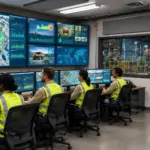
Control-room staff monitor fleet status, mine maps and production data.
The 1,000-truck figure needs context
The milestone is important, but the number needs to be read precisely.
Global autonomous haulage had already passed 1,000 trucks across all manufacturers and equipment classes. GlobalData reported that 1,068 autonomous haul trucks were operating globally by May 2022. EACON has separately reported more than 1,000 trucks equipped with its autonomous haulage system, primarily in China.
Komatsu’s achievement is narrower and commercially significant: it is the first OEM to commission 1,000 ultra-class autonomous haul trucks using one established platform.
| Metric | Reported figure | Operational significance |
|---|---|---|
| Komatsu FrontRunner autonomous ultra-class trucks | 1,000 commissioned | Demonstrates repeatable deployment at OEM scale |
| 1,000th truck payload | 290 metric tonnes | Shows the system is designed for high-volume haulage |
| Material moved using FrontRunner | More than 11.5 billion metric tonnes | Provides a substantial operating history |
| 930E-class autonomous trucks | More than 500 | Indicates concentration around a widely deployed electric-drive platform |
| Commercial FrontRunner history | Since 2008 | Nearly two decades of fleet, software and support experience |
The distinction matters for operators evaluating vendors. A single pilot can demonstrate technical feasibility. A 1,000-truck installed base provides something different: field data, maintenance experience, trained personnel, software refinement and a larger ecosystem of suppliers and service technicians.
It also gives the OEM a stronger base from which to standardize future autonomy, electrification and fleet-management systems.
Autonomy is becoming a mine-wide operating model
The truck is only the visible part of the system.
A commercial autonomous haulage deployment requires high-precision positioning, vehicle sensors, drive-by-wire controls, fleet dispatch, traffic management, emergency procedures and communications coverage. It may also require changes to haul-road geometry, berms, loading areas, dumping points and maintenance zones.
Mining companies must therefore treat autonomy as an operating-model project rather than a vehicle purchase.
Freeport-McMoRan’s Bagdad mine in Arizona illustrates the scale of that transition. The operation converted a fleet of 33 haul trucks to autonomous operation, while also building a command centre, upgrading communications, widening roads and separating autonomous and manually operated zones during the transition.
The workforce model changed as well. Drivers were not simply removed from the system. Some were redeployed to other mining roles, including shovel operation, technology support and information technology.
This is a recurring pattern across mature deployments. Autonomy reduces the need for people to sit inside moving haul trucks, but it increases demand for dispatchers, control-room operators, data specialists, high-voltage technicians, automation engineers and maintenance personnel capable of diagnosing sensors and software.
The labour question is therefore not simply how many jobs disappear. It is whether the mine can retrain and recruit for a more technical operating environment.
The productivity case is real, but not universal
Autonomous haulage can improve consistency in repetitive production cycles. Trucks can maintain controlled spacing, follow defined routes and operate without the variability associated with fatigue, shift changes and uneven driving behaviour.
Rio Tinto has previously estimated that autonomous trucks in its Pilbara operations delivered approximately 700 additional operating hours per truck per year and operating costs about 15% lower than conventional haulage. Those figures are historical company estimates, not a universal industry benchmark.
The outcome at any individual mine will depend on factors such as:
- Haul distance and road quality.
- Loading and dumping cycle times.
- Fleet utilization before conversion.
- Network reliability.
- Availability of shovels, crushers and processing plants.
- Frequency of human intervention.
- Maintenance capability.
- The number of trucks required to justify infrastructure.
A mine that already operates a highly productive conventional fleet may see a smaller immediate gain than an operation struggling with labour availability, fatigue exposure or inconsistent cycle times.
The correct comparison is not autonomous versus manual in the abstract. It is the expected performance of the existing fleet against the full cost and performance of the proposed autonomous system.
Network reliability is now a production issue
Autonomous equipment depends on a communications layer that can support positioning, telemetry, dispatch instructions, obstacle alerts and remote intervention.
That makes connectivity part of the production system.
Skillings’ analysis of autonomous mining and network infrastructure highlighted the operational consequences of weak coverage. At Newmont’s Cadia operation in Australia, private 5G connectivity was deployed after Wi-Fi limitations restricted remote dozing. Newmont reported a larger operating area and a 50% increase in dozing capacity following the deployment.
The result should not be treated as a universal 5G performance claim. It is a reminder that equipment autonomy cannot outperform the infrastructure supporting it.
Operators should measure network performance in the same way they measure truck availability:
- Coverage across active haul routes.
- Handover performance between coverage zones.
- Latency and jitter for control applications.
- Uplink capacity for video and telemetry.
- Failover procedures.
- Cybersecurity and network segmentation.
- Resilience as the mine expands or changes direction.
The most expensive autonomy failure may not be a software defect. It may be a dead zone, an unplanned road change, a damaged antenna or a network handover that interrupts production.

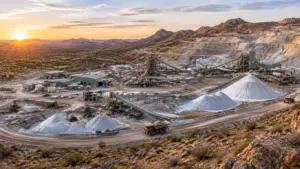
Autonomous haulage combines electric-drive equipment, sensors, telemetry and fleet software.
Electrification increases the value of integration
The Komatsu 930E platform is important because it is already an electric-drive haul truck. That gives operators a pathway to combine autonomy with trolley assist, battery-electric systems and other energy-management technologies.
Komatsu has demonstrated an autonomous electric-drive truck connected to a dynamic trolley line. Elsewhere, EACON has reported more than 1,500 battery-electric autonomous trucks within its wider deployment base.
Autonomy can help coordinate the energy constraints introduced by electrification. A dispatch system can account for battery state of charge, charging availability, route elevation, regenerative braking and production priorities.
But it also creates new risks. A battery-electric autonomous fleet needs:
- Adequate grid and substation capacity.
- Charging or battery-swapping infrastructure.
- High-voltage maintenance capability.
- Emergency response procedures.
- Battery availability during shift changes.
- Software that links energy management with production dispatch.
The business case is therefore larger than the truck. It includes the mine’s power system, road design, control room and maintenance organization.
Base, bull and bear cases
| Scenario | Operating outcome | Main risk |
|---|---|---|
| Base case | Large surface mines adopt autonomy in phases, beginning with defined haul zones and compatible truck fleets | Capital costs, mixed traffic and network upgrades slow conversion |
| Bull case | Standardized platforms, better software and electrification improve utilization while reducing exposure to haulage hazards | Workforce and regulatory systems keep pace with faster deployment |
| Bear case | Poor road conditions, weak connectivity or limited fleet scale prevent the expected productivity gains | Cyber incidents, intervention frequency or battery failures undermine confidence |
The base case appears the most credible. Large mines with long haul routes, repetitive cycles and sufficient capital can justify autonomy, but most will not convert every machine at once. Phased deployment allows operators to test infrastructure, retrain employees and measure actual performance before committing to a full-fleet transition.
What mining companies should do next
Companies considering autonomous mining technology should start with a site-readiness review rather than an equipment order.
First, establish a baseline for conventional performance. Measure tonnes per truck hour, availability, cycle-time variation, intervention frequency, maintenance downtime and fuel or energy use.
Second, identify the operating zone where autonomy has the clearest economic and safety case. A mine does not need to automate every route to generate useful data.
Third, budget for the supporting system. The capital plan should include communications, control-room infrastructure, road modifications, software integration, spares, training and emergency response.
Fourth, negotiate measurable performance criteria with vendors. Truck count is useful, but the more relevant indicators are autonomous availability, productive hours, tonnes moved, intervention frequency and cost per tonne.
Finally, preserve interoperability. A mine that becomes dependent on one proprietary platform may gain short-term simplicity but lose flexibility across future equipment purchases.
The 1,000-truck milestone is a strong signal that autonomous haulage has reached industrial scale. It is not a guarantee that every mine will achieve the same results.
The next competitive advantage will belong to operators that connect autonomy to the full production system: mine planning, copper and gold grade control, energy management, safety, maintenance and workforce development.
The truck may be driverless. The investment decision is not.
Shareable snippets
LinkedIn:
Komatsu’s 1,000th ultra-class autonomous haul truck marks a shift from pilot projects to repeatable fleet deployment. The next test is not whether trucks can drive themselves, but whether mines can integrate autonomy with roads, networks, energy systems, maintenance and workforce planning.
X:
Komatsu’s 1,000-truck milestone puts autonomous haulage at industrial scale. The next value question is mine-wide integration: dispatch, connectivity, electrification, maintenance, safety and people( not just driverless trucks.)