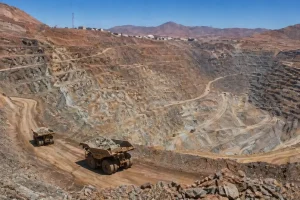
Brazilian rare earth and lithium processing facility surrounded by tropical vegetation and red laterite soil.

By Charles Pitts
Brazil has enacted a critical minerals law that gives the federal government greater control over foreign acquisitions, mining-rights transfers and selected international contracts involving strategic mineral assets, while offering up to R$7 billion in fiscal and financial support for domestic processing.
President Luiz Inácio Lula da Silva signed the measure on Sept. 16 after the Senate approved the bill on Sept. 3, according to Courthouse News Service and legal analysis from Demarest.
The law creates Brazil’s first National Policy on Critical and Strategic Minerals and establishes a council linked to the presidency. That council will review transactions involving assets and supply chains connected to rare earths, lithium, nickel, graphite and other minerals designated as critical or strategic.
For foreign investors, the immediate change is procedural as much as financial: a transaction that once could be negotiated primarily through corporate, mining and competition channels may now require an additional national-interest review at the presidential level.

What the law creates
The new framework establishes the National Council for the Industrialization of Critical and Strategic Minerals, known as CIMCE. Its responsibilities include identifying critical and strategic minerals, selecting priority projects and reviewing certain transactions involving companies that hold relevant mining rights.
The council may examine:
More Read

- Direct or indirect changes in corporate control;
- Foreign acquisitions involving a relevant stake or significant influence;
- Transfers of mining rights;
- International contracts, partnerships and supply agreements;
- Transactions that could affect Brazil’s economic or geopolitical security.
The law also allows the government to impose value-addition requirements on mineral exports. It does not prohibit exports of unprocessed ore, but detailed regulations are expected to determine how domestic processing and industrialization conditions will apply.
A national registry and traceability system will support the policy. The system is intended to track the origin of ore, mining rights, environmental licensing and participants in the production chain.
The mineral list is expected to be reviewed periodically. Rare earths, lithium, nickel and graphite are among the materials at the center of the new policy, alongside other minerals relevant to batteries, permanent magnets, energy storage, defense and low-carbon manufacturing.

Processing equipment and hydrometallurgical infrastructure inside a Brazilian critical minerals facility.
The law’s main financial instruments
The government is using tax support and credit guarantees to encourage companies to build more of the value chain inside Brazil.
| Instrument | Amount or threshold | Practical purpose |
|---|---|---|
| Processing and transformation tax credits | Up to R$5 billion | Support mineral processing, transformation, manufacturing and urban-mining projects |
| Processing credit period | 2030–2034 | Spread fiscal support over a five-year implementation window |
| Mineral Activity Guarantee Fund | Up to R$2 billion | Provide guarantees that reduce financing risk for qualifying projects |
| Presidential council screening | No published quantitative threshold | Review control changes, foreign stakes, mining-rights transfers and selected international contracts |
| Approval timeline | Unknown | Implementing rules have not yet established a statutory review period |
The Federal Program for the Processing and Transformation of Critical and Strategic Minerals will prioritize projects that move beyond extraction. Eligible activities are expected to include processing, mineral transformation, manufacturing and recycling.
Projects connected to batteries, energy storage, permanent magnets and other energy-transition technologies are likely to receive particular attention. Priority projects may also qualify for government support, tax-advantaged financing and expedited consideration by relevant agencies.
The guarantee fund is designed to improve access to long-term credit for projects that banks may otherwise view as too capital-intensive or technologically uncertain. It could be particularly relevant to rare earth separation plants, lithium conversion facilities and downstream nickel or graphite processing.
Why miners are asking for more
The incentives are significant, but mining companies and industry representatives say they may not be sufficient to support domestic processing on their own.
Processing plants typically require large upfront investments, lengthy construction periods and reliable access to feedstock. Rare earth separation, in particular, involves complex chemistry, high technical standards and strict management of residues and water.
Miners are therefore pressing for additional commercial support, including price floors and guaranteed purchases. The Courthouse News report cited an economic model suggesting that price floors and purchase guarantees could reduce the payback period for a Brazilian rare earth separation plant from roughly 10 years to four.
The enacted law does not establish statutory price floors or mandatory purchase guarantees.
That omission matters because tax credits reduce capital costs, while guarantee funds can improve access to financing. Neither instrument fully addresses the risk that a new processing facility may face weak or volatile prices once it begins operating.
Rafaela Guedes, a senior fellow at the Brazilian Center for International Relations, told Courthouse News that Brazil’s main challenge lies beyond mining. The country has major reserves, she said, but “virtually no capacity to separate or refine rare earths or manufacture magnets.”
What changes for foreign acquirers
The law introduces a new layer of deal uncertainty for overseas companies seeking Brazilian critical minerals assets.
Longer transaction timelines
Foreign buyers will need to build CIMCE review into transaction schedules. The approval period is not yet defined, and the law leaves important terms such as “relevant stake” and “significant influence” open to future regulation.
That creates uncertainty for transactions that fall short of a formal change in control but still give an investor influence over production, offtake, processing or strategic decision-making.
More presidential-level scrutiny
Because the council is housed within the presidency, critical minerals transactions will receive a higher level of political attention than ordinary commercial acquisitions.
The review is separate from environmental licensing, mining-rights approvals and any competition review. A transaction could therefore satisfy existing corporate and competition requirements while still being subject to a national-interest assessment under the new policy.
Greater deal-conditionality risk
Buyers and sellers will need to decide how CIMCE approval is reflected in transaction documents. Conditions precedent, termination rights, long-stop dates, break fees and the allocation of regulatory risk are likely to become more important in acquisition agreements.
International offtake contracts may also require closer review. The law covers contracts and partnerships where terms could affect Brazil’s economic or geopolitical security. That could include long-term agreements that finance a mine but commit most of its output to an overseas processor.
A stronger position for downstream investors
Foreign companies that bring processing, refining, manufacturing or recycling capacity to Brazil are likely to have a stronger position than buyers proposing an export-only model.
The law’s incentives are explicitly designed to promote domestic value addition. An acquirer that combines a mine with a Brazilian separation plant, lithium conversion facility, battery-materials operation or magnet supply chain may be better aligned with CIMCE’s priorities.
That does not guarantee approval. It does, however, give the government a clearer industrial-policy rationale for supporting the transaction.

Exploration drilling and core sampling on red laterite soil in a Brazilian critical minerals district.
Brazil’s position in the global policy race
Brazil’s new approach comes as major economies increasingly treat critical minerals as a matter of industrial and national security policy.
The United States has temporarily restricted exports of certain forms of battery black mass and tungsten waste and scrap. The measure, effective Aug. 27, prioritizes domestic buyers unless an exception or authorization is granted, according to Baker McKenzie’s trade update.
Washington has also expanded the use of defense-linked lending and guarantees for critical minerals projects, with conditional Pentagon loans approaching $4.9 billion through August. In Europe, policymakers have proposed a joint purchasing body intended to aggregate demand and improve the bargaining position of companies seeking strategic mineral supplies.
Brazil’s law follows the same broad direction but applies it through a domestic processing and transaction-screening framework. The country wants to attract capital while ensuring that more of the economic value from its deposits remains within Brazil.
Brazil is considered one of the world’s leading holders of rare earth resources. Some estimates place it second globally, with about 21 million metric tons of reserves. It also holds major hard-rock lithium deposits, nickel laterites, graphite resources and niobium operations.
The country has attracted capital from Chinese, U.S., European, Japanese and Gulf investors. The new rules will not necessarily close the market to those investors, but they will change the terms on which access is negotiated.
The next test is implementation
The law provides the framework, but regulations will determine how it works in practice.
Investors still need clarity on:
- Which mineral projects and transactions will fall under mandatory review;
- What constitutes a relevant foreign stake or significant influence;
- Whether offtake contracts require approval before signing or only before implementation;
- How CIMCE will coordinate with the National Mining Agency and environmental authorities;
- What review deadlines and appeal mechanisms will apply;
- How projects will qualify for tax credits and guarantee support.
For foreign acquirers, the most immediate response will be to conduct deeper regulatory diligence before signing agreements. Buyers may need to map ownership structures, financing arrangements, processing commitments, final customers and export destinations at an earlier stage.
For Brazil, the policy presents a trade-off. Stronger state oversight may protect strategic assets and support domestic industrialization, but unclear procedures could increase transaction costs and discourage capital if approvals become unpredictable.
The balance will depend on whether the government can provide transparent rules while directing incentives toward projects that create durable processing capacity.

Drill core logging and sample preparation at a Brazilian mineral exploration station.
Brazil’s critical minerals law therefore changes more than the approval path for foreign deals. It signals that mining investment will increasingly be judged not only by the quality of the deposit or the strength of the buyer, but also by the amount of processing, technology and industrial capacity brought into the country.
For companies assessing Brazilian rare earths, lithium, nickel, graphite, copper and other critical minerals, the central question is no longer simply whether an asset can be acquired. It is whether the proposed transaction fits Brazil’s emerging strategy for controlling and developing the full value chain.