The United States is putting up to $10 billion in financing behind Project Vault, a new strategic reserve designed to protect American manufacturers from disruptions in critical mineral supplies.

The initiative is broader than rare earths. It creates the U.S. Strategic Critical Minerals Reserve, an independently governed public-private partnership that will store essential raw materials at facilities across the country.
The Export-Import Bank of the United States (EXIM) approved the financing in February 2026. The structure also includes nearly $2 billion in private-sector investment.
The scale is significant. Yet a reserve does not automatically create mines, separation plants, refineries or permanent magnet factories.
That distinction is central to the rare-earth supply problem.
More Read
What Project Vault Actually Does
Project Vault is designed as a supply-chain buffer.

EXIM says the reserve will help U.S. manufacturers maintain access to critical raw materials during periods of market disruption. It is also intended to support domestic production and processing.
The model brings manufacturers and private capital providers into the same structure.
More Read
Initial participants include Clarios, GE Vernova, Western Digital and Boeing. Suppliers include Hartree Partners, Mercuria Americas and Traxys.
This gives Project Vault a different role from a traditional government stockpile.
It links inventory security with industrial demand and private-sector capital. For manufacturers, the immediate objective is greater access to materials when global supply is disrupted.
For miners and processors, the longer-term question is whether that demand can translate into investment in new capacity.
Rare Earths Expose the Bigger Problem
Rare earths show why inventory alone cannot solve supply-chain dependence.
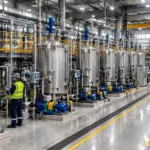
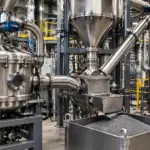
The value chain starts with mining. It then moves through beneficiation, chemical processing, separation, refining, metal production, alloying and magnet manufacturing.
Each stage requires different equipment, expertise and capital.
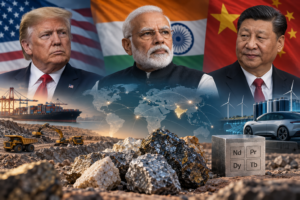
The International Energy Agency (IEA) estimates that China accounted for 60% of global mined production of magnet rare earths in 2024.
Its share rose to 91% at the refining stage. China also accounted for 94% of global sintered permanent magnet production.
The concentration becomes more important for materials used in high-performance magnets, including neodymium, praseodymium, dysprosium and terbium.
These materials support motors, wind turbines, electronics, defence systems and other advanced technologies.
Project Vault can hold material inside the United States. It cannot substitute for processing and manufacturing capacity that does not yet exist.
The Midstream Gap Is the Harder Problem
The global rare-earth industry has spent years developing new mines.
Building the processing infrastructure needed to turn those ores into usable industrial products has proved harder.
The IEA’s 2026 outlook highlights the gap.
By 2035, existing and announced projects outside the dominant supplier are expected to cover about half of projected mining requirements for magnet rare earths.
Refining capacity would cover only about a quarter of projected demand.
For magnets, the gap is even wider. Planned capacity would cover less than one-fifth of projected demand outside the dominant supplier.
The IEA estimates that diversified supply would require roughly twice as much mining capacity beyond planned expansions.
Refining capacity would need to rise fourfold. Magnet production would need to increase sixfold.
Those figures change the investment equation.
A new mine can increase the availability of ore. It does not automatically create a competitive supply of separated oxides, rare-earth metals, alloys or finished magnets.
Where Project Vault Can Buy Time
This is where a strategic reserve has a practical role.
A stockpile can provide manufacturers with a buffer when shipments are delayed or export controls disrupt normal trade.
It can also give companies more time to qualify alternative suppliers.
That matters because rare-earth supply chains are difficult to rebuild quickly.
Processing plants need technical expertise. Magnet producers need qualified feedstock and manufacturing capabilities.
End users must also validate new materials and components before replacing established suppliers.
Project Vault therefore addresses one part of the resilience problem: access to inventory during a disruption.
Its longer-term value will depend on whether the broader U.S. critical-minerals strategy continues to build production and processing capacity alongside the reserve.
China’s Position Has Changed — But Not Enough
U.S. and allied investment has begun to reduce some concentration in rare-earth refining.
Reuters reported in September 2026 that China’s share of global rare-earth refining had fallen from about 90% in 2023 to 85% in 2025.
The IEA’s outlook shows how difficult further diversification could be.
Even if all announced projects are completed, China’s refining share could remain around 70% to 73% by 2035, according to the IEA assessment reported by Reuters.
The downstream position is even more concentrated.
China produced 94% of the world’s sintered permanent magnets in 2024.
The strategic challenge, therefore, is not simply securing rare-earth ore.
It is building an alternative industrial chain from mine to magnet.
The Capital Question Comes Next
Project Vault’s most important financial feature is its combination of government-backed financing and private capital.
EXIM says the structure brings together original equipment manufacturers and suppliers around a strategic reserve.
That creates a mechanism for linking industrial demand with supply-chain security.
The bigger test will come further upstream and downstream.
Mining projects require large amounts of capital and long development periods. Processing and magnet facilities face their own technical and commercial risks.
If U.S. manufacturers gain more secure access to material but still depend on overseas processing, supply-chain exposure will remain.
For investors, that makes midstream and downstream capacity an important part of the critical-minerals opportunity.
A Bridge, Not the Destination
Project Vault addresses a real vulnerability: the risk that American manufacturers cannot obtain critical raw materials during a major supply disruption.
But the rare-earth data point to a larger structural problem.
The United States and its allies need more than inventory.
They need competitive mines, separation capacity, refining, metal production, alloy manufacturing and permanent-magnet capacity.
A reserve can buy time during a disruption.
Building the industrial capacity behind that reserve is what determines whether that time can become lasting supply-chain resilience.