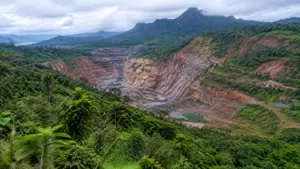
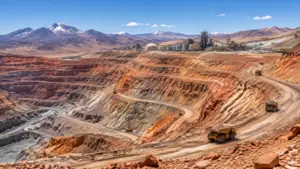
Autonomous haul trucks are moving from controlled pilots into larger commercial fleets.

By Penny Langford
EACON’s ORCASTRA autonomous haulage system has now been deployed on more than 1,500 battery-electric mining trucks, marking a significant shift in the scale of autonomous mining technology 2026.
Battery-electric vehicles account for about 42% of EACON’s autonomous fleet, making them the company’s largest powertrain category. The fleet has grown from approximately 800 trucks in March to more than 1,500, an increase of nearly 88% in less than six months.
Across all powertrains and original equipment manufacturers, EACON says its autonomous technology is now deployed on more than 3,500 mining trucks globally. The figures are company-reported, but they point to a wider change in how mining companies are evaluating autonomy: not as a demonstration project, but as an operating system for large-scale material movement.
The shift is particularly relevant to copper, iron ore, coal, gold and critical-minerals operations, where haulage represents a substantial share of energy use, operating cost and worker exposure to mobile-equipment risks.

Why the 1,500-truck milestone matters
Battery-electric haulage has often been discussed as an infrastructure challenge. Mines need sufficient grid capacity, charging stations, electrical distribution and maintenance capabilities before replacing diesel trucks at scale.
Autonomy adds another layer. Fleet software must account for battery state of charge, route length, gradients, payload, traffic, charger availability and production priorities. A truck that reaches a charging bay at the wrong point in its cycle can create delays across the entire haulage system.
EACON’s ORCASTRA platform is designed to link autonomous driving with dispatch and energy management. The system can coordinate vehicle movements, charging schedules and production tasks while integrating trucks from different manufacturers and powertrain categories.
That OEM-agnostic approach is important for existing mines. Most operators will not replace an entire fleet at once. They are more likely to introduce battery-electric and autonomous trucks alongside diesel, hybrid-electric and manually operated equipment.
EACON’s earlier deployments illustrate the operating model. At CHN Energy’s Zhundong Open-Pit Coal Mine, 120 battery-electric trucks operate with 28 charging points. At Zijin Mining’s Julong Copper Mine, 60 battery-electric autonomous trucks are operating at high altitude, where cold temperatures, snow and freeze-thaw conditions create additional demands on equipment and energy management.
The company has also reported regenerative-braking benefits at Shougang Group’s Shuichang Iron Ore Mine, where autonomous haulage moved more than 11 million tonnes and recovered approximately 386,000 kilowatt-hours of energy through braking.
These examples do not establish that every mine will achieve the same results. They do show that the critical engineering question is becoming more specific: can autonomy make electric haulage predictable enough to support continuous production?
Autonomy is becoming an energy-management system
The most important change in autonomous electric haulage is not simply the removal of the driver. It is the ability to coordinate thousands of operating decisions across a fleet.
A manually operated truck may vary its speed, braking pattern and route selection according to the driver. Autonomous control can produce more consistent driving behaviour, which may improve the predictability of energy consumption. Regenerative braking can also recover energy during deceleration and downhill travel.
That predictability gives mine planners a stronger basis for scheduling charging. However, the system still depends on the physical characteristics of the mine. Steep ramps, heavy payloads, poor road conditions, extreme temperatures and long haul distances can materially change energy requirements.
Charging therefore needs to be treated as part of the production schedule rather than as a separate electrical-services function. Operators will need to monitor queue time, charger utilization, peak demand, reserve state of charge and the impact of charging on tonnes moved per hour.

Control rooms increasingly combine fleet, safety, energy and production information.
Epiroc extends autonomy across the mine portal
While EACON’s latest scale milestone is concentrated mainly in surface haulage, Epiroc is addressing a different operational boundary: the transition between underground and surface mining.
Epiroc’s Deep Automation platform uses 3D LiDAR-based localization, mapping and obstacle detection to support autonomous truck operations beyond underground workings. The objective is to allow a truck to travel from underground loading areas to surface dumping locations without requiring an operator to take control at the portal.
Portals are difficult transition zones. They can combine steep gradients, changing light conditions, service vehicles, pedestrians, fixed infrastructure and inconsistent satellite coverage. A handover between underground and surface systems introduces another operational dependency.
A continuous control architecture could reduce that break in the haul cycle. Epiroc has demonstrated an autonomous battery-electric truck detecting obstacles on a surface route and stopping automatically. The technology remains distinct from EACON’s large surface fleet deployments, and Epiroc has not published equivalent commercial deployment figures for this specific underground-to-surface capability.
The implication for mine planners is broader than the sensor package. Autonomous underground-to-surface operations require consistent road geometry, well-defined exclusion zones, reliable communications and clear rules for mixed traffic.
Three-dimensional perception may improve localization in environments where GPS is unavailable or unreliable, but it does not eliminate the need for disciplined road maintenance and traffic management.

Underground-to-surface autonomy must account for changing geometry, lighting and traffic conditions.
Linkable data table: autonomous haulage indicators
The following table separates reported deployment figures from the operating requirements that mine owners must evaluate.
| Indicator | Reported position | Why it matters |
|---|---|---|
| EACON battery-electric autonomous trucks | More than 1,500 | Indicates that electric autonomy is moving beyond isolated pilot fleets |
| Battery-electric share of EACON autonomous fleet | About 42% | Makes battery-electric vehicles the largest reported powertrain category |
| Battery-electric fleet in March | About 800 trucks | Provides a baseline for measuring the pace of deployment |
| EACON autonomous fleet across powertrains | More than 3,500 trucks | Shows the scale of the company’s OEM-agnostic haulage base |
| Zhundong battery-electric fleet | 120 trucks | Demonstrates large-fleet charging coordination |
| Zhundong charging points | 28 | Highlights the infrastructure-to-fleet planning challenge |
| Julong copper operation | 60 battery-electric autonomous trucks | Shows deployment in a high-altitude copper environment |
| Epiroc 3D LiDAR capability | Underground-to-surface demonstration | Extends the potential operating boundary beyond underground haulage |
Figures are company-reported or based on public demonstrations. They are not directly comparable measures of commercial availability or productivity.
What operators should measure
The scale of deployment makes it possible to move the discussion from technical capability to operating performance. Mine owners considering autonomous mining technology 2026 should focus on several metrics.
Productivity: tonnes per operating hour, cycle-time variation, queueing at loading and dumping points, and idle time provide a clearer picture than the number of autonomous trucks alone.
Availability: autonomous fleet availability should be separated from charger availability, network outages, loading-equipment delays and maintenance downtime.
Energy: state-of-charge accuracy, energy consumed per tonne, regenerative-braking recovery, peak electricity demand and charging queue time should be tracked by route and operating condition.
Safety: intervention frequency, emergency stops, unauthorized-entry events and interactions with manual vehicles are important indicators of system maturity.
Infrastructure resilience: communications coverage, sensor degradation, charger redundancy and recovery procedures during grid interruptions can determine whether a fleet remains productive during abnormal conditions.

Sensor protection, calibration and maintenance are central to reliable autonomous perception.
Base, bull and bear framework
| Scenario | Operating assumptions | Likely outcome |
|---|---|---|
| Base case | Operators expand autonomy through phased deployments, beginning with repeatable haul routes and controlled operating zones | Electric and autonomous trucks grow in large mines, but mixed fleets, remote supervision and manual intervention remain common |
| Bull case | Charging, fleet software, 3D perception, digital twins and safety systems become interoperable across mine functions | Autonomous haulage expands into integrated underground-to-surface operations, with higher utilization and lower exposure to high-risk mobile-equipment areas |
| Bear case | Grid constraints, poor network coverage, cybersecurity incidents, workforce resistance or weak project economics limit expansion | Autonomy remains concentrated in selected haulage routes and demonstration sites, while mines delay broader electrification |
The base case is the most credible near-term outcome. Mining companies rarely move directly from conventional fleets to fully autonomous operations. Adoption is more likely to proceed through staged deployment, with operators building experience in charging, traffic control, remote supervision and maintenance before expanding across the mine.
The next test is mine-wide integration
EACON’s 1,500-truck battery-electric milestone shows that autonomous haulage can reach industrial scale. Epiroc’s 3D LiDAR work points toward the next challenge: maintaining autonomy as equipment moves between different mine environments.
That transition will matter for copper and critical-minerals producers seeking to increase output while managing energy costs and worker exposure. It will also increase demand for the supporting technology stack, including communications networks, power electronics, charging infrastructure, sensors, control software and high-voltage maintenance expertise.
The economic case will depend on the total system rather than the truck alone. Capital spending may shift from diesel fuel and conventional maintenance toward electrical distribution, chargers, batteries, network infrastructure and specialist technicians.
For investors, equipment suppliers and policymakers, the deployment figures offer a useful framework. The relevant question is no longer whether an autonomous truck can complete a controlled journey. It is whether an entire mine can maintain safe, productive and energy-efficient operations when hundreds of connected vehicles share the same system.
EACON’s reported fleet growth suggests that autonomous battery-electric haulage is moving into a new phase of commercial deployment. Epiroc’s underground-to-surface work shows how that technology may expand beyond defined open-pit routes.
The operators most likely to benefit will be those that treat autonomy as an integrated redesign of mine planning, energy management and workforce organization: not as a software upgrade added to existing equipment.
Sources and further reading
- EACON: Autonomous solution deployed on more than 1,500 battery-electric mining trucks
- EACON autonomous haulage solutions
- Epiroc Deep Automation
- Skillings Mining Intelligence: Autonomous mining technology and electric haulage
- Skillings mining technology coverage
- Skillings critical-minerals supply-chain analysis
Social snippets
LinkedIn: Autonomous haulage is moving from pilot projects to industrial deployment. EACON reports more than 1,500 battery-electric mining trucks using its ORCASTRA system, while Epiroc is extending underground truck autonomy onto surface roads with 3D LiDAR. The next test is mine-wide integration: charging, network resilience, mixed-traffic control and uptime.
X: EACON reports >1,500 battery-electric mining trucks using its autonomous system. Epiroc is extending underground-to-surface truck autonomy with 3D LiDAR. The next test is operational: charging, communications, safety controls and productive uptime.