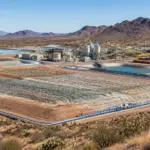
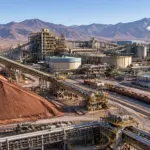
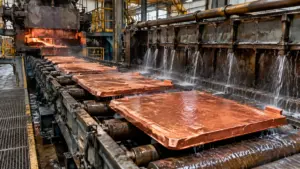
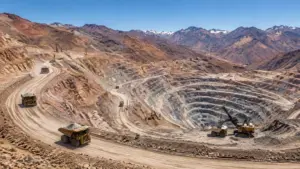
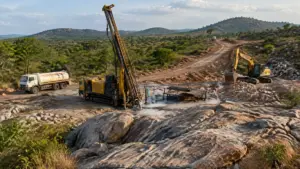
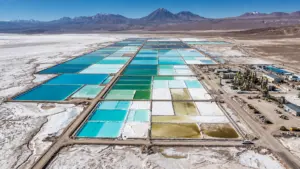
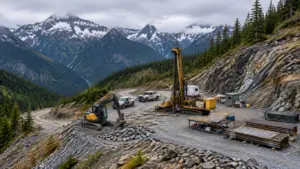
European critical raw materials processing and logistics facility.

By Salini Krishnan
The European Union plans to create a corporation to aggregate demand, purchase and stockpile critical raw materials used in batteries, semiconductors, clean technologies and defence, European Commission President Ursula von der Leyen said in her State of the Union address.
The proposal, however, remains politically defined but institutionally unfinished. As of Sept. 17, it has no defined budget, legal structure, leadership or official start date. That uncertainty is central to what the announcement means for miners, processors and investors: until the EU determines how the corporation will buy, finance and release materials, it is a demand signal rather than an operating market participant.
The initiative is designed to reduce the bloc’s reliance on China, which dominates large portions of global critical-minerals processing and has tightened export controls on rare earths, gallium and germanium. It would also give European industry a common purchasing mechanism at a time when governments are treating supply security as a strategic and defence issue.
MLex reported that von der Leyen presented the corporation as part of a broader response to the EU’s growing trade imbalance with China. Reuters has separately reported on EU plans to build a first joint stockpile focused on materials including tungsten, rare earths and gallium.

Three EU instruments, three different stages
The proposed corporation should not be confused with the European Critical Raw Materials Centre, which the Commission has been developing under its RESourceEU action plan, or with a separate parliamentary pilot for joint purchasing and stockpiling.
| EU instrument | Status | Intended scope | Funding or implementation gap |
|---|---|---|---|
| European Corporation on Critical Raw Materials | Announced by von der Leyen; operating model not defined | Aggregate demand, purchase and stockpile materials for batteries, chips, clean technology and defence | No defined budget, legal structure, leadership or start date |
| European Critical Raw Materials Centre | Commission plans legislative instruments and operations under the 2026 work programme | Market intelligence, project monitoring, joint purchasing, demand-supply matching and strategic stockpiles | Mandate and legal tools still require formalisation; dedicated funding remains unclear |
| ITRE €3 million joint purchasing pilot | Parliamentary pilot backed by the Industry, Research and Energy Committee; planned as a separate 2027 project | Test joint EU purchasing and stockpiling arrangements at limited scale | Pilot funding is not equivalent to the capital required for permanent EU-wide procurement and storage |
The Centre is described in European Parliament legislative tracking as a body that would develop market intelligence, facilitate strategic stocks and undertake joint purchasing operations.
More Read
That makes it an institutional predecessor or parallel mechanism to the proposed corporation, but not the same entity. The €3 million ITRE-backed pilot is also distinct. It is intended to test procedures and governance, while the corporation would require a much broader mandate if it is to buy materials at a scale meaningful to European manufacturers.
Why the announcement matters for operators
For mining companies, the most significant potential change is not simply the creation of another EU institution. It is the possibility of a single, coordinated European buyer.
European projects often face difficulties securing bankable offtake agreements because demand is fragmented across automakers, chemical companies, defence contractors, electronics manufacturers and national governments. A central buyer could consolidate that demand and offer longer-term purchase commitments.
That could affect:
- Offtake structures: A project might negotiate with an EU-level entity rather than several separate industrial customers.
- Price discovery: Aggregated procurement could create more transparent reference prices for materials that are often traded through private contracts.
- Financing terms: A credible, funded buyer could improve revenue visibility for projects that struggle to reach financial close.
- Inventory management: Producers and processors could gain access to a public stockpile as a buffer against supply disruption or sudden export restrictions.
- Project selection: EU procurement criteria could favour projects with European processing, traceable supply chains or lower environmental footprints.
The effect would depend heavily on whether the corporation buys concentrates, refined products, recycled materials or strategic components. A buyer focused only on refined oxides or metals would have a different impact from one willing to support upstream mining through prepayments, floor-price agreements or long-term offtake contracts.

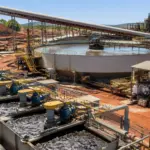
Hydrometallurgical processing infrastructure for critical raw materials.
The legal form will determine the market impact
The EU has several possible models available. The corporation could be established as a public agency, a commercially operated purchasing vehicle, a special-purpose entity backed by member states or a structure connected to the European Investment Bank and existing EU programmes.
Each model would carry different implications.
A public agency might have stronger policy authority but limited commercial flexibility. A purchasing company could negotiate contracts more efficiently but would need clear rules on state aid, competition and the allocation of losses. A financing vehicle could support projects without becoming the sole buyer, but that would make its impact on physical markets less direct.
The legal form will also determine who bears the risk if stockpiled materials decline in value. Strategic inventories can provide insurance against supply disruption, but they require storage, quality controls, rotation policies and rules for release. Those decisions are particularly important for materials whose specifications vary by end use.
The European Parliament’s work on the Centre points to a system that could connect public stockpiles with private inventories and coordinate purchases among member states. That framework could eventually provide the operating architecture for the corporation, but the two initiatives remain separate in the current policy discussion.
A response to a widening supply-security gap
The proposal comes as governments in the United States, China and Europe compete to secure supply chains for critical minerals.
The United States has expanded financing through the Pentagon, including conditional loan commitments of roughly $4.9 billion through August 2026 for projects linked to strategic materials. China, meanwhile, has tightened controls on rare earths and gallium and germanium, reinforcing concerns among Western governments about concentrated processing capacity.
Europe’s dependence is especially pronounced in refining and intermediate products. The EU’s response has included strategic partnerships, permitting reforms, recycling requirements and efforts to build domestic processing capacity. A common purchasing and stockpiling body would add a demand-management tool to that policy mix.
The approach is anchored by the Critical Raw Materials Act, which sets 2030 benchmarks for strategic raw materials:
- At least 10% of annual EU consumption from extraction within the bloc.
- At least 40% from processing within the bloc.
- At least 25% from recycling.
- No more than 65% of annual consumption from a single third country.
These are capacity and diversification benchmarks rather than guaranteed purchase volumes. The proposed corporation could make them more consequential if it converts the policy objectives into contracts for European output.
What miners should watch next
For operators and developers, the next signals will be more important than the announcement itself.
First, the EU will need to specify which commodities qualify for procurement and stockpiling. Rare earths, tungsten, gallium and germanium have appeared in earlier reporting, but the final list could also include graphite, magnesium, lithium, cobalt or recycled feedstocks.
Second, policymakers must clarify whether the corporation will buy material directly or simply match buyers and suppliers. Direct purchasing would create a more powerful demand signal but expose the EU to inventory and price risk. A matchmaking or guarantee model would be less financially intensive but may have a smaller effect on project financing.
Third, the relationship with member states will matter. National stockpiles, private inventories and EU-level reserves could compete for the same material unless the rules on ownership, storage and release are clear.
Fourth, operators will need to understand eligibility requirements. The EU may impose standards on origin, environmental performance, processing location, labour conditions or supply-chain transparency. Those requirements could favour projects that integrate mining, refining and recycling within trusted jurisdictions.

Palletised critical mineral materials prepared for industrial logistics.
Demand signal or announcement?
The proposed corporation has the potential to change how European critical-minerals projects secure customers and capital. A properly funded buyer with a clear mandate could support long-term offtake, improve market visibility and help European processors compete with established supply chains in Asia.
But the announcement does not yet establish those conditions.
Without a budget, legal structure, leadership and start date, the corporation cannot currently sign contracts, hold inventory or provide a financing commitment. The €3 million parliamentary pilot may help test procurement and stockpiling procedures, while the Critical Raw Materials Centre could supply market intelligence and coordination. Neither, on its own, would represent the scale needed to reshape global supply chains.
For miners, the immediate conclusion is therefore measured: the EU has signalled that it wants to become a more active participant in critical-minerals markets, but the commercial consequences will depend on the institutional details still to be negotiated.
The decisive question is not whether Europe intends to buy critical raw materials. It is how much, from whom, under what rules and with whose balance sheet.