By Penny Langford

The U.S. Bureau of Industry and Security’s black mass rule took effect on Aug. 27, requiring U.S. persons to allocate 100% of monthly sales of covered black mass to U.S. buyers and keep the material physically inside the country.
The measure, issued under the Defense Priorities and Allocations System, functions as a de facto export ban on shredded lithium-ion battery scrap containing cathode, anode or other residual cell materials. It also covers tungsten waste and scrap. The directive runs through Aug. 27, 2027, unless BIS extends or adjusts it.
The policy arrives as the United States tries to reduce exposure to China, which dominates large parts of global lithium, nickel, cobalt and rare earth refining. For years, U.S. recyclers have relied on overseas hydrometallurgical processors, particularly in Asia, to convert black mass into battery-grade chemicals.
The new rule changes that commercial model immediately. It is designed to force domestic recovery of lithium, nickel, cobalt, copper and manganese, but it also exposes a critical weakness: the United States can produce black mass faster than it can refine it.
U.S. black mass policy reference points
| Instrument or development | Effective date | Scope | Allocation requirement | Exception mechanism | Sunset or status |
|---|---|---|---|---|---|
| BIS Temporary Final Rule and Directive Allocation Order | Aug. 27, 2026 | Black mass in covered electrical and electronic waste; tungsten waste and scrap | U.S. persons must allocate 100% of monthly sales to U.S. persons | Company-specific or generally applicable adjustments, exceptions and interim relief | Through Aug. 27, 2027, unless extended or adjusted |
| Black mass definition | Aug. 27, 2026 | Shredded lithium-ion battery scrap containing cathode, anode or residual cell materials | Material must remain physically in the United States unless authorized | Tolling may be permitted when refined material returns to the United States | Subject to the directive |
| Tolling pathway | Aug. 27, 2026 | Export for processing or refining outside the United States | Requires prior BIS relief; refined output must return to the United States | Case-by-case adjustment or exception; BIS says it intends to respond within 14 days | Available during the rule period |
| Pentagon critical-minerals financing | Through August 2026 | Batteries, rare earths, magnets and other strategic materials | Not an allocation order; supports domestic and allied capacity | Conditional loans and strategic capital commitments | Ongoing |
| Pentagon conditional loan commitments | By August 2026 | Critical minerals and advanced materials | Not applicable | Approximately US$4.9 billion in conditional commitments | Ongoing |
| Brazil’s critical-minerals law | 2026 | Mining, processing and transformation of critical and strategic minerals | Domestic processing is the central policy objective | R$2 billion guarantee fund and up to R$5 billion in processing tax credits | Tax credits spread across 2030–2034 |
| European critical raw-materials framework | 2026 proposal and implementation work | Primary and secondary critical raw materials | Joint purchasing and strategic stockpiling | Proposed European Critical Raw Materials Centre and related platforms | Legislative process under way |
BIS describes the rule as a response to inadequate supplies of recoverable critical minerals and materials considered essential to national defense. Legal analyses by Pillsbury, Davis Wright Tremaine and Beveridge & Diamond have emphasized that the order affects recyclers, scrap dealers, battery manufacturers, e-waste collectors and companies with foreign affiliates.

Reuters reported that the administration views the restriction as a way to boost domestic recycling and reduce reliance on overseas processing.
The recycling capacity gap
The rule is supply-side policy as much as trade policy. It does not simply determine where black mass can be sold. It attempts to reshape where the United States performs the chemical work that turns battery scrap into usable materials.

That distinction matters because shredding and refining are separate stages. A recycler can mechanically process batteries, separate plastics, steel and copper, and produce a concentrated black powder. But the black mass still requires leaching, impurity removal, solvent extraction, precipitation and crystallization before it becomes lithium carbonate, nickel sulfate, cobalt sulfate or other battery-grade products.
One 2026 analysis cited by the Union of Concerned Scientists estimates North American black mass refining capacity at roughly 7,000 metric tons per year, compared with approximately 65,000 metric tons of feedstock requiring processing. Other estimates use broader definitions and place U.S. battery-scrap processing capacity much higher, but still show a substantial difference between pre-processing and finished-material recovery.
That gap is the immediate pressure point. Without enough domestic offtake, recyclers have three main choices:
- Sell to a U.S. refiner with available capacity.
- Seek a BIS exception for offshore tolling and document the return of refined material.
- Store the black mass while waiting for capacity, authorization or a change in policy.
Storage is not a frictionless alternative. Black mass may be subject to hazardous-material, environmental and fire-safety requirements. As Bergeson & Campbell noted, the BIS rule intersects with existing RCRA, TSCA and permitting questions.
The result is a policy paradox: a measure intended to increase mineral recovery could initially produce more inventory than recovered product if domestic hydrometallurgical capacity does not expand quickly.

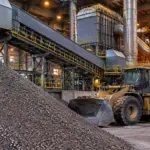
Shredded battery material moves through a sealed recycling and separation line.
Chemistry matters more than the headline tonnage
Black mass is not a uniform commodity. Its commercial value depends heavily on battery chemistry, assay, contamination levels and recovery rates.
For NMC-rich material, market analysis commonly uses indicative ranges of approximately 15%–25% lithium, 15%–25% nickel and 10%–20% cobalt, although actual assays can vary significantly by cell design, feedstock and processing losses. These metals are why NMC black mass is economically important rather than ordinary waste.
NMC chemistry can also contain copper, manganese, graphite and aluminum. A refinery able to recover several of these streams can produce a more valuable output and spread its fixed costs across multiple products.
LFP chemistry presents a different problem. Lithium iron phosphate batteries contain no nickel or cobalt, so their recovery economics depend primarily on lithium, phosphate, iron and graphite. Lithium recovery efficiency, feedstock scale, processing costs and potential gate fees become more important than high-value cobalt or nickel credits.
That chemistry split will influence which material receives priority at domestic plants. NMC-rich black mass may attract stronger competition among refiners because of its contained nickel and cobalt. LFP black mass may require long-term contracts, regulatory incentives or integrated processing models to support recovery.

Battery-recycling feedstocks vary materially by chemistry and contained metals.
What the rule changes for miners
For miners, the most important change is that recycled units now compete directly with primary units inside the U.S. supply chain.
A domestic refinery that previously depended on imported intermediates or primary concentrates may now seek black mass as a local feedstock. That creates a new domestic concentrate market, with pricing influenced by metal content, recovery rates, impurity penalties, logistics and the availability of alternative outlets.
The effect will not be uniform across commodities:
- Nickel: NMC recycling can displace some demand for primary nickel units if refined recycled nickel reaches battery-grade specifications.
- Cobalt: Cobalt-bearing black mass may become strategically valuable because recycled supply can reduce exposure to concentrated mined and refined supply chains.
- Lithium: Recycled lithium will compete with brine and hard-rock supply, although recovery economics are more sensitive to chemistry and processing costs.
- Copper: Copper recovered from battery scrap adds a secondary source, but the rule does not make recycled copper a substitute for all primary copper demand.
- Manganese and graphite: Their commercial impact will depend on whether domestic processors can recover and sell them as specification-grade products rather than treating them as low-value by-products.
This does not mean recycled supply will eliminate the need for mines. Battery demand is still expected to grow, and recycling feedstock depends on the volume and chemistry of end-of-life batteries and manufacturing scrap. Instead, the policy changes the competition for incremental U.S. demand.
A mine with reliable primary concentrate may face a different market from a refinery seeking secure black mass. The key question becomes less “how much material exists?” and more “which feedstock can be processed domestically at the required specification and cost?”
Base, bull and bear framework
The following framework focuses on battery-recycling feedstock availability and its potential effect on primary nickel, cobalt and lithium demand.
| Scenario | Feedstock and capacity outlook | Likely effect on recycled supply | Potential effect on primary demand |
|---|---|---|---|
| Base case | Domestic refining expands, but remains below available black mass through the rule period; tolling exceptions are granted selectively | Recycled output rises, but storage, logistics and chemistry constraints remain | Moderate substitution for primary nickel and cobalt; limited near-term effect on lithium |
| Bull case | New U.S. hydrometallurgical plants commission on schedule, domestic offtake strengthens and BIS supports compliant tolling | Higher recovery of NMC metals and more reliable domestic supply of battery-grade products | Stronger displacement of marginal primary nickel and cobalt demand; lithium substitution increases as LFP recycling improves |
| Bear case | Refinery commissioning slips, exceptions are slow or narrow, and LFP volumes grow faster than high-value NMC feedstock | Black mass accumulates, costs rise and some material is diverted to lower-value handling or disposal | Little near-term reduction in primary demand; miners retain the advantage where recycled material cannot meet specifications |
The base case is the most practical starting point. The rule creates a strong policy signal, but a one-year directive is shorter than the normal timeline for permitting, financing, construction and commissioning of a hydrometallurgical plant.
The broader policy response is moving in the same direction. The Pentagon’s conditional critical-minerals commitments reached roughly US$4.9 billion by August, according to reporting on the Office of Strategic Capital. Brazil’s critical-minerals framework combines a R$2 billion guarantee fund with up to R$5 billion in processing tax credits. In Europe, the Commission has proposed a European Critical Raw Materials Centre to support joint purchasing, market intelligence and stockpiling.
Together, these measures show governments competing not only for mineral deposits but also for processing capacity and secondary feedstock.

Hydrometallurgical equipment converts black mass into separated chemical products.
What to watch next
The policy’s effect will be determined by implementation rather than the headline ban. Mining companies, recyclers, investors and policymakers should track four indicators:
- BIS exception decisions: The number, timing and conditions of tolling approvals will show how much offshore processing remains available through the pressure valve.
- Domestic hydrometallurgical capacity: Announced nameplate capacity matters less than commissioning dates, qualification with customers and sustained operating rates.
- Tolling volumes and return flows: Exported material processed abroad must return to the United States under the exception pathway. Chain-of-custody data will be central.
- The sunset decision: BIS may extend, adjust or replace the directive after Aug. 27, 2027. An extension would strengthen the case for domestic refining but could increase pressure on capacity-constrained recyclers.
The U.S. black mass rule is therefore more than an export restriction. It is an attempt to turn battery recycling into a domestic critical-minerals supply system. Its success will depend on whether policy can move as quickly as the material it is trying to retain.
LinkedIn snippet
The U.S. black mass export ban is designed to keep lithium, nickel, cobalt, copper and manganese inside domestic supply chains: but the country still has far more shredding capacity than hydrometallurgical refining capacity. Our analysis examines the tolling exception, NMC versus LFP economics, the new domestic concentrate market and the base/bull/bear outlook for recycled battery metals.
X snippet
The U.S. black mass rule forces 100% domestic allocation of covered battery scrap through Aug. 27, 2027. The policy strengthens domestic refiners: but exposes a major gap between black mass production and hydrometallurgical capacity. Analysis: tolling, chemistry, miners and recycled metal demand.