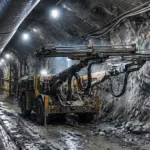
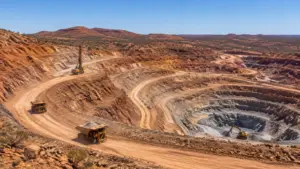
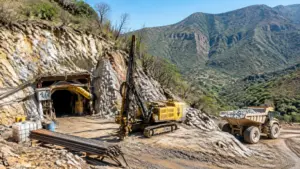
Mid-size haul truck operating on a Virginia-style aggregates quarry road.

By Penny Langford
Caterpillar is expanding autonomous haulage beyond large open-pit mines and onto the Cat 775, a key truck for the aggregates sector, as Luck Stone prepares to deploy the technology at two additional Virginia quarries.
The expansion to Luck Stone’s Boscobel and Bealeton operations follows more than 18 months of autonomous hauling at the company’s Bull Run Quarry. Since going live in November 2024, autonomous trucks have hauled more than 3.5 million tons of material at Bull Run, according to information reported by International Mining and Caterpillar.
The new deployments will be delivered with support from Cat dealer Carter Machinery and will use Caterpillar’s MineStar Command for hauling. They represent the first deployment of Caterpillar’s autonomous haulage solution on the Cat 775 model.
The move matters because quarry operations differ materially from the very large, highly controlled open-pit mines where autonomous trucks have traditionally gained traction. Quarries generally have tighter haul roads, shorter cycles, more frequent interaction with loaders and service vehicles, and greater variation in site layout.

Caterpillar and Luck Stone are therefore testing whether autonomy can be adapted to a wider section of the aggregates market, where smaller fleets and more constrained operating environments have historically made automation harder to justify.
From Bull Run to Boscobel and Bealeton
Bull Run provided the operating reference case for the expansion. Luck Stone initially used autonomous Cat 777 trucks at the Chantilly, Virginia, quarry, establishing a production operation rather than a limited technology demonstration.
More Read

The reported 3.5 million tons hauled autonomously gives the companies a substantial operating record across loading, hauling, dumping, traffic management and remote supervision. It also provides data on how workers interact with an autonomous fleet during maintenance, site changes and routine production.
Boscobel and Bealeton will extend that experience to Cat 775 trucks. The model is smaller than the Cat 777 and is widely used in quarry and aggregates applications, making the deployment relevant to operators that do not run the ultra-class fleets common at major copper, iron ore or gold mines.
Caterpillar said its autonomous trucks have now hauled more than 13 billion tonnes and travelled over 455 million kilometres without a reported injury while operating autonomously. Those figures reflect Caterpillar’s broader global autonomous haulage fleet rather than the Luck Stone program alone.
| Deployment | Equipment or system | Reported milestone | Significance |
|---|---|---|---|
| Bull Run Quarry | Autonomous Cat 777 trucks | More than 3.5 million tons hauled | Production reference case for quarry autonomy |
| Boscobel and Bealeton | Cat 775 trucks with MineStar Command | New deployment | First Caterpillar autonomous application on the Cat 775 |
| Caterpillar global fleet | Autonomous haulage trucks | More than 13 billion tonnes hauled | Scale of the company’s wider autonomy experience |
| Caterpillar global fleet | Autonomous haulage trucks | More than 455 million kilometres travelled | Operating history across customer sites |
Figures are company-reported or based on industry reporting.
Why quarry autonomy is a different test
Autonomous haulage is often associated with large mines, where wide roads, long truck cycles and dedicated operating zones can make the technology easier to implement.
Aggregates sites present a different set of conditions. Haul roads may be narrower, benches may be closer together and the distance between loading and dumping points may change frequently. Light vehicles, maintenance equipment and manually operated machines can also be more common within the same working area.
That means the technology must manage more than vehicle movement. It must fit into a production system that includes:
- Clear traffic-control rules for autonomous and manually operated equipment.
- Reliable positioning and communications across changing quarry layouts.
- Defined interaction protocols between trucks, loaders and service vehicles.
- Consistent berms, road surfaces and haul-road geometry.
- Procedures for blasting, maintenance, recovery and emergency intervention.
- Remote supervision and rapid response when the system identifies an exception.
The Cat 775 deployment will test whether those requirements can be met without imposing infrastructure or operating costs that outweigh the productivity and safety benefits.

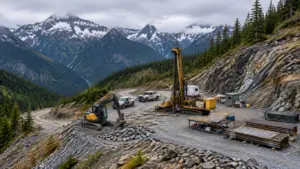
Quarry-scale autonomy must operate within tighter roads and more compact working areas.
Workforce transition moves to the centre
The workforce impact is likely to be one of the most important parts of the Luck Stone program.
Autonomous haulage does not eliminate the need for people. It changes the skills required around the fleet. Traditional haul-truck operators may move into remote supervision, dispatch coordination, equipment diagnostics, data monitoring or safety-control roles. Maintenance teams may require additional training in sensors, machine-control systems, communications networks and software-enabled troubleshooting.
The transition can be more complex in a quarry than in a large mine because employees often perform multiple operational tasks. A successful deployment therefore depends on training plans that are designed around the existing workforce rather than treating autonomy as a stand-alone equipment purchase.
Relevant skills may include:
- Remote fleet monitoring and intervention management.
- Autonomous-system inspection and fault reporting.
- Digital dispatch and production analytics.
- Sensor cleaning, calibration and replacement.
- High-voltage and electronic systems maintenance.
- Cybersecurity and communications-network awareness.
- New procedures for mixed autonomous and manual traffic.
For quarry operators, retraining can also help address a broader labour challenge. Recruiting and retaining workers for repetitive, high-exposure mobile-equipment roles is difficult in many mining and aggregates markets. Moving some work into control-room, maintenance and technology positions may create a more diverse range of career paths.
The transition still carries costs. Workers need time to build confidence in the technology, supervisors must learn new operating procedures and companies must define responsibility when a human operator, remote supervisor or automated system makes a decision.
The equipment-maker market read
The immediate commercial opportunity for Caterpillar is not limited to selling another truck model. The Cat 775 deployment gives the company a chance to extend MineStar Command, fleet-management software, site integration and dealer support into a much larger pool of quarry operations.
The aggregates market is fragmented compared with the largest global mining fleets. That can make technology rollouts more difficult, but it also creates an opportunity for repeatable systems that can be adapted across multiple sites.
Carter Machinery’s role is important in that respect. Local dealer support can determine whether autonomy remains a demonstration or becomes a maintainable production system. Dealers may be responsible for installation, commissioning, operator training, service coordination and the integration of autonomous trucks with existing quarry equipment.
The supplier opportunity also extends beyond the truck manufacturer. Autonomous quarry fleets require a supporting technology stack that may include:
- Fleet-management and dispatch software.
- Precision positioning and machine-control systems.
- Cameras, radar, lidar or other perception technologies.
- Private wireless and site communications infrastructure.
- Remote operations centres.
- Digital maintenance and equipment-health platforms.
- Safety systems for exclusion zones and mixed traffic.
- Workforce training and systems integration.
That creates a competitive question for equipment makers and autonomy suppliers: can they offer a complete operating platform, or will customers have to assemble and maintain multiple systems from different vendors?
Caterpillar’s installed equipment base and dealer network are potential advantages. Independent autonomy suppliers may compete by offering greater interoperability across mixed fleets. The balance between those models will become clearer as quarry operators move from individual pilots to multi-site deployments.
This is not a case for a simple winner-takes-all view. The market is likely to develop around the companies that can prove uptime, safety, integration and support under ordinary production conditions.
What the expansion says about autonomous mining technology in 2026
The Luck Stone program reflects a broader shift in autonomous mining technology in 2026. The industry is moving from asking whether autonomous trucks can operate to asking where the technology produces a repeatable operating and financial benefit.
The most important measures will include:
- Autonomous availability: How often trucks remain available for production after accounting for network, software, sensor and intervention downtime.
- Cycle consistency: Whether automation reduces variation in loading, hauling, dumping and queuing.
- Tonnes per operating hour: The production result after infrastructure and intervention requirements are included.
- Safety performance: The frequency of emergency stops, system interventions and interactions with manually operated equipment.
- Workforce productivity: Whether retraining allows employees to move into higher-value technical and supervisory roles.
- Total cost of ownership: The cost of technology, communications, training, maintenance and integration compared with conventional haulage.
- Scalability: Whether the same system can be deployed at additional quarries without rebuilding the operating model each time.
Caterpillar’s global haulage figures demonstrate the maturity of its technology at scale. The Cat 775 deployment addresses a different question: whether that experience can be transferred efficiently to smaller and more operationally variable aggregates sites.
What operators will be watching
Luck Stone’s next phase will provide a useful test of several issues that are central to quarry automation.
First, operators will want to see whether autonomy performs consistently on shorter haul cycles, where loading and dumping delays can have a greater impact on fleet utilization.
Second, they will be watching how the system behaves in mixed traffic. Most quarries will not become fully autonomous overnight. Manually operated loaders, water trucks, service vehicles and light vehicles will continue to share the site.
Third, the workforce model will be closely observed. The long-term value of autonomy will depend partly on whether quarry employees can be retrained and retained in technology-focused roles.
Finally, the projects will test the strength of the dealer-led support model. Reliable local service may be as important as the autonomy software itself, particularly for operators with smaller fleets and limited internal automation teams.

Technology inspections and workforce training remain central to autonomous fleet deployment.
Outlook
Caterpillar’s decision to put autonomous haulage on the Cat 775 marks a significant step in the expansion of automation into aggregates.
The Bull Run results provide a production-based foundation, while Boscobel and Bealeton will test the technology across additional quarry environments. If the deployments maintain safe and consistent output, they could strengthen the case for autonomous haulage among operators that have historically viewed the technology as too complex or too expensive for smaller sites.
The workforce dimension will be equally important. Autonomy is likely to reduce exposure to repetitive truck-driving tasks, but it will increase demand for remote operations, data analysis, diagnostics, digital maintenance and systems-integration skills.
For Caterpillar and competing autonomy suppliers, the opportunity is to demonstrate that quarry automation can be delivered as a reliable operating system rather than a technology showcase. The companies that connect equipment, software, dealer support and workforce transition will be best placed to capture the next phase of growth.
Related Skillings coverage: