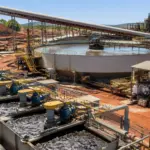
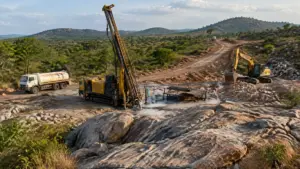
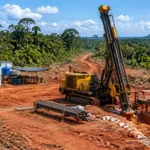
Open-pit mining operations in a rugged Newfoundland setting.

New Found Gold Corp. has reached commercial production at its Hammerdown gold mine in central Newfoundland, marking the company’s transition from an emerging developer to a producing gold company.
The milestone, effective Aug. 19, followed approximately 60 consecutive days in which the operation met or exceeded three performance benchmarks: mill throughput, gold recovery and feed grade. The results provide an early operating test for Hammerdown and give New Found Gold a producing asset as it advances the larger Queensway Gold Project.
The company’s shares trade as NFG on the TSX Venture Exchange and NFGC on the NYSE American. The development was reported by The Northern Miner on Sept. 16, 2026, following company disclosures.
Hammerdown clears the three-benchmark test
Commercial production is not simply a declaration that a mine has poured its first gold. In Hammerdown’s case, New Found Gold defined the milestone through a sustained operating test based on parameters set out in the project’s preliminary economic assessment.
The test required the operation to maintain minimum levels of throughput, recovery and grade over a continuous 60-day period.

| Operating metric | Commercial-production threshold | 60-day average |
|---|---|---|
| Mill throughput | At least 600 tonnes per day | 748 tonnes per day |
| Gold recovery | At least 80% | 87.7% |
| Feed grade | At least 80% of mine-plan head grade | 2.92 grams per tonne gold |
The throughput result is notable because the 748-tonne-per-day average exceeded the commercial threshold and was above the 700-tonne-per-day design rate referenced in the Hammerdown PEA.
Hammerdown ore is processed at the Pine Cove mill, with material transported approximately 95 kilometres by road from the mine. The mine and mill system therefore depends not only on the open-pit operation but also on the reliability of haulage, crushing, milling and recovery circuits.


The Hammerdown deposit is being mined using open-pit methods.
New Found Gold reported 9,140 ounces of gold production during the first eight months of 2026, including 1,989 ounces in August. The company said the average realized gold price during August was approximately US$4,532 per ounce.
Those figures represent a ramp-up period rather than a full year of steady-state production. New Found Gold expects Hammerdown to reach an annual production run rate of approximately 20,000 to 25,000 ounces, with an all-in sustaining cost of about US$2,500 per ounce, in line with the project’s PEA.
What commercial production changes for cash flow
The commercial-production declaration changes the financial profile of New Found Gold, but it does not eliminate the company’s capital requirements or operating risks.
As an explorer and developer, New Found Gold had primarily relied on equity financing and shareholder support to fund exploration, construction and development. Hammerdown now gives the company an operating revenue stream that could help fund corporate overhead, exploration and portions of future development work.
The company has previously said that Hammerdown cash flow is expected to support overhead and exploration costs as it advances Queensway. That creates a more diversified financing profile than the one available to a company with no producing assets.
The distinction is important for investors. Revenue from a producing mine can improve access to working-capital facilities, equipment finance and project-level funding. It may also reduce the need to fund every corporate activity through equity issuance. However, Hammerdown’s expected production remains modest compared with established intermediate and major gold producers.
At a planned 20,000 to 25,000 ounces per year, the operation will remain sensitive to:
- Gold prices and the realized price received for production.
- Grade reconciliation between the mine plan and mill feed.
- Recovery performance as processing circuits are modified.
- Fuel, labour, haulage and contractor costs.
- Sustaining capital and working-capital requirements.
- The funding needed to advance Queensway.
The approximately US$2,500-per-ounce AISC figure is a PEA-based estimate, not a guarantee of future reported costs. It also comes from a preliminary economic assessment that includes inferred mineral resources. The company’s Hammerdown technical reports and disclosure documents should be used when assessing the project’s underlying economics.

The Pine Cove mill processes ore from the Hammerdown operation.
New Found Gold has also indicated that recovery could improve toward approximately 92% following the conversion of the mill from a flotation-Merrill-Crowe circuit to a gravity-carbon-in-leach circuit. That conversion could affect future production and cost performance, but the timing, capital cost and operating results remain important variables.
Newfoundland’s gold revival gains another operating asset
Hammerdown’s commercial start adds to a broader revival in Newfoundland and Labrador’s gold sector.
The province offers established mining infrastructure, a skilled workforce, road access and a long history of mineral development. New Found Gold’s strategy has been to combine the Hammerdown deposit with the existing Pine Cove mill and tailings facilities, reducing the need to build an entirely new processing complex for the initial production phase.
The company has also emphasized local employment. In a June operating update, New Found Gold said more than 90% of new hires at Hammerdown came from Newfoundland and Labrador, with 40 new jobs created at that point.
That local operating base may become increasingly important as the company advances Queensway. The project is intended to become the company’s larger, longer-term production platform, while Hammerdown provides near-term operating experience and potential cash flow.
New Found Gold’s corporate overview describes Queensway as a district-scale project with more than 110 kilometres of strike across two prospective fault zones. The company is progressing engineering and permitting work for a planned Phase I development, subject to required approvals and financing.
The combination gives Newfoundland a new example of a staged development model: restart or repurpose existing infrastructure, establish a smaller producing operation and use the operating platform to support a larger project. Whether that model succeeds will depend on Hammerdown’s ability to maintain performance while Queensway moves through engineering, permitting and financing.

Gold production provides the first direct operating cash-flow platform for New Found Gold.
The stock lens: execution matters more than the headline
A Cramer-style reading of the announcement would likely focus on the change in status: New Found Gold is no longer only a discovery and development story. It now has production, operating metrics and a path toward recurring revenue.
A more disciplined investor lens asks whether the company can sustain the performance that triggered the declaration.
The most important indicators for New Found Gold and its peer group of emerging Canadian gold producers and near-term developers are likely to be:
| Investment lens | What to watch at New Found Gold | Principal risk |
|---|---|---|
| Production | Sustained output near 20,000–25,000 ounces annually | Ramp-up interruptions or grade variability |
| Processing | Recovery above the 80% threshold and potential improvement after mill changes | Circuit performance and commissioning delays |
| Costs | Actual AISC against the approximately US$2,500/oz PEA estimate | Inflation, fuel, contractors and sustaining capital |
| Balance sheet | Cash generation and funding available for Queensway | Continued reliance on equity or project financing |
| Growth | Queensway permitting, engineering and development progress | Delays, cost escalation or financing pressure |
Base, bull and bear framework
Base case: Hammerdown maintains throughput near its recent performance, produces within the planned 20,000–25,000-ounce range and generates a modest operating cash-flow contribution. New Found Gold continues to fund exploration and advances Queensway in stages.
Bull case: Recovery improves toward the company’s targeted 92% after the planned circuit conversion, grade reconciliation remains favourable and gold prices support stronger margins. Hammerdown then becomes a more meaningful source of internal funding while Queensway attracts project financing on improved terms.
Bear case: Feed grade falls below expectations, operating costs rise above the PEA estimate or mill modifications disrupt production. In that scenario, the company could still require additional financing for Queensway and other corporate commitments, limiting the benefit of commercial production.
The commercial-production declaration is therefore best viewed as a material de-risking event, not a blanket investment recommendation. Investors comparing New Found Gold with small-cap gold peers should place greater weight on reported cash flow, actual costs and balance-sheet strength than on resource size or exploration potential alone.
Hammerdown has cleared the first major test. The next question is whether New Found Gold can turn that milestone into consistent production, durable cash flow and a credible financing platform for Queensway.