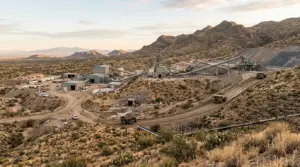
An aerial view of a Nevada gold exploration property in the Walker Lane trend.

By Charles Pitts
Lahontan Gold Corp. has agreed to acquire Emergent Metals Corp. in an all-share transaction that would give it full ownership of the West Santa Fe gold project in Nevada, remove existing royalties tied to the property and add Emergent’s New York Canyon project to its portfolio.
The transaction places another Walker Lane exploration asset under a single owner at a time when companies are increasingly using mergers, acquisitions and royalty restructuring to consolidate fragmented land positions across Nevada’s gold-silver belt.
Under the definitive arrangement agreement, Emergent shareholders will receive one Lahontan share for every 3.21 Emergent shares held. The exchange ratio implies consideration of approximately US$0.115 per Emergent share, according to company disclosures.

The deal remains subject to court, regulatory and shareholder approvals. An Emergent shareholder meeting is expected in November.

Deal terms at a glance
| Deal element | Terms |
|---|---|
| Structure | All-share acquisition through a court-approved plan of arrangement |
| Exchange ratio | One Lahontan share for every 3.21 Emergent shares |
| Implied value per Emergent share | Approximately US$0.115 |
| Assets acquired | Full ownership of West Santa Fe and the New York Canyon project in Nevada |
| Royalties eliminated | Existing royalties on West Santa Fe and the York claims |
| Required approvals | Court, regulatory and Emergent shareholder approvals |
| Expected shareholder vote timing | November 2026 |
Lahontan said the agreement will simplify its ownership of West Santa Fe, which it had been advancing through an option structure with Emergent’s U.S. subsidiary. The acquisition would remove the remaining ownership steps and give Lahontan direct control of the project.
The company’s West Santa Fe project page describes the property as a sediment-hosted epithermal gold and silver system located about 15 kilometres west of the Santa Fe Mine. Lahontan has reported shallow oxide mineralization, encouraging cyanide recovery results and a planned program aimed at supporting a maiden resource estimate.
Why royalty retirement matters
For a development-stage mining company, eliminating a royalty can have a direct effect on the future economics of a project.
A royalty is generally paid to a third party based on revenue or production, before the mine operator accounts for many of its operating costs. Retiring that obligation can increase the portion of revenue retained by the project owner on each ounce produced.
The effect is particularly important for an early-stage project because royalties can influence:
- Net revenue per ounce;
- Operating margins;
- Cut-off grades and mine planning;
- The amount of capital a project can support; and
- The attractiveness of the asset to future lenders, partners or acquirers.
In this case, Lahontan will eliminate existing royalties on West Santa Fe and the York claims as part of the broader corporate acquisition. That does not create a mine or establish economic reserves, but it removes a layer of future project obligations before the company completes its next technical work.
The value of that change will depend on the size, grade, metallurgy and mine plan eventually established at West Santa Fe. Lahontan’s project materials currently describe the asset as advancing toward a maiden resource rather than as a defined reserve-backed development project.
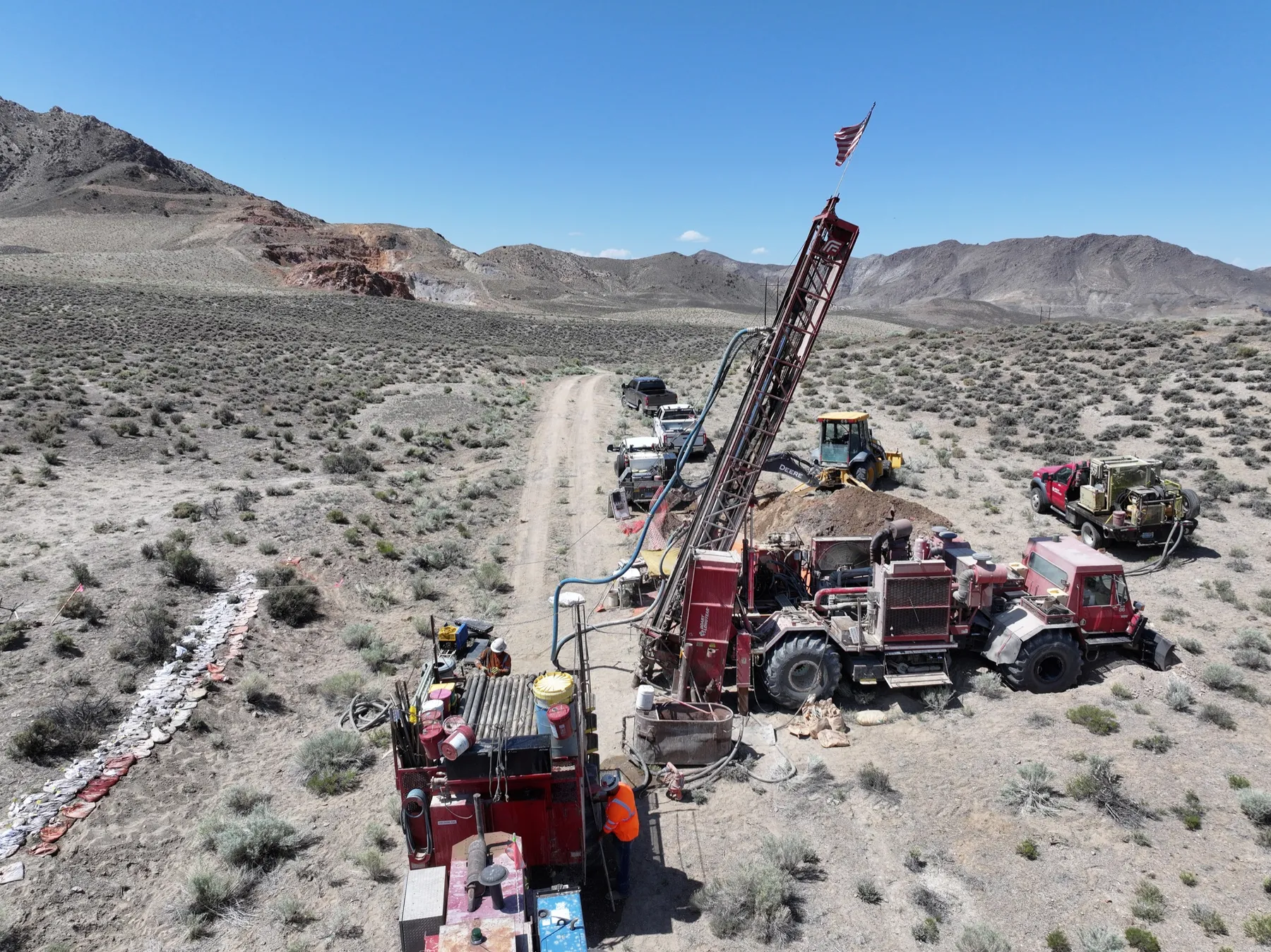
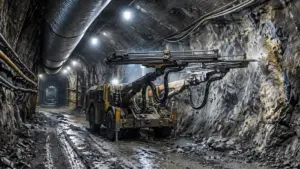
Drilling at the West Santa Fe project is focused on shallow oxide mineralization and resource growth.
Consolidating land around Santa Fe
The transaction also addresses a common issue in Nevada exploration: fragmented ownership.
Projects assembled through leases, options, royalties and adjacent claims can carry overlapping obligations and require separate permitting, environmental work, access arrangements and infrastructure planning. Bringing those interests under one owner can reduce duplication and give the operator greater flexibility when designing a future mine plan.
At West Santa Fe, the practical benefits could include:
- A single ownership structure for exploration and development decisions;
- Simpler permitting and land-management coordination;
- Greater flexibility in drill targeting and access-road planning;
- Less duplication in technical studies and environmental baseline work; and
- A clearer project package for future financing or strategic partnerships.
The project is close to Lahontan’s Santa Fe Mine and existing regional infrastructure. That proximity could eventually support shared planning for roads, power, water, processing or other services, although no development plan has yet established which infrastructure would be shared or how much capital would be required.
Land consolidation can therefore lower complexity without automatically lowering the cost of construction. The economic benefit must still be demonstrated through engineering studies and a coherent mine plan.
New York Canyon adds a copper angle
Emergent’s New York Canyon project broadens the transaction beyond gold and silver. The Nevada asset adds copper exposure to Lahontan’s portfolio as demand for energy-transition metals continues to shape exploration strategies.
The company will need to assess how New York Canyon fits alongside West Santa Fe and the Santa Fe Mine. The assets may share regional infrastructure advantages, but they are not automatically part of a single development plan. Their geological models, metallurgical characteristics, permitting requirements and capital needs would need to be evaluated separately.
For Lahontan, the acquisition creates a larger Nevada platform with exposure to both precious metals and copper. For Emergent shareholders, the consideration provides equity in a company with a consolidated West Santa Fe position rather than direct ownership of a standalone exploration company.
Emergent’s published news-release archive lists the company’s prior West Santa Fe drilling, cyanide recovery and New York Canyon updates.
Part of a broader M&A shift
The Lahontan-Emergent agreement was announced during a busy week for mining transactions and portfolio restructuring.
Elemental Royalty completed its acquisition of Vizsla Royalties, while Vizsla Copper agreed to buy Agnico Eagle’s Delta and Helm Bay projects. Krait Critical Minerals also closed its acquisition of Nevada Hills Antimony.
Those transactions differ in size, structure and commodity focus, but they reflect a broader industry preference for consolidating assets, simplifying ownership and building larger project platforms. In Nevada, where claims, royalties and historical ownership arrangements can overlap across established districts, consolidation can be as important as exploration success.
The trend is also relevant to capital markets. A larger, cleaner asset base may be easier to present to investors and potential partners, while royalty retirement can make future project economics more transparent. However, consolidation does not eliminate geological or financing risk.
As Skillings has previously reported in its coverage of mining M&A premiums and copper market pressure, transaction activity is increasingly being shaped by the quality of assets, control of future cash flow and the cost of advancing projects through permitting and construction.
What comes next
The immediate milestones are procedural. Lahontan and Emergent must secure the required court and regulatory approvals, and Emergent shareholders must vote on the arrangement. The shareholder meeting is expected in November.
The more significant tests will come afterward.
Lahontan still needs to establish a mineral resource for West Santa Fe and determine whether the project can support a viable development concept. The company’s current work program includes additional drilling and technical studies aimed at expanding the known mineralized footprint and preparing for a maiden resource estimate.
Further work will also be needed on:
- Resource definition and geological continuity;
- Metallurgical recovery across different mineralized zones;
- Mine design and potential production scale;
- Processing options for oxide and other mineralization;
- Water, power and access requirements;
- Environmental and permitting conditions; and
- Capital and operating cost estimates.
The company has reported cyanide recoveries of 81% for gold and 60% for silver from preliminary bottle-roll testing on West Santa Fe material. Those results are supportive of continued evaluation, but they do not replace a full metallurgical program or a feasibility-level study.

Core logging and geological interpretation will be central to defining the next resource stage.
Consolidation is the first step, not the final outcome
Lahontan’s acquisition of Emergent removes ownership complexity, retires royalties and adds a second Nevada project. Those changes can improve the strategic position of the combined company and increase the share of future project revenue retained by Lahontan if West Santa Fe advances into production.
But the transaction itself does not establish project economics.
The next value test will be whether the consolidated land position produces a larger, better-defined and technically workable resource. Until Lahontan publishes an updated resource estimate and completes a development study, the benefits of consolidation remain strategic rather than fully quantified.
For the Walker Lane, the deal adds to a growing pattern: exploration companies are seeking greater control over prospective ground, while investors and potential partners are placing more emphasis on ownership clarity, royalty burdens and infrastructure alignment.

Exposed mineralized terrain and access roads illustrate the exploration setting around Nevada’s Walker Lane.