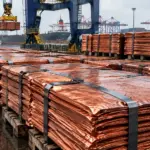
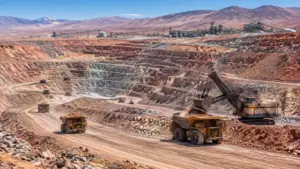
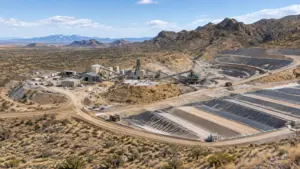
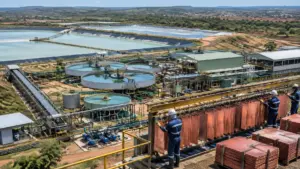
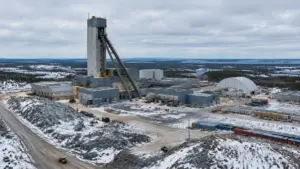
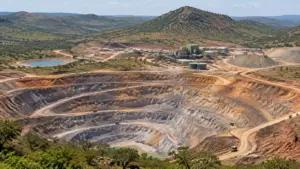
Brazilian nickel mining and ferronickel processing infrastructure.

By Penny Langford
The proposed sale of Anglo American’s Brazilian nickel business to MMG has become more than a transaction review. It is a test of whether governments can protect critical industrial supply without freezing cross-border investment in mining and processing.
The European Commission’s concerns focus on a narrow but strategically important product: low-carbon ferronickel used by stainless-steel producers. In September, Reuters reported that the Commission had issued formal objections to MMG over the proposed acquisition, arguing that the buyer could divert ferronickel away from European customers and toward affiliated stainless-steel operations.
The case matters because the wider nickel market remains well supplied, while particular forms of nickel, processing routes and customer relationships can be far more concentrated. For operators and investors, the distinction is central to the critical minerals supply-chain debate.

The transaction and the regulatory milestone
MMG agreed in February 2025 to acquire Anglo American’s Nickel Brazil business for up to $500 million. The consideration includes $350 million in upfront cash, up to $100 million linked to realised nickel prices, and up to $50 million tied to development decisions for the Jacaré and Morro Sem Boné projects, according to MMG’s transaction announcement.

The operating assets are:
- Barro Alto, an integrated mine and ferronickel operation in Goiás;
- Codemin, the Niquelândia operation in Goiás; and
- The undeveloped Jacaré and Morro Sem Boné projects.
MMG described the operating business as producing approximately 40,000 tonnes of nickel per year in ferronickel. It also highlighted the assets’ use of electricity sourced from renewable energy, a feature that supports the product’s lower-carbon positioning in stainless-steel supply chains.

The European Commission opened a Phase II investigation in November 2025. Its official decision said the target held substantial market power in a highly concentrated low-carbon ferronickel market and that European customers had limited alternative sources.
The Commission’s case file M.11944 remains listed as an ongoing Phase II merger review. Reuters reported on Sept. 16 that the regulator had sent MMG a statement of objections, escalating the process from preliminary concerns to a formal challenge to the transaction as notified.
Why ferronickel flows matter
Ferronickel is not simply another form of nickel inventory. It is an iron-nickel alloy produced mainly from laterite ores and used as a direct feedstock in stainless-steel manufacturing.
The operating chain generally looks like this:
- Laterite ore is mined and prepared.
- The ore is dried and reduced in a high-temperature process.
- Nickel-bearing material is smelted in an electric furnace.
- The resulting ferronickel is cast, granulated or shipped as an alloy product.
- Stainless-steel mills use the alloy to add nickel, strength and corrosion resistance.
That integrated structure creates commercial advantages. A producer controlling mining, power, smelting, product specification and marketing can offer customers more predictable supply than a trader assembling material from several independent sources.
It also creates the competition concern at the centre of the MMG-Anglo case. The Commission is examining whether the transaction would place a strategically important source of ferronickel under the control of a group with downstream interests connected to Chinese stainless-steel production.
The issue is not that every tonne would necessarily leave Europe. The issue is whether the combined company would have both the ability and incentive to prioritise affiliated customers when supply is tight, prices rise or European buyers become less commercially attractive.

Ferronickel production depends on integrated high-temperature processing and reliable power supply.
The market is concentrated even when nickel is oversupplied
The broader nickel market provides an important counterpoint. The U.S. Geological Survey’s 2026 nickel summary estimates 2025 global mine production at 3.9 million tonnes, up from 3.71 million tonnes in 2024.
Indonesia accounted for approximately 2.6 million tonnes, or about two-thirds of global mine output. Brazil produced an estimated 70,000 tonnes, while New Caledonia produced about 140,000 tonnes.
Those figures describe mine production, not ferronickel availability. Laterite ore can feed several processing routes, including nickel pig iron, ferronickel, matte and mixed hydroxide precipitate. Each route has different technical specifications, carbon intensity, logistics and customer qualification requirements.
That is why substitution is not immediate. A stainless-steel mill may be able to change its nickel-bearing input over time, but doing so can require new qualification work, changes to furnace chemistry, revised logistics and different carbon-accounting documentation.
Nickel and ferronickel supply indicators
| Indicator | Reported figure | Why it matters |
|---|---|---|
| MMG-Anglo transaction value | Up to $500 million | Measures the value of the assets under review |
| Nickel Brazil operating output | About 40,000 tonnes per year | Indicates the scale of the Brazilian ferronickel platform |
| 2025 global mine production | 3.9 million tonnes | Shows the wider nickel market is much larger than ferronickel |
| Indonesia 2025 mine production | 2.6 million tonnes | Highlights upstream geographic concentration |
| Brazil 2025 mine production | 70,000 tonnes | Shows the strategic importance of a smaller non-Asian source |
| EU review status | Phase II, case M.11944 | Signals that behavioural remedies have not resolved the concerns |
Sources: MMG, European Commission and USGS. Mine production and ferronickel output are different measures and should not be compared as equivalent units.
Vertical integration is now a policy variable
The transaction illustrates how vertical integration is changing the way regulators assess mining deals.
Historically, merger reviews often focused on whether a transaction removed a competing mine or gave a producer excessive control over a commodity. In critical minerals, regulators are increasingly examining the entire chain: ownership, processing, offtake, logistics, customer access and downstream affiliations.
For MMG, the strategic case is clear. The acquisition would add a producing nickel business, expand its geographic footprint into Brazil and create exposure to future growth from Jacaré and Morro Sem Boné.
For European steelmakers, the concern is different. A Brazilian operation marketed into Europe represents a non-Chinese supply option. If control changes hands and the product is redirected, Europe may retain nominal access to global nickel but lose a qualified, lower-carbon ferronickel supplier.
The proposed remedies therefore matter as much as the acquisition itself. Anglo American previously offered a structure under which it would buy ferronickel from MMG for resale in Europe for up to 10 years, according to Reuters reporting. The Commission did not consider the commitments sufficiently clear-cut and viewed them as behavioural rather than structural.
Possible remedies include:
- Binding minimum-volume commitments to European customers;
- Long-term supply contracts with transparent pricing formulas;
- Independent marketing and sales arrangements;
- A monitoring trustee with access to production and shipment data;
- Restrictions on transfers to affiliated downstream entities; or
- A partial divestiture of marketing rights, capacity or a related asset.
The harder question is enforcement. A supply guarantee is only as strong as its volume definition, pricing terms, force-majeure provisions, quality specifications and monitoring regime. A remedy that preserves tonnes on paper but permits price discrimination or quality downgrades may not address the Commission’s underlying concern.

Product chemistry, quality and delivery terms can determine whether ferronickel is genuinely substitutable.
Nickel market outlook: base, bull and bear cases
The 2026 outlook is less about a single nickel price target than about the interaction between surplus supply and strategically constrained products.
| Scenario | Market conditions | Policy outcome | Likely implication |
|---|---|---|---|
| Bull case | Stainless-steel demand improves while high-cost ferronickel capacity remains curtailed | Conditional clearance includes enforceable European supply protections | Low-carbon ferronickel premiums strengthen relative to benchmark nickel |
| Base case | Indonesia keeps overall nickel supply abundant, but qualified ferronickel remains differentiated | Deal proceeds after stronger behavioural or marketing remedies | Nickel prices remain pressured, while regional supply security carries a premium |
| Bear case | Stainless demand weakens and additional Indonesian material reaches the market | Review delay, prohibition or prolonged uncertainty | Ferronickel margins compress and development projects face tougher financing conditions |
The base case is the most plausible operating framework: broad nickel oversupply persists, but product-level bottlenecks remain. The market may therefore show weak benchmark pricing alongside firm premiums for material with reliable delivery, lower emissions and acceptable technical specifications.
For European policymakers, the lesson is that diversification is not achieved simply by counting mines. It requires access to processing capacity and commercial supply agreements that remain dependable during market stress.
For mining companies, the case shows that ownership structure and downstream relationships can influence regulatory risk as much as ore grade or operating cost. And for investors, ferronickel offers a useful reminder that the headline nickel balance may obscure the value of specific processing routes and customer-qualified supply.

European stainless-steel producers depend on consistent alloy inputs, not just global nickel availability.
What to watch next
The next milestones are the Commission’s assessment of MMG’s response to the statement of objections, the design of any revised commitments and the treatment of affiliated downstream demand.
A clearance with robust safeguards would establish a model for managing strategic-mineral transactions through enforceable access commitments. A prohibition would send a stronger signal: in concentrated critical-mineral markets, control of a relatively small but difficult-to-replace product can be sufficient to block a deal.
Either way, the MMG-Anglo transaction has moved ferronickel from a specialist stainless-steel input into a broader policy debate over supply resilience, Chinese-linked ownership and the limits of vertical integration.
LinkedIn snippet
Nickel is oversupplied globally, but ferronickel is a different policy problem. The MMG-Anglo American Brazilian nickel transaction shows why regulators are examining processing routes, customer qualification and downstream affiliations: not just mine output. Our 2026 outlook examines supply concentration, remedy options and the base, bull and bear cases for ferronickel.
X snippet
Global nickel supply may be abundant, but qualified ferronickel remains concentrated. The MMG-Anglo Brazilian nickel deal is now an EU test of vertical integration, supply diversion and critical-minerals policy. Read the 2026 outlook.