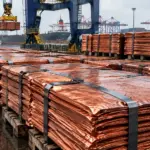
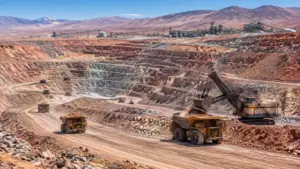
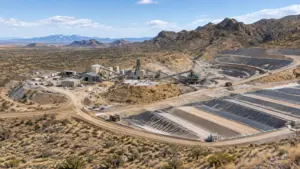
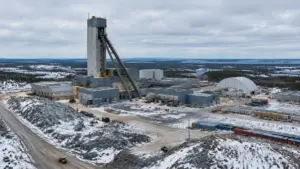
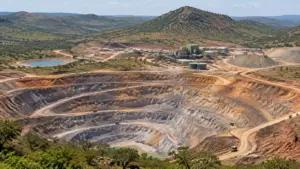
Brazilian nickel and critical-minerals processing infrastructure viewed from an elevated angle.

Critical-minerals finance is increasingly being shaped by governments before projects reach lenders’ credit committees.
The pattern is visible across three developments: the United States and Lithuania are coordinating priority projects and financing; Brazil is building a legal and financial framework to retain more value from its mineral resources; and the European Union is examining whether MMG’s proposed acquisition of Anglo American’s Brazilian nickel business could affect supply to European stainless-steel producers.
Taken together, the cases show that project finance is no longer determined only by ore quality, operating costs and commodity prices. Permitting, ownership, offtake, industrial policy and geopolitical alignment are becoming equally important variables for copper, lithium, nickel and other critical minerals.
The shift is significant for developers and investors. State support can lower capital barriers, but new approval requirements and strategic-asset reviews can also extend transaction timelines, restrict commercial flexibility and increase the cost of political-risk insurance.
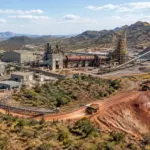
Three models of state intervention
The U.S.-Lithuania framework is the lightest-touch model. Brazil’s critical-minerals policy is more interventionist, combining incentives with oversight. The EU’s review of the MMG-Anglo transaction shows how competition authorities can intervene directly in a private deal when a mineral is considered important to industrial resilience.

| Case | Government instrument | Immediate finance effect | Main risk for developers |
|---|---|---|---|
| U.S.-Lithuania | Nonbinding critical-minerals framework | Potential public and private financing coordination | Projects may remain at the identification stage without committed capital |
| Brazil | National Policy on Critical and Strategic Minerals, guarantee support and processing incentives | Potentially lower financing costs for qualifying projects | Additional approval, local-value and transaction requirements |
| EU review of MMG-Anglo nickel deal | Merger control and supply-security scrutiny | Possible conditions, delays or restructuring | Offtake restrictions and prolonged closing timetable |
| Common trend | Strategic treatment of mineral assets | More public capital and policy support | Greater regulatory and geopolitical diligence |
The comparison is important because the mechanisms are different. A memorandum of understanding may improve access to government agencies and development finance without creating an enforceable funding commitment. A national law may provide guarantees or tax credits while adding obligations. Merger control can affect a transaction even when the mine and processing facilities are outside the reviewing jurisdiction.
U.S.-Lithuania framework puts financing coordination first
The United States and Lithuania signed a critical-minerals framework in Washington that calls for the two governments to identify priority projects and mobilize government and private-sector financing within six months.
The agreement does not require a mine or processing facility to be completed within that period. U.S. Secretary of State Marco Rubio described the timetable as applying to project identification and capital mobilization. Lithuanian Foreign Minister Kęstutis Budrys presented the arrangement as part of a broader economic-security strategy.
Lithuania’s government had already approved participation in U.S.-led initiatives covering critical minerals, rare earths, advanced manufacturing and semiconductor supply chains. The country’s role is less about large-scale domestic mining than about connecting its technology, photonics and industrial capabilities to more secure supply chains.
The framework is also explicitly limited in legal force. Lithuania’s Foreign Ministry said the minerals agreement is not an international treaty and does not create legal obligations under Lithuanian or international law, according to LRT.
For project finance, that distinction matters. A framework can support diplomatic alignment, government-backed introductions and the development of financing channels. It does not automatically provide debt guarantees, equity commitments or a bankable offtake contract.
The practical test will be whether the six-month process produces identifiable assets with defined sponsors, permits, processing routes, counterparties and capital structures. Without those elements, the agreement remains a policy signal rather than a financing instrument.
Brazil links mineral policy to domestic value addition
Brazil is taking a more direct approach. Its National Policy on Critical and Strategic Minerals is designed to support extraction while encouraging domestic processing and industrialization.
The policy covers minerals including lithium, nickel, copper, graphite, rare earths and niobium. Reported measures include a Mineral Activity Guarantee Fund with an initial federal contribution of about 2 billion Brazilian reais and tax credits intended to support processing and transformation projects. The broader package has been reported at approximately 7 billion reais.
The policy also establishes a governance structure to identify priority minerals and projects. That approach reflects Brazil’s stated aim of moving beyond raw-material exports and capturing more value in refining, intermediate products and industrial manufacturing.
Brazil’s Ministry of Mines and Energy makes the same strategic argument in its Guide for Foreign Investors in Critical Minerals. The document highlights the country’s reserves, renewable-heavy power system, public development banks and project pipeline while emphasizing domestic mineral transformation.
The policy could improve the financing profile of processing projects if incentives are predictable and transferable. Guarantees can reduce the amount of private collateral required, while tax credits may strengthen project economics during the construction and ramp-up phases.
However, these benefits come with conditions. Developers may face requirements related to local processing, reporting, social and environmental performance, research and development or government approval of certain transactions. A project that qualifies for public support may therefore have less flexibility over its offtake structure, ownership or export strategy.
That trade-off will be central to Brazil’s critical-minerals market. The country offers substantial geological potential and comparatively attractive access to renewable power, but investors will need to model both the value of state support and the cost of additional administrative oversight.

Nickel ore remains central to the competition over battery, stainless-steel and industrial supply chains.
EU scrutiny turns a nickel deal into a supply-security test
The European Commission’s review of MMG’s proposed acquisition of Anglo American’s Brazilian nickel business shows how state intervention can reach beyond national borders.
The proposed transaction is valued at about $500 million and includes operating ferronickel facilities and development projects in Brazil. MMG is majority-owned by China Minmetals, a Chinese state-owned enterprise.
The Commission opened an in-depth investigation in November 2025 under the EU Merger Regulation. Its preliminary concerns focused on the possibility that the target’s ferronickel could be redirected away from European stainless-steel producers after the acquisition.
In its formal announcement, the Commission said the target held substantial market power in a concentrated market for low-carbon ferronickel and that European customers had limited alternative supply. It also raised concerns about the potential impact on price, quality and competitiveness.
The EU’s official investigation notice did not prejudge the outcome. But the case demonstrates that an asset can become strategically relevant because of its customers, ownership structure and downstream market: not only because of where it is located.
Reports in September said the Commission had issued a statement of objections over the transaction. That step does not automatically block the deal, but it indicates that the parties may need to offer binding remedies. Possible solutions could involve long-term supply commitments, restrictions on diversion or other measures designed to preserve European access.
For lenders, the review creates a timing and structuring problem. Debt commitments may need longer validity periods. Completion accounts and conditions precedent may have to reflect regulatory approval. Sponsors may also need contingency plans if remedies reduce the asset’s commercial flexibility.

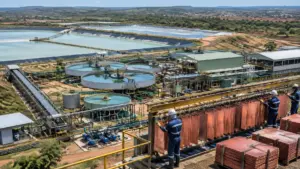
Critical-minerals projects are increasingly managed as integrated production, logistics and policy systems.
Base, bull and bear scenarios
The following framework is intended as a decision-making tool rather than an investment forecast.
| Scenario | Project finance | Permitting and approvals | Geopolitical risk |
|---|---|---|---|
| Bull case | Public guarantees, tax credits and strategic offtakes reduce weighted funding costs and help projects reach financial close | Governments prioritize critical-mineral projects without removing core environmental safeguards | Allied supply-chain agreements reduce concentration risk and support predictable trade |
| Base case | Blended finance expands, but lenders require stronger sponsors, contingency reserves and diversified offtake | Approvals remain sequential and politically sensitive; strategic designation speeds some reviews but not all | Asset reviews and trade restrictions become routine, raising diligence costs and extending timelines |
| Bear case | Incentives are delayed, withdrawn or tied to restrictive conditions; high rates and weak prices defer final investment decisions | Local opposition, environmental disputes and overlapping agencies lengthen schedules | Ownership disputes, export controls and merger remedies fragment supply chains and reduce asset flexibility |
The base case appears most consistent with current policy behavior. Governments are willing to support selected projects, but they are not removing scrutiny. Instead, they are applying it more selectively to projects deemed important for energy, defense or industrial security.
What project sponsors should track
The financial impact of state intervention will vary by project stage.
Exploration companies should monitor changes to mineral lists, access to geological data and eligibility for public exploration support. A strategic designation may improve visibility but does not replace resource definition or permitting work.
Development-stage projects should test whether guarantees and tax credits are legally available before financial close. Sponsors should also assess whether conditions attached to support affect ownership, export destinations or processing requirements.
Operating assets face a different question: whether a sale, refinancing or new offtake contract could trigger investment screening, merger review or government ratification.
Lenders and investors should add a policy map to traditional technical and financial due diligence. That map should identify the relevant ministries, competition authorities, investment-screening bodies, environmental agencies and state-backed financiers in every jurisdiction connected to the project.
Skillings’ coverage of the critical-minerals supply chain and ESG compliance and permitting provides additional context for how midstream bottlenecks and regulatory obligations are affecting project development.
The financing conclusion
The 2026 critical-minerals landscape is not defined by a simple shift from private to public ownership. It is defined by deeper state involvement in the terms under which private capital can participate.
The U.S.-Lithuania framework shows governments coordinating capital and supply-chain priorities. Brazil is combining financial support with domestic industrial objectives. The EU’s MMG-Anglo review shows that competition policy can become supply-security policy when nickel is viewed as an industrial input with limited alternatives.
For project sponsors, the implication is clear: bankability now includes political compatibility. The strongest projects will not necessarily be those with the largest resources. They will be the projects that can demonstrate credible permitting pathways, resilient logistics, diversified counterparties, acceptable ownership structures and a clear role in the host government’s industrial strategy.
LinkedIn snippet:
Critical-minerals finance is being reshaped by state intervention. The U.S.-Lithuania framework, Brazil’s new policy architecture and EU scrutiny of the MMG-Anglo nickel deal show how project finance, permitting and geopolitical risk are converging.
X snippet:
Critical-minerals projects now face more than commodity-price risk. U.S.-Lithuania financing coordination, Brazil’s value-addition policy and EU scrutiny of a Brazilian nickel deal show how governments are reshaping bankability.
Sources
- U.S.-Lithuania critical-minerals framework coverage
- Lithuania joins U.S.-led critical-minerals initiative
- Brazil’s Guide for Foreign Investors in Critical Minerals
- European Commission investigation into MMG’s proposed acquisition of Anglo American’s nickel business
- Reuters reporting on EU scrutiny of the MMG-Anglo nickel deal