Western Ethiopia’s Kurmuk project is entering final commissioning as Allied Gold prepares to add a major new operation to its production portfolio.

By Charles Pitts
Allied Gold’s US$500 million Kurmuk gold mine in western Ethiopia has entered final commissioning and is days from its first gold pour, marking a significant milestone for the company and a potential turning point for Ethiopia’s modern mining industry.
The project has already reached several key start-up stages. A 132-kilovolt transmission line connecting Kurmuk to the Ethiopian national electricity grid has been commissioned and energized, while first ore has been fed through the crushing circuit. Allied is now transferring the crushing circuit from the commissioning team to the mine’s operations team and building the ore inventory needed for a controlled plant ramp-up.
The first pour will not, by itself, represent full commercial production. It is the visible result of hot commissioning and initial processing, while the mine continues to stabilize its crushing, grinding, carbon-in-leach, elution and smelting circuits. For Allied, however, the event would confirm that a long-planned greenfields development has moved from construction into production.
A major new gold operation
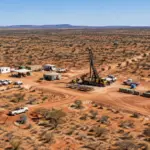
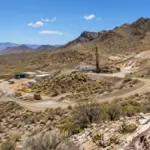
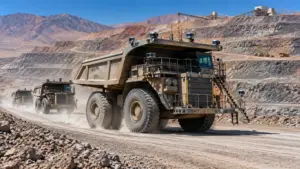
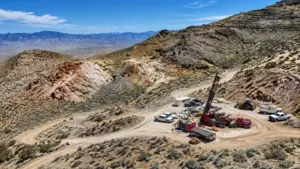
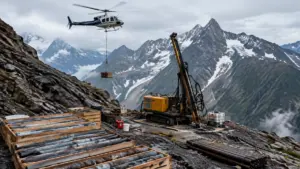
Kurmuk is located in Ethiopia’s Benishangul-Gumuz region, about 65 kilometers north-northwest of Asosa and roughly 5 kilometers from the Sudanese border. The project includes the Dish Mountain and Ashashire deposits, which will supply a conventional open-pit mining operation and carbon-in-leach processing plant.

The project’s feasibility work outlined a pre-production capital requirement of approximately US$499 million, in line with the US$500 million figure cited by Allied. That amount includes pre-stripping, the owner-operated mining fleet, processing facilities, power and water infrastructure, roads, accommodation and contingency.
Total life-of-mine capital is higher. Allied’s 2022 feasibility study estimated approximately US$717 million over a 12-year mine plan, including sustaining capital and closure costs. The distinction is important for investors: the US$500 million headline refers primarily to the initial construction and development investment, while the larger figure includes capital required throughout the operation and at closure.
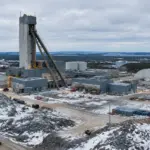
The technical study was based on a processing rate of approximately 4.4 million tonnes per year and a Proven and Probable Mineral Reserve of about 2.6 million ounces of gold. The mine is designed to produce gold doré using crushing, grinding, gravity recovery, cyanide leaching, carbon adsorption, electrowinning and smelting.

The grid connection is a critical commissioning milestone for Kurmuk’s processing plant.
Commissioning advances toward first pour
The latest project update indicates that Allied has established an ore stockpile of approximately 1 million tonnes and plans to increase it toward 1.5 million tonnes, equivalent to about three months of plant feed.
That stockpile is designed to reduce the risk of interruptions during ramp-up. Rather than relying entirely on freshly mined ore as the plant starts, Allied can draw from prepared material while the crushing, milling and recovery circuits are brought online and mining crews increase output.
The grid connection is equally important. The project’s feasibility study provided for a 72-kilometer, 132-kilovolt transmission line from the Asosa substation to Kurmuk. The Ethiopian government agreed to develop the connection as part of its participation in the project. The mine is expected to draw an average of roughly 20–21 megawatts, with higher peak demand during operation of the grinding circuit.
Grid power should reduce reliance on diesel generation and support Kurmuk’s planned cost position. The feasibility study estimated life-of-mine all-in sustaining costs of approximately US$844 per ounce, while more recent company guidance has pointed to AISC below US$950 per ounce.
The difference between feasibility estimates and current guidance reflects the normal evolution from study assumptions to operating conditions. Actual costs will depend on equipment performance, fuel and reagent prices, labor productivity, grade reconciliation, recovery rates and the pace of ramp-up.

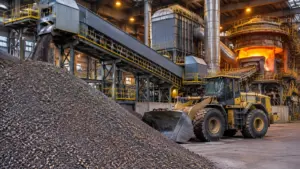
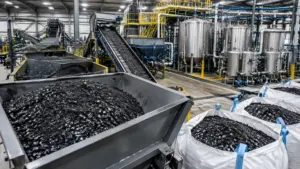
Ore handling and crushing systems are being transferred from commissioning teams to mine operations personnel.
What first pour means for Allied Gold
Kurmuk is expected to materially change Allied Gold’s production profile once it reaches steady-state operations.
Allied has indicated that 2026 will be a partial production year because the mine is starting in the second half of the year. Current guidance summarized in company and market disclosures points to roughly 100,000 to 150,000 ounces in 2026, followed by approximately 240,000 to 270,000 ounces in 2027 and about 300,000 ounces in 2028.
The project is expected to average close to 290,000 ounces per year during its first four to five years, before settling toward a life-of-mine average of at least 240,000 ounces per year under the current reserve-based plan.
| Kurmuk operating metric | Current indication |
|---|---|
| Initial development capital | About US$500 million |
| Total life-of-mine capital | About US$717 million |
| 2026 production | Approximately 100–150 koz |
| 2027 production | Approximately 240–270 koz |
| 2028 production | Approximately 300 koz |
| First four to five years | About 290 koz/year average |
| Life-of-mine average | At least 240 koz/year |
| Current cost guidance | Below US$950/oz AISC |
Sources: Allied Gold’s Kurmuk project information, Allied Gold disclosures, and the Kurmuk NI 43-101 technical report. Figures are guidance or feasibility estimates, not guarantees.
For Allied, the importance extends beyond ounces. Kurmuk would add a large-scale, long-life asset to a portfolio that has historically been weighted toward producing mines in West Africa. It also creates the possibility of extending mine life through exploration around Dish Mountain, Ashashire and nearby targets.
The company has previously identified additional mineralization within and around the planned pits, including inferred material that was excluded from the initial reserve plan. Exploration success could support a longer operating life or future processing expansion, although those outcomes remain subject to drilling, resource conversion, engineering and permitting.
Ethiopia’s mining investment case
First production at Kurmuk would also provide a test of Ethiopia’s ability to attract and support large-scale international mining investment.
The country has a long history of artisanal and historical gold production, but modern industrial mining has remained relatively limited. Kurmuk would demonstrate that a major project can be financed, permitted, constructed and connected to national infrastructure in a remote region.
Under the Kurmuk Development Agreement, the Ethiopian government receives a royalty and an equity interest in the project. The agreement also provides a framework covering taxation, customs, foreign-exchange arrangements, local employment, procurement and community development.
The project’s large-scale mining licence runs for an initial 20-year term, with renewal provisions. The feasibility study also outlined a 5% precious-metals royalty, government participation of approximately 7%, and contributions to community development programs.
That framework may help improve Ethiopia’s investment case for other projects, but Kurmuk’s start-up will also expose the practical risks of operating in the country. The mine is close to the Sudanese border, in a region where security and access can affect construction, logistics and workforce movement. The operation must also manage wet-season conditions, long supply routes, local expectations, artisanal mining activity and the availability of specialized contractors.
The project’s location makes infrastructure particularly important. Equipment and consumables must move through long road corridors connecting the mine to Asosa, Addis Ababa and the Port of Djibouti. The new power line reduces one major operational constraint, but stable access to roads, fuel, reagents and spare parts will remain essential.
The next test is ramp-up
The first pour will be a landmark event, but the more consequential milestones will follow.
Investors and mine operators will be watching the reconciliation between mined grades and plant feed, recovery rates through the CIL circuit, mill availability, stockpile drawdown and the pace at which the operation approaches commercial production. Allied will also need to demonstrate that costs remain close to its guidance as the mine moves from commissioning into full-scale open-pit production.
A controlled ramp-up could allow Kurmuk to become one of the more important new gold operations in Africa. A slower start, however, would defer the production contribution and place greater pressure on the company’s existing assets and funding plans.
Investor take
The simple read is that Kurmuk is moving from “development story” to “operating asset.” The first pour creates visibility, but the value question will be answered by the next 12 to 18 months: can Allied convert a US$500 million construction investment into roughly 240,000–300,000 ounces a year at the targeted cost profile?
That is where the project shifts from headline appeal to operating proof. The upside is meaningful production growth and a longer-term Ethiopian exploration platform. The risks are equally clear: commissioning delays, security, logistics, grade control and cost escalation. No single pour settles that debate, but it does move Kurmuk into the part of the mining cycle where performance can be measured.
Social snippet
LinkedIn/X: Allied Gold’s US$500 million Kurmuk project in western Ethiopia has entered final commissioning and is nearing its first gold pour. The mine is designed to produce up to roughly 300,000 ounces annually once ramped up, potentially reshaping Allied’s production profile and Ethiopia’s modern mining investment case. Read the full update