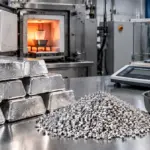
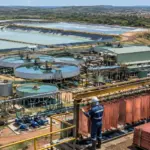
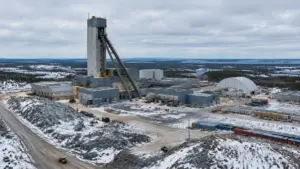
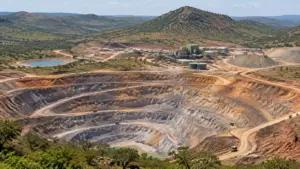
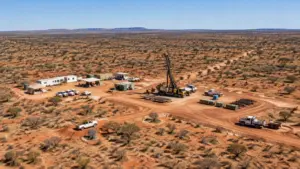
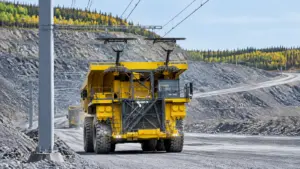
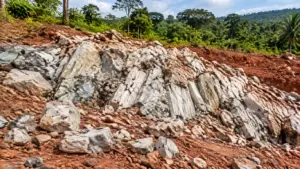
Illustrative view of a copper tailings recovery and wet-leach processing facility in Zambia’s Copperbelt.

Konkola Copper Mines (KCM) has signed a $498 million engineering, procurement and construction contract with China NERIN Engineering to build a copper recovery plant at Chingola in Zambia’s Copperbelt, targeting about 70,000 tonnes of additional annual copper capacity from existing mine tailings.
The project shifts part of KCM’s expansion strategy away from fresh ore extraction and toward the reprocessing of material already mined and deposited. KCM said the facility will use wet-leach technology and operate alongside its existing tailings-processing infrastructure at the Nchanga complex. Once completed, the company expects it to be Africa’s largest facility of its type.
The announcement gives KCM a potentially significant source of incremental copper, but the project’s value will depend on more than its nameplate capacity. Tailings variability, water and acid management, power supply, permitting, construction integration and commissioning performance will determine how much of the planned output reaches production.
Project at a glance
| Item | Details |
|---|---|
| Operator | Konkola Copper Mines |
| Location | Chingola, Copperbelt Province, Zambia |
| Capital commitment | $498 million |
| Contractor | China NERIN Engineering |
| Technology | Hydrometallurgical wet-leach processing |
| Planned capacity | Approximately 70,000 tonnes of copper per year |
| Feed source | Existing mine tailings |
| Delivery scope | Engineering, procurement, construction, installation, commissioning support, performance testing and workforce training |
| Operating context | Nchanga’s integrated mining, processing, smelting and refining complex |
The figures were reported by SMM and Reuters, citing the company’s announcement.
A secondary resource inside an existing copper hub
Tailings are not uniform waste. They are the remaining material from earlier processing stages, and their copper content can vary according to the orebody, recovery methods and operating conditions used when the material was originally treated.

At Nchanga, KCM already has a long-established processing network that includes mines, concentrators, a smelter, refinery linkages and tailings-leach facilities. The company’s Nchanga operations overview describes the complex as an integrated copper hub in Chingola. CopperTech Metals, which operates KCM, also identifies historical tailings as a secondary copper source within the complex and reports existing tailings-leach infrastructure.
That operating history matters because a new plant would not be developed in isolation. It would need to connect with established systems for materials handling, water, power, reagents, acid production, residue management and downstream copper processing.

The proposed 70,000 tonnes per year would represent approximately 7.9% of Zambia’s reported 2025 copper production of 890,346 tonnes. It would also be equivalent to roughly 23% of KCM’s stated ambition to raise production toward 300,000 tonnes per year. Those comparisons describe the project’s potential scale; they do not indicate that all of the new capacity will translate directly into national or companywide output.

Tailings reprocessing can create a secondary feed source while bringing legacy material back into the production system.
What wet-leach technology changes
Wet-leach processing uses a liquid chemical solution to dissolve copper from mineral-bearing material. The copper-bearing solution can then be treated through downstream recovery stages, depending on the plant design and the operator’s existing infrastructure.
KCM and NERIN have not publicly disclosed the proposed plant’s detailed flowsheet, expected recovery rate, throughput, acid consumption, water balance or final commissioning date. Those details will be important in assessing the difference between 70,000 tonnes of design capacity and actual annual production.
The chemistry of the tailings will be central to the project. Historical material may have different mineralogy, particle sizes and copper grades from current concentrator feed. Some zones may respond well to leaching, while others may require additional preparation or have lower recoveries. The plant’s performance will therefore depend on how well KCM has characterized the tailings resource and how effectively the design can manage feed variability.
The project also benefits from the fact that much of the material has already been mined and transported. That can reduce exposure to the geological uncertainty associated with a new pit or underground expansion. It does not eliminate operational risk. Tailings must still be reclaimed, pumped or conveyed, processed and stored again after treatment.
Environmental gains and new controls
Recovering copper from tailings can reduce the volume of legacy material remaining on site and potentially improve the long-term management of historical deposits. It may also reduce the need to disturb new ground for an equivalent amount of copper.
Those benefits are not automatic. Wet-leach operations introduce their own environmental control requirements, particularly where acidic solutions are used. Operators must manage seepage, water quality, residue stability, dust, stormwater and the potential mobilisation of metals. The final residue may have different chemical characteristics from the original tailings and will require a clear storage, monitoring and closure plan.
KCM says its operations are covered by an ISO 14001-certified environmental management system and identifies environmental stewardship as part of its operating framework. The company’s broader environmental, social and governance reporting and tailings coverage provides context for the permitting and disclosure issues facing mine-waste projects across the sector.
For the Chingola plant, the practical tests will include:
- Whether the project has sufficient water-recycling capacity for its planned throughput.
- How acid use and neutralisation requirements will be managed.
- Whether seepage and groundwater monitoring are expanded around the tailings complex.
- How reclaimed and newly generated residues will be stored safely.
- What closure obligations apply after the recoverable copper has been removed.
- How local communities will be informed about water, transport and construction impacts.
A tailings recovery project can improve the environmental profile of an operation, but it should not be treated as remediation simply because it processes waste. Its environmental performance will depend on the full lifecycle of the material, from reclamation through final residue storage.

Wet-leach plants require tight control of material flow, process chemistry, water and residue handling.
Execution is the next test
Under the contract, China NERIN will provide engineering, procurement, construction and installation services, along with support for commissioning, performance testing and workforce training. That structure gives KCM a single principal delivery partner for the major construction phases, while retaining the need for close operational integration with the existing Nchanga complex.
The announcement did not provide a construction schedule. Key execution milestones will include detailed engineering, long-lead equipment procurement, civil works, installation, tie-ins to existing infrastructure, dry commissioning, wet commissioning and performance testing.
Several issues will be closely watched by operators and investors:
Feed characterization
The project must demonstrate that the tailings contain sufficient recoverable copper at the required scale. Grade distribution and mineralogy will influence both recovery and operating cost.
Utility availability
Wet-leach facilities can be intensive users of water, electricity and reagents. The project’s output will depend on reliable access to each, particularly during ramp-up.
Integration with Nchanga
The plant will operate within an active industrial complex. Construction activities must be coordinated with existing mining, smelting, refining and tailings operations to avoid disrupting current production.
Ramp-up performance
The 70,000-tonne figure is a stated design target. Actual production may build gradually as operators tune the circuit, validate recovery assumptions and train the workforce.
Downstream capacity
Additional copper recovered from tailings must be converted into a saleable product. Connections to existing leach, solvent extraction, electrowinning, smelting or refining systems will determine how the new capacity is absorbed.

Commissioning and performance testing will determine whether the plant reaches its planned production rate.
Why the announcement matters for Zambia’s copper strategy
The project comes as Zambia seeks to raise copper production to 3 million tonnes a year by 2031, from 890,346 tonnes in 2025, according to Reuters. The country is also competing for capital and infrastructure investment with other major African copper producers, including the Democratic Republic of Congo.
Tailings recovery offers Zambia a way to add capacity through existing mining districts rather than relying only on new mine development. That can shorten the path from investment to production when the resource, processing site and supporting infrastructure are already established.
The approach also reflects a wider shift in the copper industry. As demand grows from power networks, renewable energy equipment, electric vehicles and data centers, producers are examining lower-grade resources, historic waste and process improvements alongside conventional mine expansions. Skillings’ copper market coverage tracks how supply constraints and treatment economics are shaping investment decisions across the sector.
For KCM, the new plant is both a production project and a test of industrial execution. The company will need to convert a legacy material stream into a consistent feedstock while demonstrating that environmental controls can keep pace with expansion.
The next meaningful indicators will be the release of a project schedule, details of the process design, permitting progress, construction mobilisation and the results of commissioning tests. Until those milestones are disclosed, the 70,000-tonne target remains a planned capacity addition rather than confirmed production.