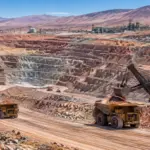
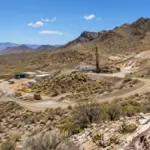
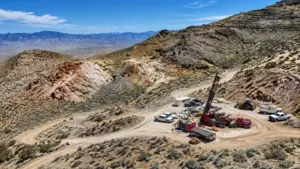
Southern Idaho’s semi-arid terrain is the setting for Liberty Gold’s Black Pine development project.

By Sonny Rollins
Liberty Gold has filed the feasibility-study technical report for its Black Pine oxide gold project in southern Idaho, outlining a 16-year open-pit, run-of-mine heap-leach operation with initial capital of about $411 million and average early production of roughly 202,000 ounces of gold a year.
The filing moves Black Pine from a feasibility-defined development concept into a more advanced engineering and permitting phase. Liberty Gold has not made a final construction decision, but says it is progressing detailed engineering, procurement planning and execution readiness while federal and state approvals continue.
The NI 43-101 technical report has an effective date of Aug. 1, 2026, and was filed Sept. 18. The study was prepared by independent technical specialists covering mineral reserves, mining, metallurgy, processing, infrastructure, hydrology, environmental compliance and financial evaluation.
Black Pine economics and production profile
The feasibility study is based on a probable mineral reserve of 4.04 million ounces of gold contained in approximately 433.3 million tonnes grading 0.29 grams per tonne.

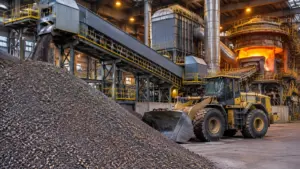
The project is designed around conventional open-pit mining and run-of-mine heap leaching. Liberty Gold says the processing route does not require ore crushing, screening or agglomeration, a configuration intended to reduce equipment requirements and simplify construction and operations.
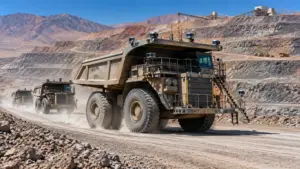
Average ore throughput is expected to be about 74,200 tonnes per day. The mine plan includes average annual material movement of approximately 64 million tonnes, with a reported strip ratio of about 1.34:1.
The operating profile is weighted toward the early years:
| Metric | Feasibility-study case |
|---|---|
| Mine life | 16 years |
| Probable mineral reserve | 4.04 million oz of gold |
| Reserve tonnes and grade | 433.3 Mt at 0.29 g/t gold |
| Average throughput | Approximately 74,200 t/d |
| Average production, years one to five | Approximately 202,000 oz/year |
| Life-of-mine average production | Approximately 177,000 oz/year |
| Life-of-mine production | Approximately 2.84 million oz |
| Initial capital | Approximately US$411 million |
| Life-of-mine average AISC | Approximately US$1,566/oz |
The study estimates peak annual production of about 277,400 ounces in the fifth year and approximately 294,600 ounces in the 13th year. Average life-of-mine gold recovery is about 70.2%.
At a base-case gold price of $3,250 an ounce, Liberty Gold estimates an after-tax net present value at a 5% discount rate of approximately $2.4 billion. The after-tax internal rate of return is estimated at 60.5%, with a payback period of about two years.
The company’s sensitivity analysis shows how strongly the project’s economics remain linked to the gold price. At $2,500 an ounce, the after-tax NPV falls to approximately $1.2 billion, the IRR declines to 33.4% and payback extends to about 3.4 years. At $4,500 an ounce, the study estimates an after-tax NPV of about $4.3 billion and an IRR of approximately 104%, with payback in roughly 1.2 years.
Those figures are feasibility-study estimates rather than operating results. They depend on assumptions covering gold prices, recoveries, capital costs, operating performance, permitting, equipment availability and construction timing.

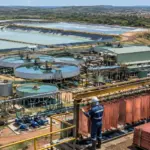
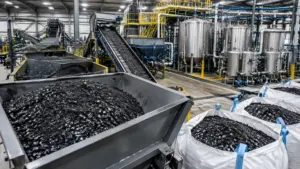
Heap-leach infrastructure is central to Black Pine’s proposed processing configuration.
Why the processing route matters
Black Pine is a past-producing, Carlin-style oxide gold deposit in the Great Basin. The deposit’s near-surface, disseminated mineralization is intended to support large-scale open-pit mining and heap-leach recovery.
The absence of planned crushing, screening and agglomeration is a central feature of the feasibility case. A run-of-mine design can reduce the number of major processing components required at the site, although it also places greater importance on leach kinetics, ore permeability, pad design, solution management and grade control.
Liberty Gold said recent bulk-column testing validated predicted operating gold-leach recoveries at run-of-mine sizing. The company has also described the project as having access to existing water rights and grid power infrastructure. Its project materials identify power capacity of up to 9.9 megawatts at the site, subject to the requirements and final configuration of the proposed operation.
The feasibility study includes a total life-of-mine capital requirement of approximately $825.5 million, including sustaining capital and closure costs. The company reports a life-of-mine average all-in sustaining cost of about $1,566 per ounce, although it notes that AISC is a non-GAAP project measure and may not be directly comparable with figures reported by other developers.
Permitting remains the key gate
The filing does not itself authorize construction.
Black Pine is advancing through a coordinated federal and state environmental review process. Liberty Gold’s project materials say the federal Mine Plan of Operations was deemed administratively complete in November 2025. The company is advancing the project under the FAST-41 framework, which is intended to improve coordination and visibility for certain major infrastructure and development reviews.
At the state level, Liberty Gold submitted a Preliminary Cyanidation Design Report to the Idaho Department of Environmental Quality. That submission is part of the state permitting pathway for the proposed cyanide-based heap-leach operation.
The company’s Black Pine project page identifies the project’s current stage as “permitting and detailed engineering.” The Mine Plan of Operations that supports permit applications remains distinct from the feasibility study, meaning final project approvals will continue to depend on agency review, environmental analysis, mitigation commitments and other regulatory requirements.
The permitting process is therefore the next major external test. The technical report establishes the project’s engineering and financial case, but regulators must still assess issues including water, wildlife, reclamation, cyanide management, land use and broader environmental impacts.
Liberty Gold has said the project is expected to support about 300 long-term jobs if developed. It is also pursuing initiatives related to sage grouse habitat restoration, mule deer migration and habitat mitigation as part of the environmental planning process.
From feasibility to a construction decision
Liberty Gold’s next steps are focused on converting the feasibility study into an executable project plan.
The company says it is advancing:
- Detailed engineering for the mine, heap-leach facilities, processing plant and supporting infrastructure;
- Procurement planning and contractor strategy;
- Construction-readiness activities;
- Ongoing federal and state permitting;
- Further technical work to refine operating assumptions and execution plans;
- Financing and corporate planning ahead of a potential construction decision.
The company’s project timeline points to a potential construction decision in late 2027 and first gold in 2028, subject to permits, financing, final approvals and a formal decision by the board. Those dates should be treated as targets rather than committed milestones.
For investors and operators following gold mining news in 2026, Black Pine stands out because its feasibility case combines a large reserve, relatively simple processing route and strong sensitivity to gold prices. For the broader critical minerals supply chain in 2026, the project is not a battery-metals development, but it reflects the same industry-wide pressure to move technically credible U.S. mineral projects from resource definition toward production.
The main question now is execution. Liberty Gold must complete permitting, hold capital and schedule assumptions together, and demonstrate that the proposed heap-leach operation can be built at the study’s estimated cost and timing.
Investor take
The headline economics are difficult to ignore: a roughly $2.4 billion after-tax NPV against $411 million of initial capital, with early production above 200,000 ounces a year.
But the next value test is not another headline number. It is whether Liberty Gold can carry the project through permitting and detailed engineering without material cost, schedule or design changes. Black Pine has a strong feasibility case; the construction decision will determine how much of that case can be converted into a producing mine.
Social snippet
Liberty Gold has filed the feasibility-study technical report for its Black Pine oxide gold project in Idaho. The 16-year open-pit, run-of-mine heap-leach plan targets average production of about 202,000 ounces a year in the first five years, with $411 million in initial capital and an estimated $2.4 billion after-tax NPV at $3,250 gold. Permitting and detailed engineering now sit between the study and a potential construction decision. #GoldMining #MiningNews #Idaho