The Boundary Waters region’s interconnected lakes and forest define the environmental stakes in the Twin Metals permitting dispute.

By Salini Krishnan
Congress reopened the federal path for mining near Minnesota’s Boundary Waters Canoe Area Wilderness. Minnesota, meanwhile, has moved to close its own regulatory path.
That split now defines the future of Twin Metals Minnesota’s proposed copper-nickel mine in the Duluth Complex. In April, Congress used the Congressional Review Act to overturn the 2023 withdrawal of about 225,000 acres of Superior National Forest from mineral and geothermal leasing. In August, Gov. Tim Walz ordered state agencies to halt new nonferrous mining work in the Rainy River Headwaters Watershed. In September, the Minnesota Department of Natural Resources canceled a Twin Metals state mineral lease.
The result is not a simple federal approval or state ban. It is a two-track conflict in which the federal government may be able to restore access to the mineral estate while Minnesota retains control over essential leases, water approvals and state environmental decisions.
What Congress changed
H.J. Res. 140 nullified Public Land Order 7917, the 2023 federal action that withdrew approximately 225,000 acres from new mineral and geothermal leasing for 20 years. The measure passed the Senate by a 50-49 vote in April and became law under the Congressional Review Act.

E&E News reported that the resolution also limits the Interior Department’s ability to issue a substantially similar withdrawal in the future. The congressional action was a significant policy victory for Twin Metals and supporters of domestic copper and nickel production.
But the measure did not approve the Twin Metals mine.
The Congressional Research Service and Congress.gov record make the legal effect clearer: H.J. Res. 140 removes a federal leasing restriction. It does not issue a mineral lease, approve a mine plan, authorize construction or waive environmental review.
The Department of the Interior and the U.S. Forest Service may now consider whether federal leases should be restored or reissued. If that happens, federal agencies could resume environmental review under the National Environmental Policy Act and assess a proposed mine plan.
That is a reopening of the process, not a guarantee of development.
Why federal leasing authority is not enough
The proposed mine is on federal land in the Superior National Forest, giving federal agencies an important role in leasing and project review. Yet the mine would operate inside Minnesota, and many of the practical approvals needed to build and operate it would remain subject to state authority.
As MinnPost reported, University of Minnesota environmental law professor Brad Karkkainen described the congressional action as removing federal impediments without overriding Minnesota’s independent authority to issue or deny permits.
That distinction is central to the dispute.
A federal lease generally gives a company the right to pursue development under the terms of that lease. It does not automatically provide:
- A state mineral lease where one is required.
- Water-quality certification.
- Air and water permits.
- Authorization for tailings or waste-management facilities.
- Approval of roads, utilities and other state-regulated infrastructure.
- A favorable state environmental review.
- Permission to begin construction.
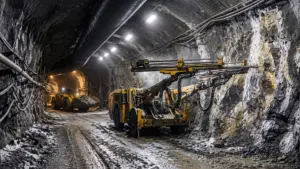
The proposed Twin Metals operation would use underground mining to produce copper, nickel and potentially other minerals from the Duluth Complex, a large geological formation in northeastern Minnesota. The project’s location near the Rainy River headwaters makes water management one of the most consequential parts of any future review.
A federal agency can decide that a project is eligible for federal leasing and complete its own environmental analysis. Minnesota regulators can still deny or withhold state approvals required for the project to function.
Permitting is a stack of approvals, not a single permit. Federal leasing may open the first door, but state leases, water approvals, environmental review and operating permits determine whether a mine can pass through the rest.
That is why the current conflict is better understood as a dispute over overlapping authority than as a straightforward federal-versus-state policy reversal.
Minnesota’s state-level response
Walz’s Executive Order 26-10 directed the Minnesota DNR and Minnesota Pollution Control Agency not to undertake environmental review or permitting work for nonferrous mining proposals in the Rainy River Headwaters Watershed. It also directed the DNR to stop issuing new state nonferrous leases in the area and to review existing leases for compliance.
The Minnesota Reformer reported that environmental groups welcomed the order while mining interests signaled that litigation could follow. The order is also connected to pending legal disputes over Minnesota’s copper-nickel mine-siting rules.
The governor’s action does not stop the federal government from considering leases or conducting federal environmental review. It does, however, prevent Minnesota agencies from cooperating with or advancing their own review while the order remains in effect.
That creates a procedural bottleneck. Federal agencies may be able to prepare a record on the mine, but they cannot unilaterally authorize every state-controlled activity needed to construct and operate it.
What the DNR lease cancellation means
In September, the DNR notified Franconia Minerals (US) LLC, a Twin Metals subsidiary, that it was canceling state mineral lease MM-9455-N. The agency said the company had not met the lease’s performance and production requirements. The cancellation is scheduled to take effect Nov. 10.
The Associated Press reported the cancellation in a syndicated account carried by Yahoo News, while MPR News detailed the lease action and its legal context.
The decision is consequential, but its direct effect needs to be defined carefully. The DNR said the specific lease was not located within the area Twin Metals had previously proposed for its main mine plan. In an April statement, the agency said cancellation of that lease would not directly affect the project the company had been pursuing.
That means the lease cancellation is not, by itself, a formal rejection of the proposed mine.
It is nevertheless important for three reasons.
First, it demonstrates that Minnesota retains independent control over state mineral leases even after Congress reopens federal leasing. Second, it reinforces the governor’s directive to review and enforce existing lease terms. Third, it signals that Twin Metals’ broader mineral position in the region may face continued scrutiny.
The immediate legal question is whether the DNR acted within the terms of the lease and applicable state law. The larger policy question is whether the state’s separate decisions can prevent a federal mine from reaching construction even if federal leases are restored.
Federal and state decision points
| Decision point | Authority | Status | Practical implication |
|---|---|---|---|
| 2023 mineral withdrawal | Federal government | Overturned by H.J. Res. 140 | About 225,000 acres reopened to potential federal leasing |
| Restoration or reissuance of federal leases | Interior Department and Forest Service | Not automatic; future federal action required | Allows Twin Metals to seek renewed federal access |
| Federal environmental review | Federal agencies | May proceed if leases are restored | Does not authorize construction or override state permits |
| Executive Order 26-10 | Minnesota governor and state agencies | In effect, subject to litigation and future policy changes | Halts new state review and permitting work in the watershed |
| State mineral lease MM-9455-N | Minnesota DNR | Canceled; termination effective Nov. 10 | Reduces Twin Metals’ state lease position, though not its main proposed mine area |
| Water-quality and operating approvals | Minnesota agencies | Not issued | Could prevent construction or operation even after federal approval |
| Future state legislation | Minnesota Legislature | Not yet enacted | Could create a broader statutory restriction on nonferrous mining |
Source framework: Congress.gov, E&E News, MPR News, Minnesota Reformer and Minnesota DNR materials.
What it means for the Duluth Complex
The dispute extends beyond one company. The Duluth Complex is one of the most important undeveloped copper-nickel regions in the United States, and projects there are often cited in arguments for expanding domestic supplies of energy-transition metals.
Copper is essential to power grids, electric vehicles, industrial equipment and data-center infrastructure. Nickel remains important to stainless steel and some battery chemistries. The United States has sought to reduce reliance on overseas mineral supply chains, making northeastern Minnesota strategically relevant to the broader critical-minerals policy debate.
But domestic supply strategy does not eliminate local permitting constraints. A project can be strategically important and still face questions about water quality, waste storage, tribal interests, recreation, tourism and long-term financial liabilities.
The same tension appears in copper markets. Skillings’ coverage of the copper supply outlook highlights the difficulty of bringing new supply online even when market demand is strong. The Boundary Waters case adds a further constraint: federal policy can prioritize mineral access, while state authorities retain substantial control over the conditions of development.
Base, bull and bear scenarios
| Scenario | Likely sequence | Indicative project timeline |
|---|---|---|
| Base case | Federal agencies consider renewed leases and advance environmental work, while Minnesota maintains its permitting freeze and the state actions face litigation | Federal review progresses, but construction remains unlikely for many years; first production slips well beyond the current decade |
| Bull case | Twin Metals restores federal leases, prevails in key litigation, a future Minnesota administration rescinds or allows the executive order to expire, and state review resumes | Several years of state and federal review would still follow; construction could become possible in the early-to-mid 2030s, subject to approvals |
| Bear case | Federal lease restoration is delayed or challenged, Minnesota sustains its restrictions, additional state leases are reviewed, and required water and operating approvals remain unavailable | Project remains stranded in permitting and litigation, with no credible construction timetable |
These are policy scenarios rather than production forecasts. Each depends on court decisions, federal lease actions, Minnesota’s next administration and the outcome of technical environmental reviews.
The near-term conclusion is more limited than either side’s political messaging. Congress has reopened the federal door, but Minnesota still controls several doors the project must pass through. The DNR’s lease cancellation does not alone eliminate the mine proposal, just as H.J. Res. 140 does not approve it.
For investors, operators and policymakers tracking the Duluth Complex, the key question is no longer whether federal leasing is possible. It is whether a project can assemble the full stack of federal and state approvals needed to move from mineral rights to construction.
That distinction will determine whether the Boundary Waters becomes a test case for U.S. critical-minerals policy, or a demonstration of how state authority can still stop a federally supported mine.
LinkedIn snippet:
Congress reopened the federal leasing path near Minnesota’s Boundary Waters, but Minnesota’s state lease, water-permitting and environmental authorities remain decisive. Our analysis explains why the Twin Metals dispute is a permitting stack, not a single federal approval.
X snippet:
Federal leasing is back on the table near Minnesota’s Boundary Waters. But state leases, water permits and environmental review remain separate gates. The Twin Metals case shows why a federal win may still produce a state-level veto.