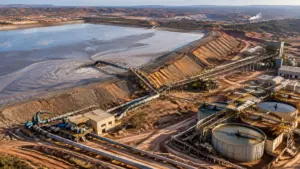
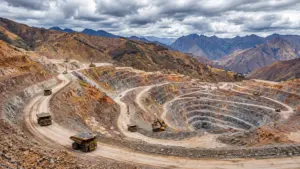
Engineered tailings storage infrastructure in a dry mountainous mining region.

By Penny Langford
For mining companies, tailings compliance is moving into a more demanding phase. The question is no longer whether an operator has adopted the Global Industry Standard on Tailings Management (GISTM) as a policy framework. Regulators, lenders, insurers, investors and communities increasingly want to see the evidence that the framework is working at facility level.
That evidence includes current monitoring data, documented inspections, independent technical reviews, updated risk assessments, emergency plans, corrective-action logs and public disclosures that can be traced back to operational records.
The shift matters because tailings storage facilities are dynamic systems. Their performance changes with water levels, pore pressure, deformation, weather, construction activity, operational practices and closure conditions. A policy document can establish accountability, but it cannot demonstrate whether a facility is behaving within its design assumptions.

The conformance gap is now an evidence gap
The International Council on Mining and Metals (ICMM) reported that 67% of 836 member tailings facilities were in full conformance with the GISTM, based on disclosures made in 2025. That represents 558 facilities, while 278 remained in partial conformance.

The figure provides an important benchmark for the sector, but it also shows where the next compliance challenge lies. ICMM reported that more than 80% of facilities classified as having “extreme” or “very high” consequences were in full conformance. For facilities classified as “high,” “significant” or “low” consequence, full-conformance rates ranged from 53% to 65%.
ICMM describes the data as collective progress rather than a final outcome. Its Tailings Progress Report also makes clear that facility-level information must be reviewed through individual company disclosures.

That distinction is increasingly important. A facility can have a formal tailings policy, a named accountable executive and a published commitment to GISTM while still lacking complete, current or independently reviewed evidence across the facility life cycle.
A useful way to understand the shift is:
Conformance is the conclusion. Evidence is the operating system.
The evidence system must allow an operator, regulator or independent reviewer to answer five practical questions:
- What was supposed to happen?
- What is happening at the facility now?
- What changed from the previous inspection or assessment?
- Who reviewed the change?
- What decision or corrective action followed?

Engineers review monitoring information from a tailings facility control room.
What evidence operators should be able to produce
The GISTM applies across the tailings facility life cycle, from site selection and design through operation, closure and post-closure monitoring. The exact evidence package will vary by facility, consequence classification and local requirements, but several categories are becoming central to credible conformance claims.
Monitoring data
Monitoring records should show more than a list of installed instruments. Operators need to demonstrate that data is collected at suitable intervals, quality-checked, interpreted against thresholds and connected to defined responses.
Relevant records may include:
- Pore-pressure readings
- Water levels and seepage measurements
- Embankment deformation and settlement
- Ground-based radar or satellite observations
- Rainfall, catchment and water-balance data
- Instrument calibration and maintenance logs
- Alarm thresholds and escalation procedures
- Records of anomalies and management responses
Monitoring data is especially important where facilities face changing climate conditions, seismic exposure, water constraints or legacy design assumptions.
Independent review
Independent technical review is a core control against institutional blind spots. The reviewer’s role is not simply to confirm that documents exist. It is to test whether the design basis, operating assumptions, risk controls and observed performance remain consistent.
A credible evidence file should include the scope of the review, the reviewer’s qualifications and independence, findings, recommendations, management responses and proof that outstanding actions were closed or formally accepted.
Risk assessments and consequence classification
Risk assessments should be living documents rather than one-time studies. They need to reflect changes in the facility, downstream population, infrastructure, land use, climate exposure, water conditions and operating plans.
Operators should be able to show:
- Current consequence classification
- Failure modes and effects analysis
- Inundation or impact studies
- Updated risk registers
- Critical controls and performance indicators
- Mitigation plans and ownership
- Review triggers following incidents or material changes
The consequence classification also affects the level of scrutiny a facility can expect from regulators, lenders and communities. High-consequence facilities generally face greater expectations for independent review, emergency preparedness and disclosure.
Inspection and corrective-action records
Routine inspection records often provide the clearest link between a written standard and day-to-day management. They should identify who conducted the inspection, what was observed, what changed, what action was required and whether the action was completed on time.
Records should be retained in a searchable system rather than scattered across spreadsheets, emails and local files. This is where automation and digital evidence management can reduce compliance risk, provided the underlying data is accurate and governance remains clear.
Disclosure and accountability
Public disclosure is part of the broader accountability system. ICMM’s member disclosure portal provides access to company-level information, but the quality and depth of disclosure can vary.
A strong disclosure should explain the facility’s location, consequence classification, conformance status, material gaps, review arrangements and plans for closing those gaps. It should avoid presenting a single compliance label without enough context for readers to understand the basis of the claim.
Evidence matrix for tailings compliance
| GISTM-related requirement | Evidence operators should maintain | Decision or use |
|---|---|---|
| Governance and accountability | Board-approved policy, accountable executive, roles and competency records | Confirms ownership and escalation authority |
| Risk assessment | Current risk register, failure-mode analysis, consequence classification and mitigation actions | Prioritizes controls, reviews and capital |
| Monitoring and surveillance | Instrument data, calibration logs, trend analysis, thresholds and response records | Detects emerging instability and supports intervention |
| Independent review | Review scope, reviewer credentials, findings, responses and closure tracking | Tests assumptions and supports assurance |
| Inspection and operations | Routine inspection reports, maintenance logs, incident records and corrective actions | Demonstrates control performance in practice |
| Emergency preparedness | Emergency action plan, contacts, drills, notification protocols and updates | Supports rapid response and downstream protection |
| Closure and post-closure | Closure design, financial provisions, monitoring plans and trigger levels | Manages long-term liability and residual risk |
| Disclosure | Facility profile, conformance statement, material gaps and improvement plan | Builds regulatory, financial and community transparency |
This matrix can also function as a management dashboard. The key is to connect each evidence category to a decision. Data that is collected but never reviewed, escalated or used to alter operations has limited assurance value.
GISTM does not replace local law
The GISTM is a global industry standard, not a substitute for national permitting, environmental regulation, mine-safety law or water-management requirements. Local law remains the legal baseline.
In practice, operators may need to satisfy several overlapping systems:
- National and regional tailings regulations
- Environmental-impact approvals
- Water permits and discharge requirements
- Dam-safety rules
- Mine-health and safety legislation
- Emergency-management obligations
- Stock-exchange and sustainability disclosures
- Lender or project-finance conditions
Where local law is more prescriptive, the operator must meet the legal requirement. Where the GISTM sets a higher management expectation, companies may adopt it as an additional control framework. The result is not always a single compliance checklist. It is a hierarchy of obligations that needs to be mapped, reconciled and maintained.
Chile provides a useful industry context. The Tailings 2026 forum in Santiago is expected to reflect the sector’s growing focus on design, monitoring, closure, water management and real-time instrumentation in Andean and seismic settings. The significance is broader than the event itself: technical and policy discussions are increasingly centered on how operators demonstrate performance over time, particularly at existing facilities.

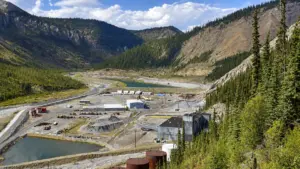
Field inspection of an engineered tailings embankment and drainage system.
Why finance, insurance and social licence are connected
Tailings evidence is becoming relevant beyond environmental, social and governance reporting.
For lenders, incomplete evidence can create uncertainty around permitting, operational continuity, closure liabilities and potential remediation costs. Project-finance agreements may require specific technical reviews, reporting procedures, insurance arrangements or corrective-action timelines.
Insurers also have an interest in the quality of risk controls. Monitoring systems, emergency plans and independent reviews do not eliminate risk, but they can help underwriters assess whether risk is identified, managed and escalated. Gaps may influence coverage terms, exclusions, deductibles or information requirements.
Social licence operates through a similar mechanism. Communities are more likely to trust an operator that can explain what is being monitored, how often results are reviewed, what thresholds trigger action and how information is disclosed. A generic assurance statement is less useful than a clear explanation of facility performance and response protocols.
The result is a convergence of ESG, operational risk and financial risk. Tailings compliance is no longer confined to the sustainability department. It affects engineering, operations, legal, finance, insurance, investor relations and senior management.
Base, bull and bear scenarios for operators
The following framework is designed to help operators assess their position as evidence expectations rise.
| Scenario | Operating position | Likely implications | Priority response |
|---|---|---|---|
| Base case: partial conformance | Core GISTM systems exist, but evidence is uneven across monitoring, reviews, inspections or disclosure | Continued scrutiny, follow-up actions and possible financing or permitting conditions | Close the highest-consequence gaps first; assign owners, deadlines and independent verification |
| Bull case: fully conformant and evidence-ready | Facility-level evidence is current, traceable, independently reviewed and linked to operational decisions | Greater confidence among regulators, lenders, insurers and communities; faster response to emerging risks | Maintain continuous assurance, test data quality and prepare for changing climate and closure conditions |
| Bear case: legacy-data gaps | Historical records are incomplete, instruments are unreliable or design assumptions cannot be fully reconstructed | Delayed approvals, higher review costs, insurance uncertainty and loss of stakeholder confidence | Reconstruct the baseline, increase monitoring, commission independent studies and disclose material uncertainty |
The bull case is not a permanent status. Tailings management requires continuous improvement, and a facility can move backward if monitoring systems fail, operating conditions change or corrective actions are not sustained.
For facilities with legacy-data gaps, the first objective should be to establish a defensible baseline. That may require surveying, new instrumentation, updated water balances, revised consequence assessments, independent engineering review and a documented plan for unresolved uncertainties.

Monitoring instruments and water-management infrastructure on a tailings facility.
The next compliance advantage will be traceability
The remaining one-third of ICMM member facilities in partial conformance will not all face the same challenge. Some may need to close a narrow set of technical actions. Others may need to rebuild fragmented records, strengthen independent oversight or address long-standing uncertainty around legacy facilities.
For operators, the practical test is whether an auditor can move from a requirement to a record, from a record to a decision and from that decision to an outcome.
That is the standard likely to shape tailings ESG compliance in 2026. GISTM adoption remains important, but the differentiator will be whether conformance claims are supported by reliable, current and independently reviewable evidence.
In a sector under pressure to expand copper, lithium, nickel, gold, silver and other critical-minerals supply, tailings governance will increasingly be judged as an operational capability. The companies best prepared for that scrutiny will be those that treat evidence not as a reporting exercise, but as part of how the facility is managed every day.
Related reading: Skillings Mining Intelligence | ICMM Tailings Progress Report | GISTM Conformance Protocols