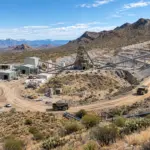
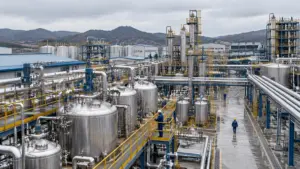
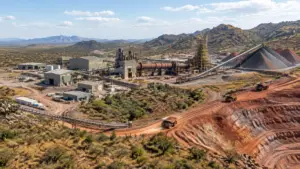
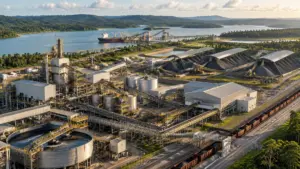
Rare earth separation infrastructure illustrates the supply chain’s midstream bottleneck.

By Charles Pitts
INTELLIGENCE HOOK : THE MIDSTREAM DECIDES WHAT REACHES MARKET
The defining constraint in critical minerals is no longer simply the ability to locate or permit ore. It is the ability to convert that material into qualified chemical, metal and magnet products through processing networks that remain concentrated in a small number of jurisdictions.
That distinction connects this edition’s major developments, from tungsten defense funding and Project Vault to Hudbay’s Copper World permits, Rio Tinto’s gallium demonstration plant and the capital required to build new North American supply chains.

1. REFINING IS THE BOTTLENECK
86% is the central supply-chain figure. Across key energy-transition minerals, the top three refining countries account for roughly that share of refined output, according to the IEA’s critical-minerals analysis. For refined rare earths and related midstream capacity, concentration is approximately 86% or higher depending on the processing stage and material counted.

A project can be permitted, financed and technically sound yet still fail to deliver saleable material if conversion capacity sits elsewhere. Ore production creates optionality; separation, refining, metalmaking and customer qualification determine whether that optionality becomes supply.
| Material | Indicative mining concentration | Indicative refining or processing concentration | Supply-chain implication |
|---|---|---|---|
| Rare earths | China about 60% of mining | China about 85%–91% of separation and refining | Mine diversification has not removed the separation bottleneck |
| Lithium | Australia, Chile and China together represent most mine supply | China about 65%–75% of chemical conversion | Spodumene and brine require specialized conversion capacity |
| Graphite | China about 75% of natural graphite mining | China above 90% of processing | Non-China mines remain dependent on downstream conversion |
| Cobalt | Democratic Republic of Congo about 70% of mining | China above 70% of refining | Mining and refining concentration occur in different jurisdictions |
| Gallium | China about 98% of primary production | China above 80% of refined supply | By-product recovery limits rapid substitution |
Indicative shares are not directly comparable across materials. The approximately 86% figure refers to concentration in refined rare earths and related midstream capacity, while some rows show the leading mining or processing jurisdiction.
Can boards approve new mine supply without securing conversion, qualification and offtake capacity at the same time?
2. TUNGSTEN AND THE DEFENSE STOCKPILE
US$150 million to US$175 million is the reported investment range for restarting the Springer Tungsten Complex in Nevada through a partnership involving Blue Moon Metals, Elmet and EQ Resources. The project includes a mine, mill and planned ammonium paratungstate plant, linking extraction to a higher-value chemical intermediate.
The Pentagon is also committing US$450 million to Elmet through redeemable preferred equity, warrants for up to 19.9% of common stock and board representation. Separately, the Defense Logistics Agency has awarded a contract with a ceiling of US$2 billion to supply tungsten ores, concentrates and sodium tungstate to the National Defense Stockpile. The contract includes a funded minimum, so the ceiling should not be treated as immediate revenue.
Tungsten is used in armor, armor-piercing munitions, aerospace systems, cutting tools and high-temperature applications. Skillings previously described it as the metal in every missile the United States still cannot fully produce at home. China supplies the majority of global output, making the restart a test of whether defense procurement can support an integrated alternative chain.
| Instrument | Reported scale | Strategic function |
|---|---|---|
| Blue Moon, Elmet and EQ Resources Springer restart | US$150 million–US$175 million | Restart mine, mill and APT processing in Nevada |
| Elmet equity and warrants | US$450 million | Expand U.S. tungsten manufacturing and supply |
| DLA stockpile contract | Up to US$2 billion | Create long-term procurement authority for the National Defense Stockpile |
| Almonty–Rwanda partnership | Rwanda 25% stake in subsidiary | Build allied collection, pre-concentration and processing capacity |

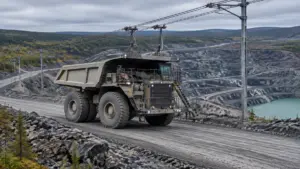
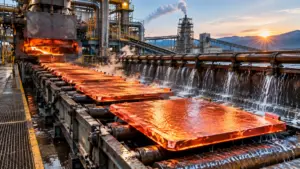
Tungsten processing infrastructure for an integrated defense supply chain.
Will the United States measure tungsten security by announced funding, or by qualified tonnes delivered from mine to finished component?
3. PROJECT VAULT : A BRIDGE, NOT A FIX
US$10 billion in financing under Project Vault is intended to establish a U.S. Strategic Critical Minerals Reserve, supported by nearly US$2 billion in private-sector capital. The initiative can provide manufacturers with inventory during disruption and give alternative suppliers time to qualify.
It cannot, by itself, create separated heavy rare earth capacity, magnet-making capability or qualified supply chains. China accounted for about 91% of rare earth refining and 94% of sintered permanent magnet production in 2024, according to the IEA figures cited in Skillings’ Project Vault analysis.
The timing is consequential. The suspension of broader Chinese export controls expires on Nov. 10, while some Chinese suppliers have already slowed shipments to U.S. and Japanese buyers. Brazil is building a parallel framework through a new critical-minerals law that includes a R$2 billion guarantee fund, up to R$5 billion in processing tax credits and a presidential council to screen foreign transactions. The European Commission has proposed a European Corporation on Critical Raw Materials for joint purchasing and stockpiling, but without a defined budget, legal structure or start date.
Can strategic reserves buy enough time for allied processing and magnet capacity to move from policy design into qualified commercial production?
4. HUDBAY COPPER WORLD, ARIZONA : PERMITS ARE NOT CAPITAL
85,000 tonnes per year is Hudbay Minerals’ planned Phase I copper output from Copper World over approximately 20 years. The project has cleared its major state permits, including aquifer protection, air quality and reclamation requirements. Its broader measured and indicated resource base is approximately 1.1 billion tonnes at about 0.36% copper, while the mine-plan reserve is higher grade.
The permitting milestone lowers jurisdictional risk but does not fund construction. Hudbay still faces the capital, power, water and copper-price assumptions required for a final investment decision. That distinction is central to the current U.S. copper pipeline: regulatory clearance can improve an asset’s strategic value without establishing economic certainty.
Freeport-McMoRan’s pending roughly US$4.5 billion Bagdad decision before year-end presents the same issue at larger scale. At Grasberg, operations are running at about 65% capacity, with full capacity planned by the end of 2027. In both cases, installed or permitted capacity only matters when capital and execution convert it into reliable output.

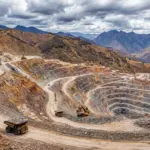
Copper processing infrastructure at industrial scale.
Which permitted copper projects can secure capital, power and water before the market’s next supply window closes?
5. GALLIUM AND URANIUM : FIRST POUR IS NOT QUALIFICATION
3.5 tonnes per year is the initial target associated with Rio Tinto’s gallium extraction demonstration at the Vaudreuil alumina refinery in Quebec. The company has since outlined a pilot plant at Complexe Jonquière, expected to validate the technology in an industrial environment, with a demonstration plant of up to four tonnes annually and a longer-term commercial ambition of 40 tonnes.
Denison Mines’ Phoenix in-situ recovery project at Wheeler River in Saskatchewan represents a different qualification chain. The project contains about 75.6 million pounds of U₃O₈, with initial output targeted near 6 million pounds per year. In both cases, first output is only an early milestone. Material must then pass customer qualification, specification testing and, ultimately, fab-level or reactor-fuel acceptance.
Saudi Arabia’s announcement of 110 million tonnes of rare earth- and uranium-bearing ore at Jabal Sayid, together with India’s MMDR amendment and Supreme Court ruling on state mineral-tax powers, shows how jurisdictions are rewriting access rules. Geological scale may attract attention, but commercial value still depends on extraction, processing, licensing and customer acceptance.
| Qualification stage | What must be demonstrated | Principal risk |
|---|---|---|
| Demonstration output | Stable recovery and product purity | Process performance may not scale |
| Customer qualification | Repeatable chemistry and specifications | End users may require multi-year testing |
| Commercial integration | Reliable delivery into a fab or reactor-fuel chain | First production does not guarantee offtake |
Will operators and policymakers value first production as a headline milestone, or as the beginning of the longer qualification process that creates real demand?
6. CAPITAL MARKETS, PRECIOUS METALS AND THE WORKFORCE
C$340 million in final funding brings Generation Mining’s Marathon copper-palladium project in Ontario closer to its approximately C$1.3 billion construction package. The financing combines a C$200 million bought deal, a C$40 million Canada Growth Fund placement and C$100 million of convertible notes, with early works expected in the fourth quarter.
Hancock Prospecting has taken 13.5% of White Cliff Minerals, while lithium supply cuts have removed roughly 500,000 tonnes of capacity from the market. USA Rare Earth has begun its US$1.2 billion South Carolina magnet plant, planned to produce up to 6,400 tonnes per year of sintered NdFeB magnets and 5,000 tonnes of rare-earth metal and alloy.
The precious-metals backdrop is less forgiving. Gold mining costs have crossed US$1,500 per ounce, while gold and silver declined as an oil rally and hot inflation increased expectations of further Federal Reserve tightening. The Fed raised rates by 25 basis points on a 12-0 vote, with 16 of 18 policymakers projecting another hike. The World Gold Council expects roughly 850 tonnes of central-bank gold buying during the year.
The workforce is now part of the production equation. Autonomous fleets, electrification and AI-assisted exploration are raising the technical bar, while FIFO rosters, trades shortages and higher labor costs constrain ramp-ups. China Geological Survey reporting that parts of the exploration cycle have compressed from roughly six months to about one week illustrates the productivity gap that operators must evaluate rather than simply assume.
| Scenario | Supply-chain outcome | Board-level indicator |
|---|---|---|
| Base | Allied projects advance, but refining remains concentrated | Qualification timelines and cost inflation |
| Bull | New separation, recycling and magnet plants reach commercial scale | Multi-stage supply contracts and reliable commissioning |
| Bear | Export controls tighten while projects face delays and labor shortages | Stockpile drawdowns, missed ramp-up targets and rising unit costs |
Is the industry prepared to treat technical talent, commissioning capability and automation readiness as production assets rather than overhead?
What to watch next week
- The Nov. 10 Chinese export-control expiry and follow-through from the Xi–Trump summit.
- Whether BIS black-mass and tungsten restrictions, effective Aug. 27, 2026, through Aug. 27, 2027, accelerate U.S. recycling and refining announcements.
- Denison Phoenix and Rio Tinto gallium qualification milestones, alongside India’s MMDR implementation and state royalty litigation.
- Details of Saudi and Brazilian critical-minerals frameworks, copper’s Section 232 window, and the Hudbay and Freeport capital decisions.
- AI-assisted exploration productivity claims, plus third-quarter cost reporting from gold producers after AISC crossed US$1,500 per ounce.
Mining, energy, and supply chains: explained without hype.
PowerMap: https://skillings.short.gy/PowerMap
Skillings Mining Review: https://skillings.net/ | Digital Daily: https://lnkd.in/genXr2Ga | Partnerships: advertising@skillings.net | Support: https://skillings.short.gy/subscribe