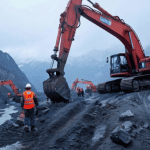
Sovereign Metals Ltd has announced the successful completion of a dry mining trial, which was marked by the excavation of a test pit as part of its ongoing pilot mining and land rehabilitation programme at the Kasiya Rutile-Graphite Project in Malawi.

Successful Excavation Confirms Efficient Mining Techniques
The test pit, spanning 120 meters by 110 meters and reaching a depth of 20 meters, confirms that Kasiya ore can be efficiently mined using conventional dry-mining techniques and a simple mobile excavator fleet. A 10-meter wide ramp, constructed at appropriate geotechnical angles, ensures accessibility.
“Completion of the test pit at this scale marks a significant achievement. The mining, hydrology, and geotechnical data collected throughout is invaluable in our understanding of the orebody and the simplicity of a potential dry-mining operation at Kasiya,” said Frank Eagar, Managing Director of Sovereign Metals.
Related news
- West Virginia Coal Mining Fatality: Woman Dies in Second Incident of 2024
- Anglo American under close investor scrutiny as BHP’s potential resurgence looms
- Former Barrick Gold CFO Shaun Usmar to Lead Vale’s Base Metals Unit
- Seafloor ‘Dark Oxygen’ Phenomenon Adds Complexity to Deep-Sea Mining Debate
Key Findings and Future Steps
The dry mining fleet used for the test pit consisted of four excavators, 20 trucks, and a support fleet, including two bulldozers and a motor grader. The saprolite-hosted mineralisation at Kasiya is largely homogenous and has consistent physical properties throughout the 1.8 billion-tonne mineral resource estimate. The pilot phase data confirmed that no drilling, blasting, crushing, grinding, or milling is required before stockpiling material for processing into rutile and graphite products. This indicates potentially lower mining costs and a reduced carbon footprint compared to hard rock deposits.
Approximately 170,000 bench cubic meters of material were mined during the test-pit programme. The steady-state operations envisage 24 million tonnes of material being mined annually. The test pit material will be processed through cyclones on-site for deposition test work.
More Read

Environmental Considerations and Next Steps
In the next steps of the pilot phase, the company will conduct a hydraulic mining trial, cyclone separation of ore, backfilling of test pits, and soil rehabilitation. The main pit will be backfilled with dry material, while material from hydraulic mining will be used to fill rehabilitation pits.

A temporary water storage pond has been constructed and sealed using natural clay from excavated material, minimizing the use of conventional plastic lining. The pond, which is nearing its capacity of 6 million litres, is being filled via eight boreholes delivering water to the site. This water will be initially used for the hydraulic mining stage.
“We now look forward to the next steps of the pilot phase including the hydraulic mining trial, cyclone separation of ore, backfilling of test pits, and soil rehabilitation,” added Eagar.
More Read
Sovereign Metals’ successful dry mining trial at Kasiya highlights the project’s potential for efficient, low-cost, and environmentally conscious mineral extraction, marking a pivotal step towards full-scale operations.