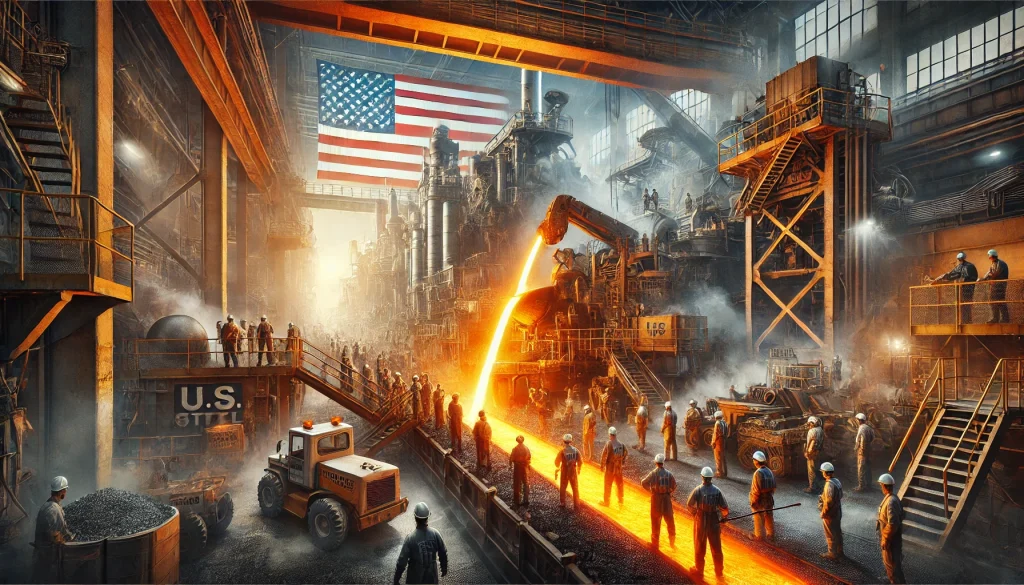
As President-elect Donald Trump gears up for his second term, his renewed focus on implementing aggressive tariffs targeting key trade partners—Canada, Mexico, and China—has raised concerns across industries. Having made tariffs a cornerstone of his 2024 campaign, Trump’s trade stance is expected to reshape US trade relations while deeply affecting critical sectors, including the US trade and steel industry as well as automotive manufacturing.

Canada and Mexico: Renewed Tariff Battles on the Horizon?
Trump has repeatedly criticized the United States-Mexico-Canada Agreement (USMCA), labeling it during his campaign as “the worst trade deal ever made.” Central to his critique is his proposal to impose a 25% tariff on imports from Canada and Mexico. If enacted, these measures could spark retaliatory tariffs and disrupt the trilateral trade relationship forged under the USMCA.
Industry experts are raising alarms. Warren Maruyama, former general counsel for the Office of the US Trade Representative, cautions that such tariffs would likely prompt reciprocal actions from Canada and Mexico. “It’s a lose-lose situation,” Maruyama warned, emphasizing that while domestic sectors such as the US steel industry might experience short-term gains, globally competitive industries like automotive manufacturing could suffer.
The potential impact is underscored by data. In November 2024, Canada and Mexico accounted for 23.06% and 12.54% of total US steel imports, respectively, according to the US International Trade Administration. Imposing tariffs would likely disrupt these flows, leading to ripple effects throughout supply chains.
Related News
- Terra Drone Arabia Showcases Advanced Drone Solutions at Future Minerals Forum 2025
- Minerals 260 Acquires Bullabulling Gold Project in $166.5 Million Deal
- Riyadh Innovation Hub: Newlab’s Launch to Support Mining Startups in Saudi Arabia
- Kutcho Copper’s High-Grade Opportunity: Poised for Electrification Demand
Automotive Sector in the Crosshairs
The US trade and steel industry isn’t the only sector affected. The potential tariffs could severely disrupt the integrated supply chains of the US auto industry, which depends heavily on seamless trade with Canada and Mexico. “The automotive sector is uniquely menaced by these tariff concerns,” said Samir Kapadia, chief operating officer at the Vogel Group. With car parts and finished vehicles regularly crossing borders, higher tariffs would increase costs, disrupt production schedules, and erode competitiveness.
More Read

China Remains a Target
China, another focal point of Trump’s trade strategy, could face a 10% tariff on all imports as part of efforts to curb illegal drug flows, according to Trump’s campaign rhetoric. While China accounted for only 1.67% of US steel imports in November 2024, the broader implications for US-China trade relations could be significant.

Kapadia suggests that Trump might strategically target tariffs on input materials like semiconductors and industrial components rather than consumer goods to reduce inflationary risks. Such actions could place added pressure on supply chains in technology and manufacturing—key sectors tied to both US trade and steel production.
Steel Industry: Beneficiary or Collateral Damage?
For the US steel industry, Trump’s tariff strategy could bring significant benefits. The Section 232 tariffs imposed during his first term resulted in higher steel prices and improved profit margins. From 2018 to September 2024, the average margin for hot-rolled coil production rose to nearly $640 per ton, compared to just over $400 per ton during the prior five years, according to Fastmarkets analytics.
More Read

Kapadia predicts a similar trend this time. “Steel prices will go up, and it’s going to be a good year for the [US] steel industry,” he noted. However, the broader economic consequences, including retaliatory measures from trade partners and negative effects on downstream industries like automotive, remain significant concerns.
Outlook: Trade, Industry, and Uncertainty
Trump’s tariff proposals signal a volatile future for US trade policy. While domestic steel production may benefit, the broader ripple effects on trade relations and key sectors, including automotive and technology, could harm the overall economy. With the USMCA set for review in 2026, Trump’s second term may usher in a period of intensified trade negotiations that could redefine the foundations of North American economic integration.
As Trump prepares to take the oath of office on January 20, 2025, the eyes of industry leaders, policymakers, and trade partners are on Washington. The stakes for the US trade and steel industry are immense, with the potential for profound shifts in the nation’s trade policy on the horizon.