In a move that blends economic ambition with national security strategy, President Donald Trump’s suggestion to “purchase” Greenland has reignited longstanding U.S. interest in the Arctic landmass. While dismissed as a diplomatic curiosity by some, the proposition underscores deeper geopolitical stakes, particularly in the realm of rare earth elements in Greenland—critical to modern technologies and defense applications.

A Renewed Interest in Greenland
The U.S. government’s fascination with Greenland is not new. The first recorded attempt to acquire the territory dates back to 1868, with a more concerted effort under President Harry Truman in 1946, when the U.S. offered Denmark $100 million in gold. Trump’s proposal to purchase Greenland during his 2019 term reflected a continuation of this historical pattern, though his methods were less conventional, sparking international debate.
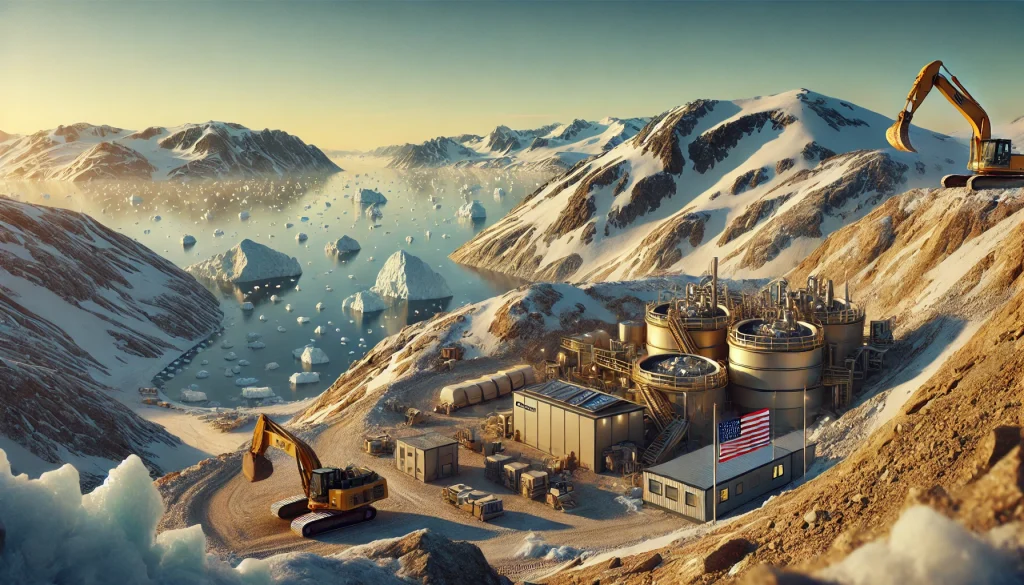
Unlike past attempts, Trump’s push ties directly to Greenland’s abundant reserves of rare earth elements, including neodymium, dysprosium, and scandium. These minerals are indispensable to the production of electric vehicles, wind turbines, advanced defense systems, and nuclear energy applications. Greenland’s Kvanefjeld deposit, a treasure trove of rare earths and uranium, makes the island uniquely valuable.
“Greenland is strategically vital, not just as a resource hub but as a potential chokepoint in global supply chains,” says Neha Mukherjee, senior critical minerals analyst at Benchmark Mineral Intelligence.
Related News
- Lithium-Ion Battery Recycling: A Game-Changer in Economic and Technological Stakes
- Nickel Prices Hit Four-Year Low Amid Economic and Supply Challenges
- Revitalizing the U.S. Uranium Mining Industry: A Strategic Imperative
- Antimony: Alaska’s Emerging Role in America’s Strategic Mineral Supply
The Rare Earths Equation
Rare earth elements are vital to the global economy, yet their production and processing remain heavily concentrated in China. As of 2024, China accounted for approximately 70% of global rare earth mining and 90% of processing. The dominance is even starker in heavy rare earths, critical for cutting-edge technologies like EV batteries and fiber optics, where Beijing commands 99% of processing.
More Read

This monopoly provides China with significant geopolitical leverage. Beijing has weaponized its control over rare earths, using export restrictions to exert pressure in trade disputes. In October 2024, China further tightened its grip by banning the export of REE extraction technologies. Such actions underscore the urgency for nations like the U.S. to diversify supply chains.

Greenland’s vast reserves of rare earth elements offer a solution. By establishing a foothold in Greenland, the U.S. could reduce reliance on Chinese rare earths, enhancing supply chain resilience and economic security.
Challenges to Diversification
Breaking China’s stranglehold on rare earth elements is easier said than done. Economies of scale, heavy government subsidies, and extensive stockpiles allow Chinese firms to undercut global competitors. Additionally, many rare earths are by-products of mining other minerals like iron ore, complicating efforts to ensure consistent production.
Moreover, developing Greenland’s resources presents its own set of challenges. Harsh Arctic conditions, environmental concerns, and geopolitical tensions could slow exploration and production efforts.
“Resource-rich regions like Greenland hold immense promise, but the infrastructure and investment required to operationalize these reserves are daunting,” Mukherjee notes.
Arctic Geopolitics: A Three-Way Contest
Greenland’s rare earth elements are only one piece of the Arctic puzzle. The region is increasingly a focal point for great-power competition, with Russia and China asserting their influence. Russia has prioritized the Northern Sea Route, a critical Arctic shipping lane, and is expanding its mining activities in the region. Meanwhile, China has declared itself a “near-Arctic state,” signaling its ambitions in the polar zone.
The U.S., for its part, sees Greenland as a critical counterbalance. Gaining access to its resources would not only secure rare earth element supply chains but also bolster U.S. strategic positioning in the Arctic. Trump’s framing of Greenland as a “national security” asset reflects this dual imperative.
Outlook: The Tug of War Continues
While Trump’s proposal to buy Greenland may not have gained traction, it brought attention to the strategic importance of the island’s resources. The Arctic, once a frozen frontier, is now a geopolitical hotbed where economic interests and national security intertwine.
As global demand for rare earth elements in Greenland surges, the island will likely remain a focal point for U.S. efforts to counter China’s dominance. However, realizing this potential will require navigating a minefield of environmental, logistical, and diplomatic challenges.