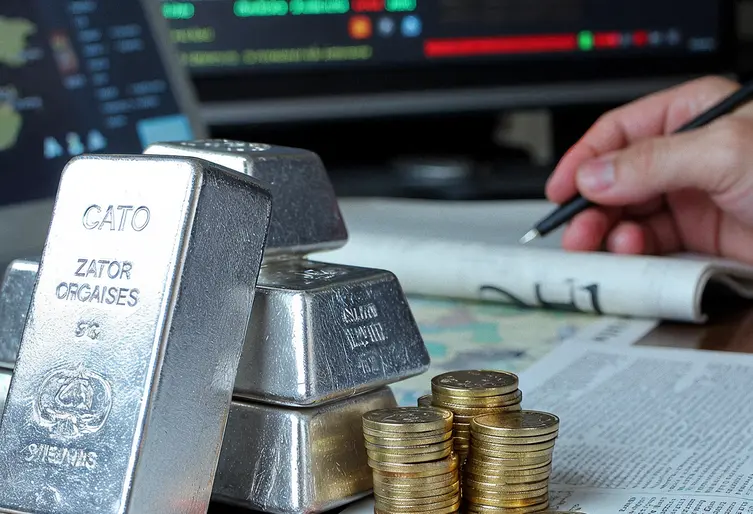

As gold prices consolidate and traders bank profits, attention is shifting sharply to silver—buoyed by a surge in short-term momentum, geopolitical jitters, and speculative fervor not seen since the 2011 bull run. But history, and the markets, may not be so easily outshone.
Spot silver climbed to $34.30 this week, marking a blistering rally that has traders eyeing $36.26 and $37.80 as early as April 7, provided the metal holds above $33.50. The metal’s trajectory, according to analysts, is being fueled less by inflation data and more by macro-political undercurrents, particularly rising global protectionism and instability among traditional U.S. allies.
“Silver is much more bullish than gold in the near term,” said a veteran metals strategist based in Singapore, who has tracked the sector for over two decades. “But April is historically brutal for silver—this time looks different due to trade-related geopolitics.”
Bullish Sentiment on Silver, but With a Caveat
The bullish case hinges largely on continued strength in physical demand from Asia, elevated central bank gold purchases, and deteriorating Western trade relationships. “Asia is buying. Europe’s central banks are restocking. And the U.S. is pivoting inward,” said the strategist. “It’s the perfect storm for precious metals.”
Still, experienced traders are approaching April with caution. Historically, silver has suffered significant price crashes in April, driven by macro headwinds, liquidity adjustments, or profit-taking following first-quarter rallies. This year, however, the calculus may have shifted.
More Read

“This is one of the rare times when the probability of an April silver crash is low,” the strategist noted. “But given past behavior, I’ll still be extremely cautious with short-term silver exposure.”

Auto Tariffs, NATO Tensions and the Gold Bid
U.S. trade policy remains central to market positioning. Former President Donald Trump’s proposed tariffs on imported automobiles are reviving tensions among NATO allies, with the economic blow set to land hardest on nations that have historically backed U.S. foreign policy initiatives, from Iraq to Afghanistan.
That irony is not lost on investors in Europe.
More Read

“Gold demand among NATO countries is going to rise sharply,” said a senior fund manager at a Frankfurt-based ETF provider. “There’s already a notable shift to physical ETFs and bullion products. Central banks are buying aggressively.”
According to the World Gold Council, central banks added 1,037 tonnes to global reserves in 2023, the second-highest annual total on record. Much of that came from Asia and Europe.
In this climate, gold’s safe-haven allure is likely to grow—even as silver steals the spotlight in the short term. “Silver may outperform tactically,” said the fund manager, “but the strategic flows are moving into gold.”
Inflation Numbers Lose Market Grip
U.S. February core PCE data—the Fed’s preferred inflation gauge—was released this week, but it failed to stir the precious metals markets. Traders appear more focused on fiscal and geopolitical tailwinds than monetary indicators.
“The market doesn’t care about February core PCE right now,” said an options strategist at a major U.S. brokerage. “What’s moving metals is a breakdown in global cohesion and the potential for a realignment in trade blocs.”
Indeed, there’s growing speculation about an emerging Asian trade coalition involving China, India, Russia, South Korea and Japan—a response to aggressive U.S. tariff policy that could reshape global demand chains and hard asset accumulation patterns.
“A united Asia won’t need the U.S.—not even for a pin,” said the Singapore-based strategist. “If they coalesce, the U.S. will suffer prolonged economic fallout, and the metals market will reflect that shift.”
What Could Derail Silver’s Run?
Despite the optimism, traders are warned not to leave intraday positions open next week. Spot silver faces stiff resistance at $35.35. A failure to break that level by April 7, coupled with a downturn in U.S. equities, could spark a sharp reversal.
Technical analysts point to $33.50 as the near-term floor. A breach could trigger sell-offs, especially if macro risk sentiment turns or equity markets falter.
“In this market, you have to trade light and fast,” said the options strategist. “Silver is not for the faint of heart, especially with April’s track record.”
Outlook: Flashy but Fragile
Silver is having a moment—but it’s balancing on a knife’s edge. The bullish setup remains intact for now, but fragile under the weight of macro uncertainty and technical resistance. Seasoned traders are riding the wave, but with tight stops and an eye on the exits.
Whether silver breaks out to $40 or buckles under April’s historical weight will depend less on inflation and more on how global alliances fracture—or hold—under economic pressure.