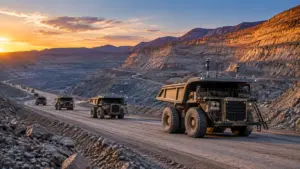
Autonomous electric mining trucks have hit a global milestone: China’s Huaneng Yimin Mine is now operating a fleet of 100 fully driverless, battery-powered haul trucks—the largest and most advanced deployment of such technology to date. The landmark project, nestled in the coal-rich Inner Mongolia Autonomous Region, positions China at the forefront of next-generation mining logistics, with an eye toward reducing carbon emissions and labor-intensive operations.

Owned by state-run utility giant China Huaneng Group, the Yimin open-pit mine is part of a broader push by Beijing to modernize its resource extraction industry. The deployment is being hailed as a pivotal moment in the shift toward zero-carbon mining, blending artificial intelligence, electric propulsion, and remote command infrastructure to create a more efficient and environmentally neutral mining model.
Related News
- U.S.-Led Peace Talks Could Unleash Rwandan Processing of Congo’s Critical Minerals
- Rare Earth Supply Chain Splinters as U.S. and Brazil Ramp Up Processing Capacity
- Green Hydrogen and Automation Are Redefining Mining—But Skills Lag Behind
- Mined Grassland Restoration in China: 7 Strategies to Tackle Carbon Loss Crisis
A Leap Forward for Automation and Emissions
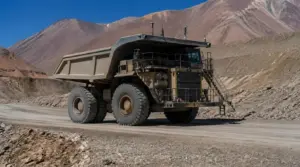
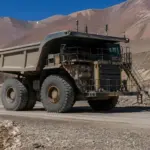
Each of the autonomous electric mining trucks—designed and manufactured by TAGE Idriver and CRRC Corporation—operates without human intervention, relying instead on a fusion of sensors, GPS modules, radar, and 5G communication to navigate rugged terrain. Capable of hauling over 90 tons of material per load, the trucks are powered by lithium-iron phosphate batteries and recharge at intelligent, on-site stations that optimize energy usage based on real-time grid demand.
The system’s software suite allows for coordinated fleet management, enabling continuous operations with minimal downtime. According to the Huaneng Group, the trucks have reduced overall energy consumption by 20% and lowered site-wide carbon emissions by approximately 30,000 metric tons annually.
“The transition to autonomous electric haulage not only improves operational safety and efficiency but also aligns with China’s decarbonization goals,” said Wu Gang, Director of Intelligent Mining at Huaneng.
More Read
Strategic Implications for Global Mining
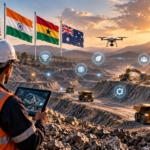
China’s move puts pressure on major mining nations—such as Australia, Canada, and the United States—to accelerate their own automation and electrification efforts. While companies like Rio Tinto and BHP have been experimenting with autonomous trucks in the Pilbara and Western Australia, none have matched the scale or full electrification achieved at Yimin.

The implications extend beyond coal. As the global race for critical minerals intensifies, particularly for lithium, copper, and rare earths, nations are increasingly viewing automation as essential for both cost efficiency and sustainability.
Industry analysts note that China’s investment in autonomous electric mining trucks serves dual purposes: it addresses domestic environmental mandates while also bolstering the competitiveness of Chinese industrial technology on the global stage.
Policy-Driven Innovation
This initiative is aligned with Beijing’s “Dual Carbon” strategy, which aims to peak carbon emissions before 2030 and achieve carbon neutrality by 2060. The Ministry of Industry and Information Technology (MIIT) has prioritized mining automation in its 14th Five-Year Plan, offering subsidies and tax incentives for smart mining technologies.
Huaneng’s Yimin project received funding support from the National Development and Reform Commission and leveraged research partnerships with Tsinghua University and the China University of Mining and Technology.
While the shift to electrified mining vehicles remains capital-intensive, the cost savings in fuel, labor, and maintenance are expected to yield positive ROI within five years, according to internal Huaneng projections.
Future Outlook
Huaneng has confirmed plans to expand autonomous electric operations to other mines across its portfolio by 2026. Global competitors are watching closely, with Volvo, Komatsu, and Caterpillar already trialing similar vehicles.
The autonomous electric mining trucks at Yimin Mine may be just the beginning of a deeper transformation in extractive industries—one that redefines productivity through the lens of decarbonization and digitalization.