By Charles Pitts

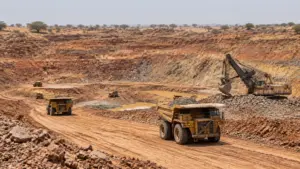
Autonomous mining technology is moving from isolated pilot projects into routine production across surface and underground operations. In September, EACON said its autonomous solution had been deployed on more than 1,500 battery-electric mining trucks, representing about 42% of its autonomous fleet.
The figure illustrates how quickly autonomy and electrification are converging. The latest deployments also show that adoption is no longer limited to the largest iron ore or coal mines. Caterpillar and Luck Stone are extending autonomous haulage to two additional Virginia quarries; Africa’s first underground autonomous electric locomotive haulage project has entered routine operation at Zambia’s Chambishi copper mine; and Canada Nickel has selected Komatsu and SMS Equipment for a planned autonomous and electrified fleet at Crawford.
At the same time, First Quantum Minerals has secured UK patent and trademark protection for its Quantum Electra-Haul trolley-assist system, highlighting the growing importance of proprietary power and haulage architectures.
Citable insight: Autonomous mining is shifting from a vehicle purchase to a mine-wide operating model in which haulage, energy, workforce design, cybersecurity and fleet software must work as one system.
From 1,500 electric trucks to broader deployment
EACON’s September 2026 update marks a significant increase from the company’s earlier disclosed deployment base. In a 2025 case study, EACON reported more than 450 autonomous battery-electric haul trucks and more than 5 million kilometres of operating experience. Its latest company-reported figures now place the battery-electric fleet above 1,500 units.
EACON says its overall autonomous fleet exceeds 3,500 trucks. Battery-electric units therefore account for approximately 42%–43% of the total, depending on rounding. The company’s ORCASTRA platform combines autonomous vehicle control with dispatch, energy management and charging coordination.

The importance of the figure is not only scale. EACON’s system is designed to operate across different truck models and mixed fleets, which could give mine operators a pathway to automation without replacing every vehicle at once. The economics will still depend on truck age, site geometry, communications infrastructure and the cost of retrofitting drive-by-wire, sensing and safety systems.
The company has reported that its battery-electric autonomous deployments can reduce energy costs compared with diesel and hybrid-electric equipment. Those figures are company claims and should be evaluated against local electricity prices, charging infrastructure, battery replacement costs and mine utilization.
Autonomy expands beyond large open pits
Caterpillar and Luck Stone are taking autonomous haulage into a different operating environment: aggregates quarries.
Following an 18-month autonomous haulage pilot at Luck Stone’s Bull Run Quarry in Virginia, Caterpillar said the Cat 777 fleet had moved more than 3.5 million tons autonomously since going live in November 2024. The partners are now expanding the program to the Boscobel and Bealeton quarries, using Cat 775 trucks supported by Carter Machinery.
According to Caterpillar, the expansion represents the first deployment of its autonomous haulage solution on the Cat 775 model. That matters because quarry operations generally involve smaller fleets, shorter haul routes and tighter operating areas than the ultra-class surface mines where autonomy first became established.
The quarry rollout is a test of whether autonomous mining technology can deliver value at a broader range of production scales. It also indicates that autonomy providers are adapting systems for mixed equipment, confined work areas and more frequent interactions between haul trucks, loaders, service vehicles and people.

Remote operating teams increasingly supervise equipment, exceptions and production data rather than operate individual trucks.
Underground autonomy reaches routine operation in Zambia
At Chambishi Copper Mine in Zambia, Africa’s first underground autonomous electric locomotive haulage project has passed final acceptance inspection and entered routine operation, according to China Nonferrous Metal Mining Group.
The system uses unmanned electric locomotives on underground rail routes serving the Chambishi Main and West ore bodies. Centralized monitoring and control are integrated into the mine’s broader digital management platform.
Underground rail haulage presents a different autonomy challenge from surface truck fleets. Positioning, communications and traffic management must function in enclosed areas with limited line of sight, changing tunnel conditions and complex interaction with production schedules.
The Chambishi project is significant because it moves autonomous electric haulage beyond demonstration status. Routine operation provides a stronger test of reliability, maintenance requirements and workforce integration than a short-duration pilot.
For copper, nickel and gold mines, underground rail autonomy could reduce worker exposure in active haulage areas while improving cycle consistency. It may also support remote operating centers that coordinate drilling, loading, transportation and processing across multiple production zones.
Crawford combines autonomy, electrification and fleet management
Canada Nickel has selected Komatsu and SMS Equipment to supply the planned load, haul and support fleet for the Crawford Nickel Project in Ontario.
The company said the proposed fleet would include more than 300 machines with a current value of approximately C$1.5 billion over Crawford’s expected 40-year mine life. Canada Nickel selected the suppliers after reviewing proposals from four equipment vendors.
The planned technology platform includes Komatsu’s DISPATCH fleet-management system and FrontRunner autonomous haulage technology. Canada Nickel CEO Mark Selby also cited Komatsu and SMS experience with trolley-assisted truck haulage, which can reduce diesel use and support a future transition toward battery-electric vehicles.
The company expects to negotiate definitive agreements, including fleet-support arrangements and financing arrangements with Taykwa Tagamou Nation, by the first quarter of 2027.
Crawford illustrates an important distinction between retrofitting autonomy into an existing mine and designing a new operation around automation. A new project can plan haul roads, power distribution, communications, charging areas and control rooms around autonomous production from the start. That can reduce integration risk, although it also concentrates more capital and execution risk before commissioning.
Trolley-assist economics remain relevant
Battery-electric trucks are not the only route to lower-emission haulage. Trolley-assist systems can use overhead electrical lines on uphill ramps, allowing trucks to draw power directly from the grid while their diesel engines are reduced or switched off.
First Quantum Minerals received a UK patent and trademark in 2026 for its Quantum Electra-Haul trolley-assist system. The company said it has more than 14 years of experience designing and operating trolley-assist systems and had more than 15 kilometres of trolley line installed across its three largest sites.
First Quantum reported that its trolley systems can reduce diesel use by up to 90% on fully loaded uphill sections and save approximately two minutes per trolley-assisted stretch. It also said the technology saved an estimated 45,000 tonnes of greenhouse-gas emissions in 2025.
Those results are site-specific. Trolley assist is most suitable where haul routes are long, ramps are steep, power is available and truck traffic is sufficiently dense to justify overhead infrastructure. Battery-electric trucks may offer greater flexibility, but trolley systems can provide high-power energy delivery without requiring the full battery capacity needed for an entire haul cycle.
The two approaches can also be combined. First Quantum is continuing a trial of a full-battery ultra-large dump truck with trolley assist at its Kansanshi copper and gold mine in Zambia.

Trolley assist can reduce diesel consumption on high-load uphill sections while supporting the transition to electric haulage.
Autonomous mining deployment tracker
| Development | Reported scale | Technology | Operating context | What it indicates |
|---|---|---|---|---|
| EACON | 1,500+ battery-electric trucks; 3,500+ autonomous trucks overall | ORCASTRA autonomous haulage and energy management | Surface mines and quarries | Battery-electric autonomy is scaling beyond isolated pilots |
| Caterpillar and Luck Stone | Three Virginia quarries in the program after Bull Run pilot | Cat autonomous haulage on 775 and 777 trucks | Aggregates | Autonomy is moving into smaller and more confined operations |
| Chambishi Copper Mine | Routine operation following final acceptance | Autonomous underground electric locomotives | Underground copper | Rail autonomy is advancing from project stage to production |
| Crawford Nickel Project | More than 300 planned machines; C$1.5 billion current value | Komatsu FrontRunner and DISPATCH | Planned open-pit nickel mine | New mines can design automation into the operating model |
| First Quantum | More than 15 km of trolley line across three major sites | Quantum Electra-Haul | Copper and gold operations | Trolley assist remains a practical electrification bridge |
Sources: company announcements and disclosures. Reported figures are not directly comparable because companies use different definitions for deployed, commissioned and planned equipment.
Adoption scenarios for 2026–2028
The following framework is an editorial scenario model for the share of eligible haulage activity using autonomous control. It is not company guidance or an investment forecast.
| Scenario | 2026 penetration of eligible haulage | 2028 penetration | Operating conditions | Main constraint |
|---|---|---|---|---|
| Bear | 8%–15% | 15%–25% | Limited network coverage, slow permitting and manual-autonomous segregation | Reliability, cybersecurity and stranded infrastructure |
| Base | 15%–25% | 30%–45% | Selective automation on repeatable routes; mixed diesel, trolley and electric fleets | Workforce transition and interoperability |
| Bull | 25%–40% | 50%–70% | Integrated dispatch, charging, trolley assist and remote supervision | Grid capacity, capital availability and supply-chain execution |
The base case assumes autonomy first reaches repetitive haul cycles with predictable routes. The bull case requires more than capable trucks. It depends on reliable private wireless networks, high-quality positioning, common data standards, charging or trolley infrastructure and an operating workforce trained to manage exceptions.
Labour, interoperability and cybersecurity
Labour constraints are a major reason operators are evaluating autonomous mining technology. Remote and fly-in, fly-out sites face shortages of experienced drivers, technicians, dispatchers and maintenance specialists. A remote operating center can broaden the recruitment pool, but it does not eliminate the need for skilled workers.
Autonomous fleets require people who can supervise multiple machines, investigate abnormal behavior, manage traffic interruptions and maintain sensors, batteries, networks and control systems. The workforce changes from one centered on individual vehicle operation to one focused on fleet supervision, reliability and data.
Interoperability is another critical issue. A mine may operate equipment from Komatsu, Caterpillar, Epiroc, Sandvik and other suppliers. Vendor-specific autonomy platforms can speed deployment, but incompatible data structures and control systems can create long-term lock-in. Operators should therefore assess open interfaces, traffic-management compatibility and the ability to operate safely in mixed fleets.
Cybersecurity must be treated as an operational safety issue, not only an information-technology concern. A compromised dispatch system, positioning network or remote-control link could affect production and worker safety. Mines will need network segmentation, identity controls, secure software updates, intrusion monitoring, backup communications and manual fallback procedures.

Underground electric locomotive autonomy depends on reliable signaling, communications and centralized traffic control.
What decision-makers should monitor
Four measures will show whether autonomous mining technology is delivering production value:
- Intervention rates: How often does a remote operator need to take control?
- Availability: Does the autonomous fleet maintain production during network, sensor or charging interruptions?
- Cost per tonne: Are energy, labour and maintenance savings exceeding software and infrastructure costs?
- Integration depth: Are haulage, charging, mine planning and processing coordinated through one operating system?
The September developments suggest that the sector is entering a more practical phase. EACON’s 1,500-plus battery-electric trucks demonstrate scale. Caterpillar and Luck Stone are testing autonomy in quarries. Chambishi shows that underground electric rail can move into routine operation. Crawford is incorporating autonomy into a new nickel mine design, while First Quantum is protecting and expanding trolley-assist technology.
The central question for operators is no longer whether a truck can drive without a person in the cab. It is whether the mine can coordinate machines, energy, people and data more reliably than a conventional operation.
Sources and further reading
- EACON: Large-scale autonomous battery-electric haulage deployment
- Caterpillar: Luck Stone expands autonomous hauling in Virginia
- CNMC: Chambishi autonomous electric locomotive project
- Canada Nickel selects Komatsu and SMS Equipment for Crawford
- First Quantum: Quantum Electra-Haul patent and trademark
- Skillings: Remote operating centers and mining automation
- Skillings: Underground and surface autonomous fleets