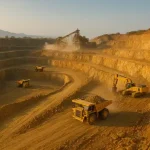
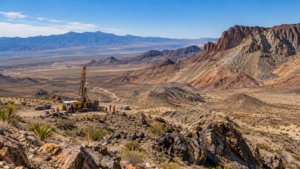
When Ottawa unveiled its list of five “nation-building” projects under a new federal fast-track program, two were copper mines: Newmont’s Red Chris block-cave expansion in northwest British Columbia and Foran Mining’s McIlvenna Bay build in Saskatchewan. The Prime Minister’s Office says Red Chris alone could lift Canada’s copper production by more than 15%, extend mine life by a decade, and support thousands of jobs during construction. Paired with a greenfield copper-zinc mine in Saskatchewan now slated for commercial production in mid-2026, the government has effectively placed copper at the centre of its growth model—grids, EVs, and the power-hungry data centres driving artificial intelligence.

Fast-track policy meets a supply gap
The federal Major Projects Office (MPO) was created to compress permitting timelines that can stretch a decade or more. Its inaugural roster leaned heavily on copper, repeating the claim that Red Chris alone could deliver a >15% boost to national output. That scale matters: according to Natural Resources Canada, domestic copper production fell 22% between 2014 and 2023 (from 654,000 tonnes to 508,000 tonnes). The drop has coincided with accelerating global demand for electrification, leaving Canada more exposed in North American supply chains.
Ottawa’s decision to front-load copper is therefore more than political optics—it is an attempt to arrest structural decline and signal to investors that Canada remains serious about supplying the energy-transition metals its allies increasingly demand.
What the projects actually add
Red Chris (B.C.): Block cave expansion
After acquiring Newcrest, Newmont (70%) and partner Imperial Metals (30%) moved quickly to advance a block-cave at Red Chris. Newmont’s technical disclosures and B.C. government engagement packages point to a >15% lift in Canada’s copper production once the underground mine is fully online. By leveraging existing mills, roads, and power connections, the project also aims to reduce emissions intensity per tonne. Imperial’s latest updates show copper output trending higher even before the block-cave ramps.
McIlvenna Bay (Saskatchewan): Building a district
Foran Mining reports construction 56% complete, with a 100,000-tonne stockpile already built. The company says the project remains on budget and on schedule for mid-2026 commissioning. Saskatchewan has now included McIlvenna Bay in its critical minerals incentives, aligning provincial support with federal priorities. While the first-phase tonnage will not vault Canada into the global top tier, Foran controls a 140,000-hectare land package surrounding the mine. The strategy is explicitly district-building: infrastructure installed for McIlvenna can serve future deposits across the Trans-Hudson corridor.
More Read

Why copper, and why now
- Electrification load: Copper is the essential conductor for transmission, motors, and renewable installations. Ottawa’s messaging connects the metal to EV adoption, grid upgrades, and the surging power demand from AI-driven data centres.
- Geopolitical reliability: Canada holds less than 1% of global copper reserves, far behind Chile’s ~19%. Building domestic production is as much about supply security for Canada and the U.S. as it is about economics.
- Cycle positioning: Global miners and analysts warn of a structural copper deficit late this decade. By fast-tracking Red Chris and McIlvenna, Ottawa positions Canada to catch the upcycle rather than import at peak prices.
The real boost: signal, speed and spillovers
In the near term, the tonnage is helpful but not transformative. The greater value is in policy certainty and execution speed that capital markets can underwrite.

- In B.C., Red Chris is tied into an existing mill, workforce, and grid—reducing cost risk.
- In Saskatchewan, McIlvenna Bay brings fresh infrastructure to a region long without a copper-zinc build, lowering the hurdle rate for juniors exploring the belt.
Together, these projects reset investor expectations after years of stagnation and demonstrate that Canada is once again prepared to permit, finance, and build large copper assets.
Execution watch-outs
Block caves are capital-intensive and technically sensitive to cave propagation and ventilation. Commissioning curves can be uneven. For McIlvenna Bay, much will depend on ramp discipline, metallurgical performance, and sustaining capital as the mine moves from start-up to steady-state. Both projects must also manage community relations, environmental compliance, and tailings to meet modern investor and regulatory standards.
More Read

Skillings analysis
- Policy leverage matters: The MPO, paired with provincial incentives, creates a credible path to first copper—often the missing piece in Canadian project timelines.
- Signal over size: Red Chris’s >15% lift is real, but the more powerful effect is crowding in exploration dollars across B.C. and Saskatchewan.
- Cycle timing: With production down more than a fifth since 2014, landing new tonnes into mid-decade demand is smart cycle math for Ottawa and operators alike.
Looking ahead
Into year-end and the first half of 2026, market attention will focus on Red Chris’s block-cave feasibility milestones and McIlvenna Bay’s construction cadence. If both projects stay on track, Canada will re-enter the copper conversation not just with incremental tonnes but with a repeatable playbook—one that could speed approvals for the next wave of copper, nickel, and battery-metal projects waiting in the queue.