The Democratic Republic of Congo just dropped a bombshell on the global mining industry. On January 9, 2026, Kinshasa unveiled the MIFOR project: Mines de Fer de la Grande Orientale: a $28.9 billion iron ore and logistics mega-development that, if it actually gets built, would reshape how the world sources its steel feedstock.

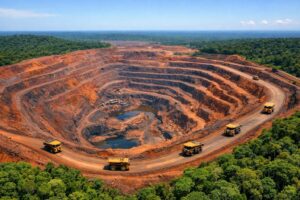
This isn’t some incremental expansion. The DRC is swinging for the fences here, targeting a resource base of 15 to 20 billion tons of iron ore at an average grade of around 60%. That’s world-class material sitting in one of the most resource-rich yet infrastructure-poor regions on Earth.
For a country synonymous with copper and cobalt: and all the supply chain anxiety that comes with it: this marks a strategic pivot that mining executives and commodity investors need to take seriously.
The Scale Is Almost Absurd
Let’s put the numbers in perspective. The initial production target sits at 50 million tons per year. That alone would make the DRC a significant iron ore exporter overnight. But the government isn’t stopping there. Plans call for expansion to 300 million tons annually.

More Read
To give you a reference point: Guinea’s Simandou project, which has consumed decades of planning, billions in capital, and enough corporate drama to fill a Netflix series, targets around 120 million tons per year at full capacity. The DRC is talking about more than doubling that figure.

Over a projected 25-year operating life, MIFOR could generate cumulative revenue exceeding $679 billion with net cash flow hitting $308.2 billion. Those numbers come from the government’s own projections using what they describe as “conservative market assumptions.” Take that with the appropriate grain of salt, but even at half those figures, you’re looking at a transformational asset.
Infrastructure: The Make-or-Break Factor
Here’s where it gets interesting: and where the whole thing could fall apart or come together spectacularly.
More Read
The iron ore deposits sit in the former Orientale province, now carved into Ituri, Haut-Uélé, Bas-Uélé, and Tshopo. If you’ve followed DRC mining at all, you know this region presents logistical nightmares that would make even the most seasoned project managers lose sleep.
The $28.9 billion price tag encompasses not just extraction and processing facilities but an entire multimodal logistics corridor. We’re talking heavy-haul rail lines, river transport utilizing the Congo River system, and critically, a connection to the deep-water port of Banana on the Atlantic coast.

Banana matters. A lot. It’s the DRC’s only direct ocean access, sitting at the mouth of the Congo River. Developing proper deep-water port capacity there would give the country something it desperately lacks: an efficient export route for bulk commodities that doesn’t depend on neighbors or rickety colonial-era infrastructure.
For context, most of the DRC’s copper and cobalt currently moves through Zambia, Tanzania, or South Africa: a situation that adds cost, complexity, and geopolitical risk to every ton shipped. An operational Banana port handling 50 million tons (eventually 300 million tons) of iron ore would fundamentally change the equation.
The Elephant in the Room: No Feasibility Study
Now for the uncomfortable part. Despite the eye-popping numbers and ambitious timelines, MIFOR lacks a formal feasibility study. The government references “resources” rather than “extractable reserves”: and in mining, that distinction matters enormously.
Resources are what geologists think might be there based on available data. Reserves are what engineers have confirmed can be economically extracted with current technology at current prices. Moving from one category to the other requires drilling programs, metallurgical testing, mine planning, environmental assessments, and typically hundreds of millions of dollars in pre-development spending.
International investors have reportedly expressed interest in MIFOR. But as of mid-January 2026, no binding commitments exist. The financing structure remains unclear. The implementation timeline hasn’t been announced. An expanded inter-ministerial commission has been established to oversee strategic direction, which is bureaucrat-speak for “we’re still figuring this out.”

None of this means MIFOR won’t happen. Massive projects in challenging jurisdictions get built all the time: just look at Simandou finally moving forward after years of false starts. But anyone evaluating this opportunity needs to understand the current maturity level. This is early-stage, high-concept stuff that will require years of de-risking before shovels hit dirt at scale.
Why the DRC Is Making This Move Now
The timing here isn’t accidental. The DRC has watched its copper and cobalt sectors attract enormous attention: and enormous problems. Artisanal mining concerns, ESG scrutiny, supply chain audits, and the constant pressure of being the world’s dominant cobalt source have taken a toll.
Diversifying into iron ore offers several strategic advantages. The commodity is more mature, the end markets are more diverse, and the ESG profile is generally less fraught than battery metals extraction. Steel isn’t going away anytime soon, regardless of how the energy transition plays out. If anything, building renewable infrastructure requires massive amounts of steel.
China’s record-breaking iron ore imports in 2025: 1.26 billion tons: demonstrate that demand remains robust despite property sector headwinds. Global supply growth projections for 2026 suggest markets can absorb additional tonnage, though price pressure remains a concern if too much new supply hits simultaneously.
For the DRC government, MIFOR represents a chance to build world-class infrastructure that serves multiple purposes. Rail and port facilities designed for iron ore could eventually support other bulk commodities. Employment and tax revenues would diversify beyond the copper belt. And critically, the country would gain leverage in global commodity markets where it currently plays no meaningful role.
What Investors and Industry Watchers Should Monitor
Several key milestones will determine whether MIFOR transitions from ambitious announcement to actual development:
Feasibility study completion – Until independent engineers validate the resource estimates and produce bankable economics, this remains conceptual. Watch for announcements of drilling programs and technical partnerships.
Financing commitments – $28.9 billion doesn’t materialize from government budgets alone. Major mining houses, sovereign wealth funds, or Chinese state-backed entities will need to write big checks. Track who shows up at the table and on what terms.
Infrastructure progress – The rail and port components are arguably more important than the mines themselves. Any movement on Banana port development or heavy-haul rail construction signals real commitment.
Political stability – The DRC’s eastern regions have faced ongoing security challenges. While MIFOR’s location differs from the most conflict-affected areas, investors will price in sovereign risk heavily.

The Bigger Picture for Global Iron Ore Markets
If MIFOR achieves even a fraction of its stated potential, it adds another major source of high-grade iron ore to global supply. Combined with Simandou’s development in Guinea and ongoing expansion in Australia and Brazil, the 2030s could see a significant reshaping of iron ore trade flows.
For steel producers, more supply diversity is generally positive: it reduces dependence on any single jurisdiction and creates competitive tension among suppliers. For incumbent producers like BHP, Rio Tinto, and Vale, new African supply represents both a challenge to market share and potentially an opportunity for partnership or acquisition.
The DRC itself stands at a crossroads. Execute MIFOR successfully, and Kinshasa demonstrates it can deliver complex mega-projects that attract international capital. Fumble the execution, and the skeptics who’ve always questioned African mining megaprojects get another data point.
Either way, the announcement itself signals intent. The DRC wants to be more than the world’s cobalt supplier. Whether that ambition translates into 300 million tons of iron ore moving through Banana port remains the $29 billion question.
For ongoing coverage of African mining developments and global commodity markets, visit Skillings Mining Review.