By Penny Laneford | January 24, 2026

Washington is done playing nice on critical minerals. After years of hand-wringing about supply chain vulnerabilities and China’s stranglehold on processing capacity, the federal government is finally putting real money where its mouth is: $2.5 billion, to be exact: while simultaneously strong-arming allied nations into building what officials are now calling a “Mineral Shield” against Beijing’s dominance.
The dual-track approach, combining executive action with bipartisan legislation, represents the most aggressive move yet in the intensifying mining geopolitics of 2026. And unlike previous half-measures, this one has teeth.
The Executive Order: Allies or Tariffs
On January 15, President Trump signed an executive order titled “Adjusting Imports of Processed Critical Minerals and Their Derivative Products into the United States”: a mouthful of bureaucratese that boils down to a simple ultimatum for US allies: help us secure these supply chains, or face trade consequences.
The order directs the Secretary of Commerce to negotiate agreements with foreign partners to guarantee adequate US supplies of processed minerals. If those negotiations fail? The order explicitly contemplates tariffs and import restrictions. Not exactly the velvet glove approach.
More Read

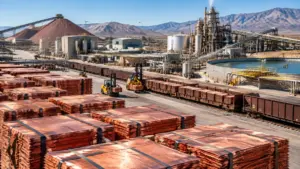
Here’s the thing that makes this order different from previous posturing: it acknowledges the actual problem. The United States is the second-largest producer of unmined rare earth oxides on the planet. We’ve got the rocks in the ground. What we don’t have: what we’ve systematically offshored for decades: is the processing capacity. American miners dig up rare earths, ship them overseas for refining, and then buy back the finished materials at whatever price foreign processors decide to charge.

It’s an absurd arrangement, and one that leaves Washington entirely at the mercy of foreign processing capacity: most of which sits in China.

More Read

The executive order embeds critical minerals security into a framework of international trade negotiation and shared supply chain resilience with “trusted partners.” Canada, Australia, and select European nations are the obvious targets for these partnerships. The message to allies is clear: get your lithium stockpile programs in order, expand your processing facilities, and coordinate with Washington: or watch US trade policy become considerably less friendly.
The SECURE Act: $2.5 Billion to Build a Buffer
The legislative piece arrived the same day as the executive order, and the timing was no accident.
The SECURE (Securing Essential and Critical U.S. Resources and Elements) Minerals Act dropped on January 15, introduced by a bicameral, bipartisan group that includes Senators Jeanne Shaheen (D-NH) and Todd Young (R-IN), alongside Representatives Robert Wittman (R-VA) and John Moolenaar (R-MI). The fact that you’ve got Democrats and Republicans on this together tells you something about how seriously both parties are now taking the China mining threat.
The bill’s centerpiece is the Strategic Resilience Reserve (SRR): a new independent government corporation that would receive $2.5 billion in funding authorization. The SRR would be run by a seven-member board appointed by the President and confirmed by the Senate, with a mandate to support domestic production and processing of minerals vital to clean energy and national defense.
What can the SRR actually do? Three things, mainly:
Financial contracts with domestic miners and processors to guarantee purchase agreements and reduce investment risk. Stockpiling of critical materials to buffer against price volatility and supply disruptions. And market analysis to identify vulnerabilities before they become crises.
The bill prioritizes domestic projects and US-based supply chains while incorporating recycling initiatives. It specifically targets minerals where American import dependence approaches 100%: which, for certain rare earths and specialty metals, is exactly where we are right now.
Why Congress Is Finally Moving
The politics here have shifted dramatically. Five years ago, critical minerals legislation was a niche concern championed by a handful of defense hawks and mining industry lobbyists. Today, it’s a mainstream priority with genuine bipartisan energy.
The reasons aren’t complicated. Electric vehicle batteries need lithium, cobalt, and nickel. Wind turbines need rare earths for their magnets. Defense systems: everything from fighter jets to guided missiles: depend on specialty metals that the US cannot currently produce domestically in sufficient quantities.

China controls roughly 60% of global rare earth mining and, more critically, about 90% of rare earth processing. Beijing has already demonstrated its willingness to use that leverage: the 2010 export restrictions against Japan over a territorial dispute remain fresh in policymakers’ memories, and recent supply chain disruptions have only reinforced the vulnerability.
The SECURE Act’s path forward looks promising. The House Committee on Natural Resources has scheduled a mark-up hearing, and Senate leadership is actively considering including the legislation as part of the National Defense Authorization Act (NDAA). Attaching it to the NDAA would virtually guarantee passage: defense bills don’t fail in Washington.
The Allied Coordination Challenge
Building a genuine “Mineral Shield” among allied nations presents its own complications. Australia has substantial lithium and rare earth deposits but limited processing infrastructure. Canada offers nickel, cobalt, and potential rare earth development. The European Union has been pushing its own Critical Raw Materials Act but faces NIMBY opposition to new mining projects.
Coordinating stockpiling strategies, processing investments, and supply guarantees across multiple sovereign nations: each with their own domestic political pressures: is exactly as difficult as it sounds. But the alternative is continued dependence on China, and Washington has apparently decided that’s no longer acceptable.
The executive order’s threat of tariffs if negotiations fail serves as both carrot and stick. Allied nations that cooperate can expect preferential trade treatment and access to US markets. Those that drag their feet risk finding themselves on the wrong side of American trade policy.
What Comes Next
The Strategic Resilience Reserve, if funded and operational, would represent the first serious US government intervention in critical minerals markets since the Cold War-era strategic stockpiles. The $2.5 billion authorization is substantial but not unlimited: actual appropriations will determine how much of that money actually flows.
For the mining industry, the implications are significant. Domestic lithium projects that have struggled to secure financing may find the SRR willing to provide purchase guarantees. Rare earth processing facilities: expensive, technically challenging, and previously considered too risky for private capital: might finally pencil out with government backing.
The geopolitical dimensions are equally consequential. If Washington successfully builds a coordination framework with allied nations: shared stockpiles, joint processing investments, aligned trade policies: it would fundamentally reshape the global critical minerals landscape. Beijing’s leverage would diminish. Price volatility would decrease. And the mining geopolitics of the next decade would look very different than the past one.
That’s a lot of “ifs,” of course. Legislative timelines slip. Diplomatic negotiations stall. Funding gets diverted to other priorities.
But for the first time in years, there’s genuine momentum behind critical minerals security in Washington. The executive order has teeth. The legislation has bipartisan support. And the underlying vulnerabilities: American dependence on Chinese processing, the strategic importance of lithium and rare earths, the defense implications of supply chain disruption: aren’t going away.
The Mineral Shield concept is moving from think-tank white papers to actual policy. Whether it works remains to be seen. But the conversation has fundamentally shifted, and that alone is significant.
For more coverage on mining geopolitics and critical minerals policy, visit Skillings Mining Review.