The United States has spent the better part of a decade talking about rare earth independence. Most of it was white papers and diplomatic hand-wringing. But here is the uncomfortable reality: talking doesn’t build a supply chain. Infrastructure does.

MP Materials just moved the needle from conversation to concrete. The company has officially greenlit “Project 10X,” a massive $1.25 billion rare earth magnet manufacturing campus in Northlake, Texas. This isn’t just another factory; it is a 120-acre statement of intent. By 2028, this site aims to produce 10,000 metric tons of neodymium-iron-boron (NdFeB) magnets annually.
For perspective, that is roughly the same amount the U.S. currently imports from China every single year. This isn’t a rounding error. It is a strategic decoupling.
The Northlake Blueprint: Beyond Assembly
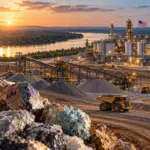
Located less than 10 miles from the company’s existing Fort Worth plant, the Northlake campus represents the final piece of the vertical integration puzzle. While many domestic “green” initiatives rely on imported precursors, MP Materials is building a closed-loop system.
The facility will handle the full lifecycle:
More Read
- Refining and metallization.
- Alloying and sintering.
- Finished magnet production.
- End-of-life recycling.
The raw material feeding this Texas engine? The Mountain Pass mine in California. This internal synergy is what makes the $1.25 billion price tag both terrifying and necessary. You cannot secure a supply chain if you don’t own the dirt, the refinery, and the magnet press.


The Department of War and the Geopolitical Stakes
This isn’t purely a commercial venture. Project 10X is the cornerstone of a high-stakes public-private partnership with the US Department of War. This partnership, formalized in July 2025, underscores a brutal truth: without NdFeB magnets, the U.S. military cannot build F-35s, Virginia-class submarines, or precision-guided munitions.
More Read
Currently, China controls nearly 90% of the global rare earth magnet market. That is a stranglehold. By partnering with the Department of War, MP Materials is positioning itself as a vital defense contractor, not just a mining firm. The strategic calculus here isn’t subtle: the U.S. is effectively subsidizing the re-industrialization of its most critical supply chain to mitigate the risk of trade restrictions.
We’ve already seen how export controls can cripple regional markets. For a deeper look at how these dynamics play out, see our analysis on gallium and germanium export controls and regional price spreads. The rare earth sector is following a similar, albeit more capital-intensive, trajectory.
Financing $1.25 Billion: A New Blueprint for Mining Finance
How do you fund a billion-dollar gamble in a volatile commodity market? You don’t do it alone. MP Materials has stitched together a complex financing quilt that should be studied by every CFO in the sector.
The breakdown is telling:
- Private Capital: A $1 billion commitment from JPMorgan Chase and Goldman Sachs. These aren’t venture capitalists chasing “green” hype; these are institutional heavyweights betting on long-term off-take stability.
- Public Support: A $200 million support package from Texas state and local governments, including tax abatements that stretch over a decade.
- Pentagon Loans: A $150 million loan specifically earmarked to expand the Mountain Pass mine to ensure the Texas facility has a steady diet of raw NdPr (neodymium-praseodymium).
This mix of traditional debt, government loans, and local incentives reflects the shifting landscape of mining finance. As capital becomes more selective, the ability to demonstrate strategic necessity is becoming as important as the grade of the ore. Investors are increasingly looking at royalty vs streaming vs equity structures to find the right balance of risk and reward in these high-capex projects.

The 2028 Horizon: Operational Risks and Hurdles
The timeline is aggressive: full commissioning by 2028. In the world of large-scale industrial construction, that’s tomorrow. MP Materials isn’t just building a shed; they are building a high-precision chemical and metallurgical complex.
The risks are twofold. First, the technical challenge of scaling sintering and metallization to 10,000 tons has never been done at this speed in the West. Second, the labor market. MP Materials expects to create 1,500 direct jobs. In a tight Texas labor market, finding 1,500 qualified chemical engineers and specialized manufacturing technicians is a massive undertaking.
Furthermore, the project must navigate an evolving ESG landscape. While rare earth magnets are essential for EVs and wind turbines, the processing of rare earths is historically messy. MP Materials is betting heavily on their “closed-loop” recycling and modern refining techniques to meet the stringent standards of 2026. This isn’t optional. As we’ve noted before, mining ESG reporting is now a prerequisite for accessing capital.
Market Impact: EVs, Defense, and the China Factor
What happens to the global market when 10,000 tons of non-Chinese supply hits the tape?
Initially, the impact will be absorbed by the U.S. defense sector and domestic EV manufacturers like General Motors, who already have a long-term supply agreement with MP Materials. However, the broader implication is price stability. The rare earth market is notorious for price spikes driven by Chinese policy shifts. Domestic production acts as a shock absorber.
Rare earth magnets are the “secret sauce” of modern electrification. While the industry is obsessed with the copper deficit and the 800kt supply gap, magnets are the components that actually turn that copper into motion. Without the magnets, the copper is just wire.

The Strategic Reality
MP Materials’ move into Northlake is a pivot from being a “mining company” to a “technology and materials company.” It is a necessary evolution. The days of shipping concentrate overseas for processing and buying back the finished product are ending: not because of ideology, but because of survival.
The $1.25 billion investment is a bet that the future of the mining industry isn’t just about extraction; it’s about the entire value chain. It’s a bet that the US Department of War is a more reliable partner than a volatile global spot market. And most importantly, it’s a bet that Texas is the new hub for the American industrial renaissance.
1,500 jobs. $1.25 billion. 10,000 tons. The numbers are big, but the stakes are bigger. By 2028, we will know if Project 10X was a visionary masterstroke or an expensive lesson in the difficulties of reshoring. Given the institutional backing and the geopolitical tailwinds, the smart money is on the former.
For those tracking the broader shift in how major players handle capital and asset disposal in this high-stakes environment, the Glencore $14 billion pivot offers a parallel look at how the industry’s giants are reshuffling their decks to fund a decarbonized, decoupled future.
The clock is ticking. 2028 is closer than it looks.