By Charles Pitts

Here’s the thing nobody wants to admit: the "rare earth" conversation isn't actually about geology. It’s about a stranglehold. While the West spends billions on subsidies and "strategic frameworks," the reality of the global supply chain remains tethered to a handful of holes in the ground that most people couldn't find on a map.
The transition to a high-tech, electrified economy: what many call the global battery revolution: is fundamentally a race for seventeen elements that aren't actually that rare in the Earth’s crust. They’re just exceptionally difficult and "dirty" to process at scale.
By 2026, the delta between "ambition" and "availability" is set to widen. If you want to understand where the power lies, you have to look at the mines that actually move the needle. Everything else is just noise.
Bayan Obo: The Center of the Rare Earth Universe
If there is a sun in the rare earth solar system, it’s the Bayan Obo mining complex in Inner Mongolia. Owned and operated by China Northern Rare Earth Group, this isn’t just a mine; it’s a geological anomaly that dictates global pricing.
More Read

Bayan Obo accounts for the lion's share of China’s production, which reached approximately 270,000 metric tons of rare-earth oxide (REO) in 2024. That represents nearly 70 percent of total global production.

70 percent. That's not a rounding error. That's a monopoly.
The deposit is primarily a byproduct of iron ore mining, which gives China a massive cost advantage. They aren't just mining for neodymium and praseodymium; they’re getting them as a "bonus" while pulling out millions of tons of steel-making material. This structural advantage allows China to throttle production and manipulate prices in a way that makes Western financiers wake up in a cold sweat.
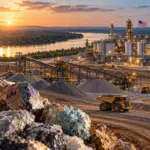

Mountain Pass: America's Lone Bastion
For a long time, the Mountain Pass mine in California was a ghost of its former self: a relic of a pre-globalization era. Today, operated by MP Materials, it stands as the only significant rare earth source in North America.
In 2025, Mountain Pass produced approximately 51,000 tonnes of REO. On paper, that makes the U.S. the second-largest producer globally. But here’s the kicker: for years, most of that concentrate was shipped right back to China for processing.
The "Sino-American decoupling" is a slow, painful process. While MP Materials has made strides in bringing separation and refining capabilities back to the Mojave Desert, the U.S. remains roughly one-sixth the size of China’s production volume.
The strategic importance of Mountain Pass cannot be overstated, but it highlights a brutal reality. Even with a world-class deposit and Tier-1 jurisdiction, the West is playing catch-up against a thirty-year head start. It’s a bit like trying to build a rival to the interstate highway system using a single shovel.
Mount Weld: The Australian Alternative
In the remote scrubland of Western Australia, Lynas Rare Earths operates Mount Weld. If China is the incumbent and the U.S. is the challenger, Lynas is the indispensable third party.
Mount Weld is consistently ranked as one of the highest-grade rare earth deposits on the planet. Its focus is on the "magnet metals": neodymium and praseodymium (NdPr). These are the elements that make EVs move and wind turbines spin. Without them, the "green transition" is just a collection of expensive prototypes.
Lynas is currently undergoing a massive expansion to boost annual production of NdPr products to 12,000 metric tons by the end of 2025. Unlike MP Materials, Lynas has successfully integrated its supply chain through its refining facility in Malaysia and a new plant in Kalgoorlie.
They’ve proven it can be done outside of China. But it required a decade of geopolitical maneuvering, billions in investment, and a level of persistence that most mining juniors simply don't possess.
The Emerging Frontiers: Hype vs. Reality
As we look toward the remainder of 2026, the industry is desperate for new supply. We’ve seen significant buzz around the Per Geijer deposit in Sweden, which has been touted as a game-changer for European sovereignty.
But you can't disrupt geology with a press release.
While the Per Geijer deposit is massive, the timeline for European permitting is notoriously glacial. Similarly, Greenland holds world-class reserves but currently has zero operating mines. The gap between "identifying a resource" and "shipping a product" is often ten to fifteen years.
Several Australian projects are trying to bridge that gap:
- Arafura Rare Earths (Nolans Project): Focused on a long-life NdPr supply in the Northern Territory.
- Northern Minerals (Browns Range): A heavy rare earth play currently navigating a feasibility study due late 2025.
- Iluka Resources: Building the Enneaba Refinery to process their own monazite stockpiles.
These projects are essential, but they are all fighting the same enemies: capital intensity and technical complexity. Rare earth metallurgy is a nightmare. It’s not just about digging dirt; it’s about a chemical process that requires hundreds of stages of solvent extraction.

The Strategic Calculus: Why Reserves Don't Matter
If you look at a chart of global rare earth reserves, you’ll see countries like Brazil, Vietnam, and Russia holding massive quantities of these minerals. Investors often mistake reserves for supply.
They shouldn't.
Production is about more than just having the rocks. It’s about the "concentrated expertise" required to refine them. China doesn't just control the mines; they control the patents, the scientists, and the chemical supply chains.
Even when Western explorers find a massive discovery: like Frontier Lithium's Spark discovery in the lithium space: they realize that the infrastructure required to turn ore into a battery-grade chemical is the real hurdle.
In the rare earth sector, this problem is amplified by a factor of ten.
2026: The Inflection Point
The world is currently split into two camps. On one side, you have the established Chinese giants: China Northern and China Southern Rare Earth Groups: who control the majority of the market share. On the other, you have a fragmented group of Western operators trying to build a "China-free" supply chain.
The 2026 outlook is grim for those who expect price stability. Global mine production increased to 390,000 tonnes in 2025, but demand from the EV and defense sectors is accelerating at a rate that traditional mining simply can't match.
We’ve seen this play out in other commodities. Whether it’s Kazakhstan’s dominance in uranium or Chile’s struggles with copper output, the mining industry is consistently reminded that geography is destiny.
The Bottom Line
Bayan Obo, Mountain Pass, and Mount Weld will continue to lead the global supply for the foreseeable future. There is no "hidden" giant waiting to be discovered that will change this dynamic overnight.
The strategic importance of these mines has transcended economics; they are now instruments of national security. As the US and its allies push for "aluminum independence" and a secure critical minerals corridor, they are realizing that you can't print rare earths. You have to mine them, refine them, and: most importantly: compete with an incumbent that is decades ahead.
The world’s largest rare earth mines are the gatekeepers of the 21st century. Those who control the gates control the future of technology. Right now, most of those gates are in Inner Mongolia.
That’s the reality. The rest is just politics.
For more in-depth analysis on the global mining industry, visit our latest Skillings Mining Review issues.