Everyone loves a diversification narrative until the invoice arrives. For a decade, the West has talked a big game about breaking the Chinese stranglehold on critical minerals. We’ve had summits, signed memorandums of understanding, and launched enough “strategic initiatives” to fill a library.

But here is the uncomfortable truth nobody wants to admit: 2026 is the year the bluff gets called.
The rare earth supply chain isn’t just stressed; it is bifurcating. On one side, you have a Chinese processing machine that remains the most efficient, integrated, and dominant force on the planet. On the other, you have a fragmented Western effort that is finally, painfully, starting to produce its first few grams of metal.
The strategic calculus here isn’t subtle: if you don’t own the processing, you don’t own the supply chain.
The China-Light Fantasy vs. The 2026 Reality
For years, the goal has been “China-light”, a supply chain that minimizes or eliminates reliance on Chinese refining. It’s a noble goal, sure. It’s also incredibly difficult when China still controls roughly 85% of global rare earth processing capacity.
More Read

In 2026, the pressure is mounting. Demand for key elements like neodymium and dysprosium is climbing at roughly 7% annually. This isn’t just about consumer gadgets or the global battery revolution. This is about the permanent magnets required for EV motors and, more critically, the sophisticated guidance systems and motors used in Western defense programs.

The numbers are brutal. Potential Chinese export quotas are expected to displace as much as 13,000 metric tons of demand this year alone. That isn’t a rounding error. That’s a crisis for Japanese manufacturers and Western defense contractors who are now acting as marginal buyers in a market where they have zero leverage.
Geopolitics: The US-Australia Pincer Movement
The U.S. government has stopped asking nicely for the private sector to fix this. In 2025, the administration made domestic sourcing a survival issue.
We’ve seen the U.S.-Australia Critical Minerals Framework commit $1 billion to joint projects. This isn’t just a political handshake. It’s a direct response to the realization that the U.S. cannot do this alone. Australia has the rocks; the U.S. has the demand and, increasingly, the willingness to subsidize the midstream.

But you can’t disrupt geology. Building a refinery isn’t like building a software app. It takes years of permitting, environmental headaches, and massive capital expenditures. However, we are seeing some wins.
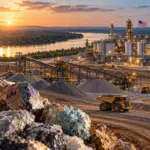
The Sheep Creek Project in Montana is the one to watch. Backed by a $120 million Department of Defense contract, their light and heavy rare earth separation plant is slated to start operations here in 2026. This isn’t some pilot plant in a lab. It’s a facility designed to process high-grade ore, roughly 9% total rare earth oxides, straight from Montana soil.
The Magnet Gap: More Than Just Mining
Mining is the easy part. Processing is the hard part. Making the magnets is the part where everyone has been failing.
Until now.
In early 2025, Vulcan Elements in North Carolina produced its first batch of sintered NdFeB magnets. By the middle of 2026, they are expected to hit full commercial scale. This matters because a pile of rare earth oxide is useless to a drone manufacturer or an EV company. They need the magnets.
Without domestic magnet production, we are just digging up rocks and shipping them back to China for processing, the exact trap we’ve been in for thirty years.
Table: Key Rare Earth Projects Commissioning (2026-2029)
| Project | Location | Focus | Status |
|---|---|---|---|
| Sheep Creek | Montana, USA | Separation / Refining | Commissioning 2026 |
| Vulcan Elements | North Carolina, USA | NdFeB Magnets | Full Ops 2026 |
| Steenkampskraal | South Africa | High-grade Monazite | Development |
| Per Geijer | Sweden | Apatite/REE | Exploration/Permitting |
| Giadec/EGA | Ghana | Bauxite/REE potential | Planning |
The Per Geijer discovery in Sweden remains a long-term beacon for Europe, but for the immediate 2026-2027 window, the heavy lifting is being done in North America and Africa.
Africa: The New Frontier of High-Grade Supply
While the U.S. focuses on midstream processing, the search for high-grade raw materials has moved to Africa. By 2035, the continent is projected to hold 9% of the global market.
South Africa’s Steenkampskraal Monazite Mine is the standout. It’s one of the highest-grade deposits in the world, averaging 14.5% total rare earth oxides. In an industry where people get excited about 1% or 2% grades, 14.5% is a monster.
These projects are the true “China-light” alternatives. But they come with their own set of geopolitical risks. China isn’t sitting still while the West scouts Africa. They are already there, often with better financing and fewer ESG hoops to jump through.
The Recycling Myth: Why E-Waste Won’t Save Us (Yet)
There’s a lot of talk about the “circular economy” and recycling e-waste to solve the rare earth shortage. It sounds great in a corporate ESG report.
Ironically, the reality is much nastier. Rare earth minerals in consumer electronics are present in tiny amounts, often bonded with other materials in ways that make extraction an environmental and economic nightmare.

Yes, recycling facilities are increasing. Yes, companies are getting better at extracting magnets from old hard drives and EV motors. But the volume isn’t there. You cannot recycle your way out of a 7% annual demand growth when the primary demand is for new infrastructure that won’t be retired for twenty years.
Recycling is a 2040 solution for a 2026 problem.
Defense: The Strategic Throttle
The military-industrial complex is the quiet driver behind the current price floors. A single F-35 requires nearly 900 pounds of rare earth materials. A Virginia-class submarine? Nearly 10,000 pounds.
As NATO members ramp up defense spending to levels not seen since the Cold War, they are realizing their weapon systems are built on a foundation of Chinese minerals. This is the definition of a strategic vulnerability.
The 180-day deadlines and “Buy American” mandates are no longer suggestions. They are becoming law. If a defense contractor can’t prove their magnets didn’t originate in a Chinese state-owned enterprise, they are going to find themselves locked out of the next generation of contracts.
What Happens Next
2026 marks the inflection point where the “intelligence” phase of the rare earth race ends and the “execution” phase begins.
Those who haven’t secured offtake agreements by now are going to find themselves at the mercy of a bifurcated market. On one side: cheap, plentiful Chinese supply with massive geopolitical strings attached. On the other: expensive, scarce Western supply that satisfies regulatory requirements but strains balance sheets.

We are looking at a supply gap that will likely widen toward the 2028-2030 window. The projects coming online today: Sheep Creek, Vulcan, and the African high-grade plays: are essentially the only lifeboats we have.
There’s not enough to go around. Those who think the lithium forecast was volatile haven’t seen anything yet. Rare earths are more complex, more concentrated, and far more political.
Welcome to the new reality. It’s expensive, it’s complicated, and it’s absolutely necessary.