Everyone wants to talk about the “green transition” as if it’s a foregone conclusion. We see the sleek EVs and the towering wind turbines and think we’ve already won. But here is the uncomfortable truth: the entire revolution is built on a foundation of minerals that most people can’t name and even fewer know how to get out of the ground.

2026 marks a brutal inflection point. The demand for permanent magnets: the heart of the robotics and EV sectors: is no longer just growing. It is exploding. Meanwhile, the supply chain remains dangerously concentrated, and the technical hurdles of extraction are getting steeper.
If you’re an investor or an operator, you don’t need a lecture on why rare earths are “important.” You need to know where the bottlenecks are, which geologies actually matter, and why the current capital influx might still be too little, too late.
Geology: Not All Dirt is Created Equal
Rare earth elements (REEs) aren’t actually that rare in the Earth’s crust. The problem is they are rarely found in concentrations that make economic sense to dig up. You aren’t looking for a “vein” of neodymium like you would for gold. You’re looking for specific mineral host structures.
The industry lives and dies by two primary sources: Bastnasite and Monazite.
More Read

Bastnasite: The Industry Workhorse
Bastnasite is a carbonate-fluoride mineral. It’s the primary source for the world’s light rare earths (LREEs). If you’re looking at the massive Mountain Pass mine in California or the Bayan Obo operations in China, you’re looking at bastnasite. It is preferred because the processing, while still a nightmare of chemical engineering, is relatively straightforward compared to the alternatives.

Monazite: The Radioactive Headache
Monazite is a phosphate mineral. It’s often richer in the “heavy” rare earths (HREEs) that the military and high-end tech sectors crave. But monazite has a nasty habit of hanging out with thorium and uranium.
That means if you’re mining monazite, you aren’t just a miner; you’re effectively managing radioactive waste. This is why many Western projects stalled for decades. The regulatory burden of handling thorium makes the margins razor-thin. However, as we see in the Per Geijer rare earths discovery, Europe is finally starting to realize that environmental risks are the price of entry for resource independence.

Extraction: Moving Mountains for Grams
The extraction of REEs is a game of volume. You are moving massive amounts of waste rock to get to a tiny fraction of usable material.
Open Pit vs. Underground
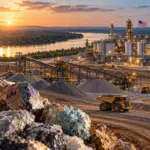
Most REE operations today are open pit. Why? Because the grades are usually low and the deposits are large. You need the scale and lower OpEx of an open-pit mine to make the numbers work. Underground mining for REEs is rare, reserved only for the highest-grade deposits where the surface footprint must be minimized or the ore body plunges deep.
But the mine is only 10% of the battle. The real “mining” happens in the separation plant.
The Processing Bottleneck
You can’t just smelt rare earths. You have to use solvent extraction: a process involving hundreds of stages of chemical baths to separate elements that are chemically almost identical. China dominates this because they spent 30 years perfecting the “dirty” work while the West outsourced its industrial base.
In 2026, we are seeing a shift toward automation and field digitization to bridge the efficiency gap. Companies are implementing predictive maintenance to keep these complex chemical circuits running 24/7. Because if a pump fails in a 500-stage solvent extraction circuit, your production doesn’t just slow down: it breaks.
The Geopolitical Stranglehold
Let’s look at the numbers. They aren’t pretty. China still controls roughly 91% of the rare earth permanent magnet supply chain. From extraction to refined metal to the final magnet, they have a stranglehold.
This is a “single-country risk” on a global scale. We’ve seen what happens when that lever is pulled. Export controls on gallium and germanium were just the warning shot.
The American Response
The strategic calculus here isn’t subtle. The U.S. is finally throwing real money at the problem. In late 2025, the administration announced a $1.4 billion public-private partnership aimed at reshoring neodymium-iron-boron magnet production.
- $50 million in CHIPS Act incentives.
- $700 million in conditional loans from the DoD.
- Target: 10,000 metric tons of annual output.
Is it enough? Probably not. Global mining investment hit $186 billion in 2024, but to meet the 2035 targets for the global battery revolution, we need to be hitting $260 billion annually. We are currently short by about $74 billion a year. That’s not a rounding error. That’s a crisis.

The ESG Trap: The Irony of “Green” Mining
There is a deep irony in rare earth mining: you have to get your hands very dirty to make the world “clean.”
The environmental considerations are massive. Between the acid leaching used in some clay-based deposits and the radioactive tailings in monazite projects, the ESG profile of an REE mine is a minefield.
Investors are no longer taking “we follow local laws” as an answer. They want blockchain-enabled traceability. They want to know exactly where the tailings are going. If you mess up your ESG reporting, you don’t just get bad PR: you lose your cost of capital. We’ve seen this play out across the sector; many firms are still making 7 common mistakes with mining ESG reporting that are costing them institutional backing.
2026 Price Forecast: Drivers and Risks
Where do prices go from here?
The Bull Case: Supply diversification takes longer than expected. African and North American projects face permitting delays. Demand for AI-driven robotics and high-performance EV motors outstrips the 475 kilotons of expected production. Prices for Neodymium and Dysprosium moonshot.
The Bear Case: China floods the market to kill off Western competition: a tactic they’ve used before. Simultaneously, “thrift” technologies emerge, where engineers find ways to use less REE material in motors.
The Base Case: Volatility remains the only constant. We expect a steady 5-7% CAGR in pricing as the “easy” deposits are exhausted and we move into more complex, higher-cost jurisdictions.
| Element | 2025 Avg Price (Est) | 2026 Forecast (Base) | Primary Driver |
|---|---|---|---|
| Neodymium | $75/kg | $88/kg | EV & Wind Demand |
| Dysprosium | $320/kg | $355/kg | High-temp Magnets |
| Terbium | $1,100/kg | $1,250/kg | Military/Aerospace |
Data Context: These aren’t just numbers; they are the floor for project feasibility in 2026.

The Frontier: Beyond China
While China is the elephant in the room, the frontier is moving. We are seeing significant exploration budgets: roughly 80% of the global total: being concentrated in just four countries: Australia, Brazil, the USA, and Canada.
Canada, in particular, is positioning itself as the “ethical” alternative. Projects in the Northwest Territories and Saskatchewan are trying to prove that you can mine rare earths without destroying the local ecosystem. It’s a tall order, but the Frontier Lithium Spark discovery in the lithium space shows that the North American critical minerals corridor is real and gaining momentum.
The Final Word for 2026
Rare earth mining in 2026 isn’t for the faint of heart. It is a sector defined by geological complexity, geopolitical gamesmanship, and a desperate race against the clock.
The companies that will win aren’t just the ones with the best dirt. They are the ones that can navigate the permitting labyrinth, handle the radioactive tailings without a PR disaster, and secure the massive CapEx required to build separation plants on Western soil.
The strategic importance of these elements has never been higher. But as any seasoned operator knows: you can’t disrupt geology. You can only hope to survive it. The clock is already ticking, and there’s simply not enough to go around.
Welcome to the new reality of the resource war. It’s going to be a long, expensive ride.