2026 Lithium Power Map : Early Access Open ($59) | Get the latest sector data and secure your copy here: https://skillings.short.gy/LithiumPreSale


SASKATOON, SASKATCHEWAN : Vanguard Mining Corp. has announced a definitive move to consolidate its presence in the world’s premier uranium jurisdiction, entering into a share exchange agreement to acquire 100% of Quark Uranium Ltd. The deal, valued at approximately C$1.4 million, grants Vanguard a massive 28,746-hectare land package in the western Athabasca Basin, a region increasingly viewed as the “Saudi Arabia of Uranium” as global energy markets pivot toward nuclear baseload power.
The acquisition comes at a critical juncture for the nuclear industry. With global decarbonization targets looming and the rapid deployment of Small Modular Reactors (SMRs) necessitating a secure, Western-aligned fuel supply, junior miners are racing to lock down prospective acreage in proven districts. By absorbing Quark Uranium, Vanguard Mining shifts from an exploration-stage player to a strategic landholder adjacent to some of the industry’s most significant recent discoveries.
Transaction Terms and Financial Structure
Under the terms of the agreement, Vanguard will acquire all issued and outstanding common shares of Quark Uranium Ltd. in exchange for 8 million common shares of Vanguard Mining Corp. These shares carry a deemed price of $0.15 per share, representing a C$1.2 million equity component. Additionally, Vanguard has committed to a cash payment of C$200,000, bringing the total transaction value to C$1.4 million.
More Read

To ensure market stability following the deal, the consideration shares are subject to a statutory hold period of four months and one day from the date of issuance. Notably, the company confirmed that no finders’ fees were paid in connection with the transaction, reflecting a clean deal structure aimed at maximizing shareholder value.

Strategic Geography: The Athabasca Edge
The Quark Uranium property is comprised of eight mineral claims totaling 28,746 hectares (approximately 71,030 acres). Its location in the western Athabasca Basin places it in the shadow of giants. The claims sit within the Western Wollaston Domain and the Wollaston-Mudjatik Transition Zone: the geological heart of Canada’s uranium production.
Geologically, the Athabasca Basin is unique. It hosts the world’s highest-grade uranium deposits, often featuring grades 10 to 100 times higher than the global average. This high-grade profile is the primary driver for regional M&A activity, as it significantly lowers the “all-in sustaining cost” (AISC) for future production compared to lower-grade sandstone or calcrete deposits found elsewhere.
More Read

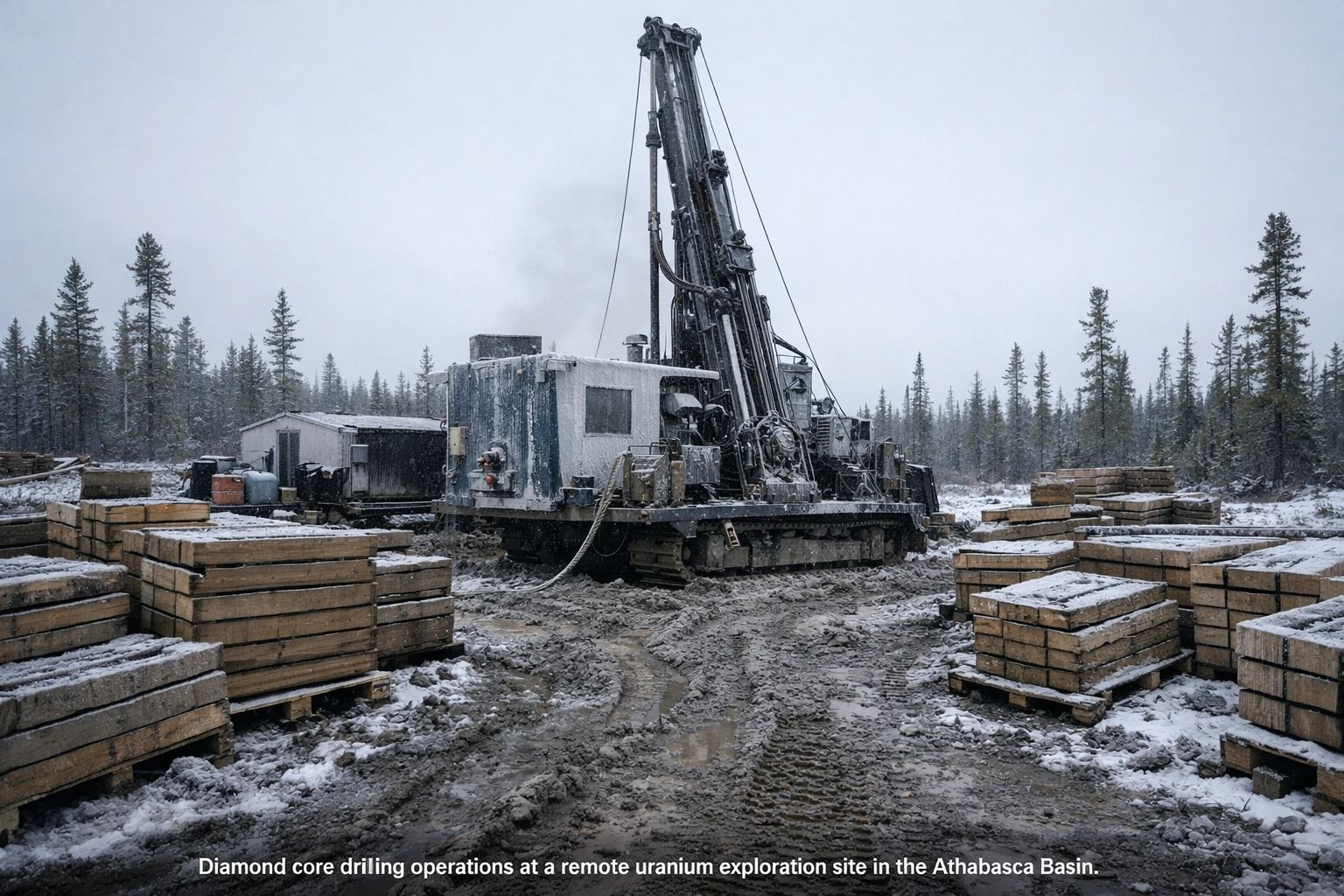
Vanguard’s new holdings are strategically positioned near infrastructure-heavy projects operated by Orano Canada and Fission Uranium Corp. The proximity to Orano’s Cluff Lake mine and Fission’s Patterson Lake South (PLS) project provides more than just geological “closeology”; it offers a potential roadmap for future logistical and processing synergies.
The Macro Driver: Uranium’s Bull Run in 2026
The timing of Vanguard’s acquisition aligns with a significant tightening of the global uranium market. As analyzed in our Uranium Price Forecast 2026, the supply-demand deficit has moved from a theoretical projection to a physical reality. The structural shift toward nuclear energy is no longer confined to China and India; the European Union and the United States have both reclassified nuclear as a “green” investment, unlocking billions in capital for both traditional large-scale plants and next-generation SMRs.
“This acquisition provides our shareholders with direct exposure to one of the world’s leading uranium districts at a time when the fundamental case for nuclear energy has never been stronger,” said David C. Greenway, President and CEO of Vanguard Mining. “Securing nearly 30,000 hectares in the Athabasca Basin is a transformative step that complements our existing strategic mineral portfolio.”
Market Snapshot: Athabasca Basin Activity 2026
To understand the scale of Vanguard’s move, it is necessary to look at the regional land grab occurring in Saskatchewan. Below is a snapshot of the current uranium landscape in the Western Athabasca region.
| Company | Key Project | Land Position Approx. Hectares | Status |
|---|---|---|---|
| Vanguard Mining | Quark Uranium Acquisition | 28,746 | Exploration/Acquisition |
| Fission Uranium | Patterson Lake South | 31,039 | Feasibility/Development |
| NexGen Energy | Rook I | 35,065 | Permitting/Construction |
| Orano Canada | Cluff Lake / Shea Creek | Various | Care & Maintenance / Exploration |
| CanAlaska Uranium | West McArthur | 36,000 | Active Drilling |
Data compiled by Skillings Mining Intelligence, April 2026.
Portfolio Diversification and the Energy Transition
While the Athabasca Basin acquisition is the current headline, Vanguard Mining has been quietly building a diversified “energy transition” portfolio. The company currently maintains interests in uranium projects in the United States and Paraguay, providing a geographic hedge against localized regulatory or geopolitical shifts.
The move into Saskatchewan, however, represents a shift toward “Tier One” assets. As seen in recent industry trends: including the surge in M&A activity across the sector: investors are increasingly favoring companies with large, contiguous land packages in stable, mining-friendly jurisdictions. Saskatchewan consistently ranks as one of the top jurisdictions globally in the Fraser Institute’s annual Survey of Mining Companies.
Uranium and the SMR Revolution
The broader context of this acquisition is the rise of Small Modular Reactors (SMRs). Unlike traditional billion-dollar reactors that take decades to build, SMRs are designed for rapid deployment and factory-style assembly. They are particularly well-suited for de-carbonizing remote mine sites, a trend we explored in depth regarding remote mine site decarbonization.
As SMR technology matures, the demand for high-assay low-enriched uranium (HALEU) and standard uranium fuel is expected to rise exponentially. By securing a massive land package in a district known for high-grade ore, Vanguard Mining is positioning itself as a potential upstream supplier for this new nuclear fleet.
Operational Outlook and Next Steps
With the acquisition finalized, Vanguard is expected to begin a systematic exploration program on the Quark claims. The initial phase will likely involve high-resolution airborne geophysical surveys: such as VTEM (Versatile Time Domain Electromagnetic) or ZTEM (Z-Axis Tipper Electromagnetic): to identify conductive trends that often host uranium mineralization in the Athabasca Basin.
These surveys are essential for narrow-down targets in the “blind” portions of the basin, where the uranium-bearing unconformity is covered by layers of sandstone. The goal for 2026 will be to identify “drill-ready” anomalies that can be tested during the winter drilling season, when frozen ground allows for easier transport of heavy machinery across the northern muskeg.
Analyst Perspective: The Junior Mining Shakeout
The Vanguard-Quark deal is a microcosm of a larger trend in the junior mining space. As the BC regulatory shocks and other policy changes impact exploration elsewhere, Saskatchewan remains a beacon of relative stability. However, the cost of entry is rising. Companies that secured land during the 2020-2023 downturn are now seeing those assets appreciate as majors and well-funded mid-tiers look for “bolt-on” acquisitions.
For Vanguard, the C$1.4 million price tag may eventually be seen as a bargain if geophysical work reveals extensions of the Patterson Lake or Shea Creek trends. However, exploration in the Athabasca is notoriously capital-intensive. The company’s ability to leverage this new asset to raise further exploration capital will be the key metric for investors to watch in H2 2026.
Conclusion
Vanguard Mining Corp.’s entry into the Athabasca Basin via Quark Uranium is a calculated bet on the long-term resurgence of nuclear power. By acquiring a significant land position in a proven district, the company has effectively “purchased a seat at the table” in the ongoing global energy transition. While exploration risks remain, the strategic value of 28,000 hectares in the heart of the world’s most productive uranium basin cannot be overstated.
As the industry looks toward the remainder of 2026, the focus will shift from acquisition to discovery. In the Athabasca, the difference between a minor anomaly and a world-class deposit is often a matter of a few meters; and a lot of perseverance.