By Charles Pitts
G Mining Ventures (GMIN) has expanded quickly in Guyana’s gold sector. As of April 2026, the company has moved from developer to emerging producer. It is anchored by the Oko West project and the recent C$3 billion acquisition of G2 Goldfields.
That expansion has effectively unified the Oko district, a high-grade gold trend in the Guiana Shield, into one contiguous mining complex. By combining G2’s Oko-Ghanie deposit with the now-permitted Oko West, G Mining has assembled a Tier-1 asset with a combined resource profile of more than 9 million ounces.
Oko West sets the near-term production base
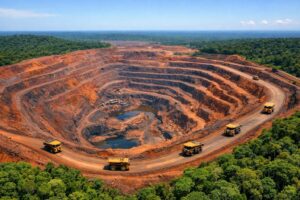
At the center of G Mining’s Guyana strategy is Oko West. In March 2026, the company released a year-end reserve update showing 4.64 million ounces of gold in proven and probable reserves at the project. That was the main driver behind a 221% year-over-year increase in total reserves, which reached 6.52 million ounces across the company’s global portfolio.
More Read

The project’s economics remain strong. Based on the latest feasibility data, Oko West carries an after-tax NPV5% of $2.2 billion and an internal rate of return of 27% at a base gold price of $2,500 an ounce. It also has projected all-in sustaining costs of $1,123 an ounce. That matters because cost control will shape margins if gold prices become more volatile.

The site is also entering its heaviest construction phase. Detailed engineering is about 60% complete. Full construction remains on track for completion by the third quarter of 2026. G Mining still targets first gold in the second half of 2027. Commercial production is expected in January 2028.
G2 Goldfields deal extends control across the district
The biggest move in the Guiana Shield this year was G Mining’s acquisition of G2 Goldfields. The all-share transaction, valued at about C$3 billion (US$2.2 billion), was designed to remove the boundary between two of the region’s most promising deposits.
More Read

Under the terms of the deal, which is expected to close by June 30, 2026, G Mining will acquire the Oko-Ghanie Project. That adds 362 square kilometers of exploration ground within 20 kilometers of Oko West. The rationale is straightforward: the combined company can sequence higher-grade phase-one pits from both systems into a single plant feed. As a result, annual production could rise to more than 500,000 ounces once the integrated mining plan is fully realized in 2029.
Investors have viewed the deal as an important step for mining investments and valuation metrics, especially as gold prices continue to draw support from broader macroeconomic shifts. However, the strategic benefit is operational as much as financial. By controlling the full district, G Mining can reduce duplicate permitting and infrastructure work that likely would have slowed two separate operators.

Greenheart and G3 keep exploration optionality in place
Oko West and Oko-Ghanie are the near-term production focus. However, G Mining has also kept exposure to the wider Guiana Shield through its stake in Greenheart Gold Inc.
After the 2024 merger with Reunion Gold, G Mining spun out non-core exploration assets into Greenheart Gold. As of April 2026, G Mining holds a 10.5% interest in Greenheart through its subsidiary, G Mining Guyana Corp. That stake gives the company exposure to early-stage exploration in Suriname and other parts of Guyana without taking on the full capital burden of direct management.
The G2 Goldfields acquisition also created G3 SpinCo, a new exploration vehicle funded with C$45 million. G3 SpinCo will focus on G2’s non-core properties. G Mining, meanwhile, retains a potential contingent value right of up to C$200 million tied to future resource growth at those sites. That layered structure matters because it lets the company keep upside to new discoveries while staying focused on construction and mine buildout. It also keeps G Mining tied to broader 7 surprising mining trends for 2026 around regional consolidation and resource discovery.

Permitting and funding support the buildout
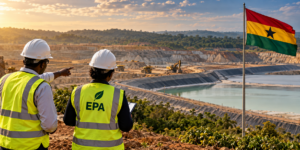
Securing the long-term viability of the Oko district required key regulatory approvals. In late 2025, G Mining received a 20-year mining license from the Guyana Geology and Mines Commission. It also secured a final environmental permit from the EPA, authorizing operations through 2030 and beyond.
The 2026 construction budget is the largest in the company’s history. Peak capital expenditure is estimated at $540 million for the year. That spending is going toward a modular processing facility and open-pit infrastructure using modern open-pit mining technologies to maximize throughput.
To fund the build, G Mining is drawing on a mix of its $350 million undrawn credit facility and cash flow from the Tocantinzinho gold mine in Brazil. That self-funding capacity stands out because many junior miners still depend heavily on equity markets. However, execution risk remains important as spending peaks during construction.
| Project Metric | Standalone Oko West | Consolidated (Oko West + G2) |
|---|---|---|
| M&I Resources | 4.64 Moz (Reserves) | 7.0 Moz (Resources) |
| Inferred Resources | 0.8 Moz | 2.3 Moz |
| Annual Production | 350,000 oz | 500,000+ oz |
| LOM AISC | $1,123/oz | TBD (H1 2027 FS) |
| Mine Life | 12.3 Years | 15+ Years (Est.) |
Why the Guiana Shield is drawing more attention
The Guiana Shield, a Proterozoic formation spanning Guyana, Suriname, and French Guiana, is widely seen as one of the world’s last major gold frontiers. It has historically been less explored than the West African Shield. However, activity is now increasing as commodities surge amid shifting fiscal policies.
Guyana, in particular, has become a more important mining jurisdiction because of its relatively stable regulatory environment and the government’s effort to diversify the economy beyond offshore oil. G Mining’s progress is therefore being watched closely. It may help show whether the country can support large-scale industrial gold mines that meet modern ESG expectations.

What comes next for G Mining in Guyana
G Mining Ventures is no longer simply part of Guyana’s gold expansion. It now sits at the center of district consolidation. By combining the 4.64 million-ounce Oko West project with G2 Goldfields’ assets and keeping a strategic foothold in Greenheart Gold, the company has strengthened its position across the most prospective parts of the Guiana Shield.
As the company moves toward the end of construction in late 2026, attention shifts to execution. If G Mining delivers first gold on schedule in 2027, it could set a new benchmark for how a junior miner scales into an intermediate producer through disciplined M&A and technical delivery. However, that outcome will depend on maintaining schedule, controlling costs, and integrating the broader district plan.