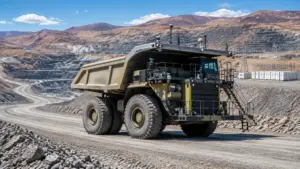
Aerial view of an active open-pit mining operation in Guyana’s tropical landscape.

By Charles Pitts
Omai Gold Mines has updated the mineral resource estimate for its Omai project in Guyana, lifting total contained gold by 22% to 8 million ounces. The mid-April 2026 update matters because the Canadian junior is now moving from exploration toward a Preliminary Economic Assessment (PEA) expected within the next 90 days.
The increase reflects heavy drilling and a revised geological model. It also converted a large portion of higher-grade inferred material into the indicated category. That shift is important for Guyana’s gold sector, which has drawn fresh attention after several recent discoveries across the Guiana Shield.
Resource update lifts scale and confidence
The updated estimate covers two main deposits: the Wenot open pit and the Gilt Creek underground zone. Together, they now contain 38.1 million indicated tonnes grading 2.04 grams per tonne (g/t) gold for 2.5 million ounces, plus 106.6 million inferred tonnes at 1.59 g/t for another 5.5 million ounces.
More Read

The previous estimate stood at 6.5 million ounces, so the latest number marks a clear step up in scale. However, the confidence upgrade may be just as important as the headline ounce count. Omai moved more than 2.5 million ounces into the indicated category, which gives the company a stronger base for upcoming economic studies. In the mining industry, valuation metrics often depend on the balance between indicated and inferred resources because indicated material supports more advanced study work.


Modern mineral processing plant at sunrise, showing modular units designed for efficient extraction.
Wenot and Gilt Creek shape the project plan
The resource is split between two mining settings, and each offers a different operational advantage.
More Read

The Wenot Deposit: This open-pit target now contains 1.45 million indicated ounces grading 1.59 g/t. It also holds 3.9 million inferred ounces at 1.33 g/t. Wenot remains open at depth and along strike, so the resource could still grow with more drilling.
The Gilt Creek Deposit: Gilt Creek sits below the historic Fennell pit, which supported Omai’s production in the 1990s. It now contains about 2.5 million ounces grading 3.26 g/t. The grade has held up as tonnage increased, and that matters because it supports the case for a longer-life underground operation.
Together, the two deposits give Omai flexibility on mine sequencing. Open-pit mining often generates earlier cash flow, while underground development usually takes more upfront work. Because of that, many projects use the open pit to support later underground expansion. This staged model is increasingly common in modern open-pit mining.

Mining professionals reviewing site plans in an open-pit environment to coordinate exploration and operations.
PEA will test whether scale can translate into output
The next major checkpoint is the PEA. A 2024 study outlined annual production of 142,000 ounces. However, current internal projections point to 250,000 to 300,000 ounces a year, and the company is expected to formalize that range in the June/July 2026 PEA.
That is a material jump in expected output. If Omai can support the higher range with solid economics, the project would move into a different peer group in South America. The market responded quickly after the resource update, with the stock rising 10% to a record C$2.34.
The 2026 PEA is expected to outline:
- Capital Expenditure (CAPEX): The upfront cost to restart the mine, potentially using parts of the site’s legacy infrastructure.
- Operating Costs (OPEX): Analysts will focus on all-in sustaining costs, especially because Guyana’s energy and logistics costs remain important variables.
- Mine Life: With 8 million ounces defined, observers broadly expect a mine life of more than 15 years.

Geologists inspecting core samples at an exploration drill site in the Guyana gold district.
Guyana’s wider gold story adds context
The Omai upgrade fits into a broader shift in Guyana’s mining sector. The country has attracted global attention because of offshore oil, but mining is also regaining momentum. The government has maintained a generally supportive stance on mineral development as it looks to broaden the economy.
Omai’s latest results also stand out across the Guiana Shield. The region is known for high-grade quartz veins and major shear zones. However, it has seen less systematic deep drilling than more mature mining regions such as Western Australia and Canada. Because of that, Omai’s 50,000-metre campaign is being watched as a sign that deeper targets in Guyana may still be underexplored.
The next challenge is execution. The company still needs to move through regulatory, environmental, and technical work. As mining trends for 2026 show, ESG factors now carry as much weight as drill results in many project reviews. Omai may have an advantage because it is a brownfield site, meaning it was mined before and already has a long operating history.
What comes next as the study window narrows
Omai has already completed 18,000 metres of drilling since the previous estimate, and it plans another 50,000 metres. That means the 8-million-ounce figure may not be the final ceiling. However, the company is now focused on reducing project risk as much as adding ounces.
That work includes geotechnical drilling to confirm pit wall stability at Wenot. It also includes metallurgical testing to check whether ore from deeper parts of Gilt Creek can be processed as efficiently as material closer to surface. Those steps matter because resource growth alone does not guarantee mine development.
Investors and industry observers are now waiting for the summer PEA. If the study supports the larger geological footprint with workable economics, Omai could draw broader strategic interest from producers looking to replace reserves in South America.

Advanced underground mining infrastructure integrated within carved rock walls, showcasing modern mine development.
Market Snapshot: Omai Gold (April 2026)
| Metric | Value |
|---|---|
| Total Resources | 8.0 Million Ounces Au |
| Indicated Grade | 2.04 g/t Au |
| Inferred Grade | 1.59 g/t Au |
| Upcoming Milestone | PEA (June/July 2026) |
| Current Stock Price | C$2.34 (+10% on update) |
| Projected Annual Production | 250,000 – 300,000 oz |
Skillings Mining Intelligence provides daily coverage of commodity markets, regulatory changes, and operational developments. Stay informed on the latest breakthroughs in the global mining sector by following our expert analysis.